
The work by Jota Castro (Perú, 1965) merges in an interesting way an openly political proposal with an accurate positioning within the biennial and museum circuits. His strategies of assimilation utilize those that belonged to the institutional critics of the 1960s and 1970s. He combines these with the theoretical discourse and artistic practices of the 1990s. From his assimilated, mixed Franco-Peruvian background and with a solid education in international law (he worked until the end of the 1990s at the UN), Castro operates on the border of several fields, including political “activism” and art.
Jota Castro has developed with intelligence a theoretical body that relies upon his criticism of phallus-centered culture and economic-political power relations. Departing from these preoccupations, he creates sculptures and photographs and performs actions to research the behavior of the public. Without forming part of a formal unit, Castro’s works are conceptually structured from a renunciation of the poetic act in terms of action or form, as his pieces favor the forcefulness of a recognizable message. Recurrent themes allude to his experience as an individual living in two cultures and economies, to migration and the imbalance produced by globalization between rich and poor countries, and to the repercussions of colonialist strategies in today’s world.
The attention his public work has generated stems from controversy and media attention. In Madrid Abierto (2008), No More No Less, a series of controversial photographs of bottoms being penetrated by Western cultural symbols, were distributed as advertising posters in the streets. Also in Madrid Abierto, his sculpture titled La Huacha de los Incas (The Piggy Bank of the Incas) – which disappeared after being installed at the Paseo de la Castellana in the heart of Madrid – became the center of a political discussion between the artist and local authorities. Other public actions, such as La Palabra de los Mudos (The Word of the Mutes) that were performed in Lima, Perú, in 2008, called people together (among these, a group of non-speaking persons) at a beach for a political-poetic act, within the context of the V Summit of Latin-American, Caribbean, and European heads of state. More discrete was Castro’s collaboration with Tania Bruguera in El Acuerdo de Marsella (The Marseille Agreement), in which each artist agreed to donate their body to the other at death.
Low Cost is the second individual exhibition by the artist in Madrid, where he continues with the same line of socio-political criticism. What is new is the simplicity and coherence of the works shown. Jota Castro appropriates and re-signifies objects with a use-value and exchange-value that incorporate the added significance of the work. As its title indicates, the words intertwine a complex field of material relationships between the pieces as a group and the economic and political meanings of the messages conveyed. Low Cost addresses the current global economic market that survives on cheap labor and low production costs, although the human price paid is very high. It is in pieces such as Tricky, with balls manufactured in China covered with barbed wire, that the commentary is obvious and verges on the tautological. The same occurs in Uncomfortable Handcuffs, a restraining device that represents the trap that the world sets as it plays with illusions that are transformed into disintegrating paper. On the other hand, there are sculptures that utilize representative symbols of powerful countries such as the U.S. and that clearly allude to their ruling principles: the dollar in Private Dance, a vertical axle that obviously refers to a phallus fashioned from dollar bills, or Cheers Black Light, a glass containing petroleum and a Statue of Liberty stirrer.
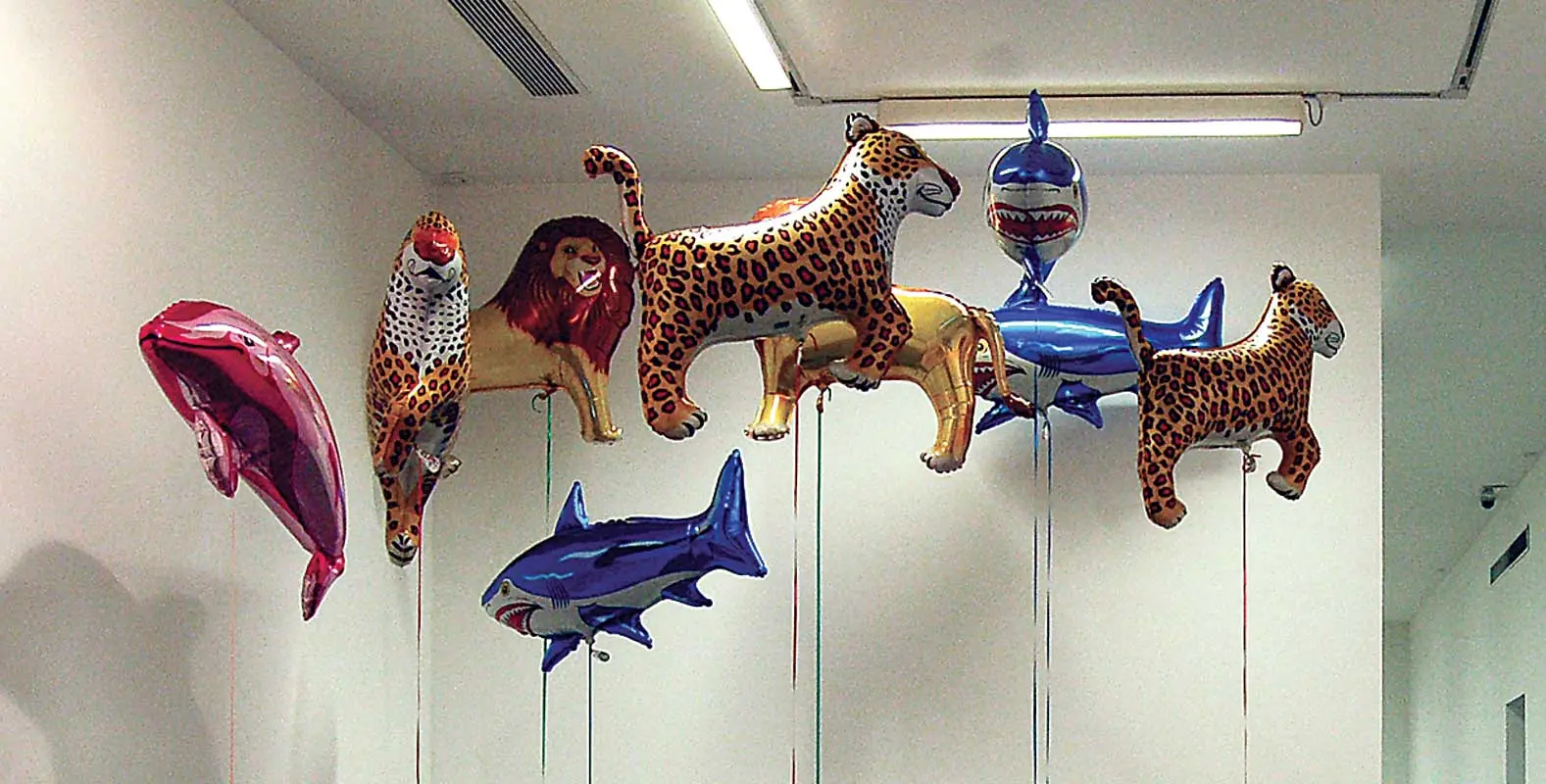
In other works, particularly in Go Kids Go, the meaning is amplified and generates other visual games. Nine gloves in the shape of animals float over the gallery space. Their movement is halted by a delicate equilibrium maintained by a bullet tied to a thread. The contrast between the munitions’ hardness and the colorfulness and fragility of the colorful childhood elements could also be understood as a game in which J. Castro returns the “low cost” market that the objects produced as items for denunciation, now highly valued as artistic. This is a strategy of inversion that in his piece titled Morpheus produces another effect: the Mali Mask, representative of the coming of age of virility, when turned around represents a “cayuco” (a boat utilized by Africans to cross the sea and attempt to reach the European coast).
Low Cost opens a new direction in the work by J. Castro, while it also could be interpreted as a revision of his earlier work as he now considers formats that are less controversial, but more suggestive. This is an exhibit that surprises due to its ability to confer new meanings on inexpensive, mass-produced industrial objects. From this precarious materiality, the artist sets in motion mechanisms to communicate his ideas to the spectators by posing questions and eliciting reactions concerning events known to the public. Is this political activism, denouncement art, or utilization of the more and more ambiguous and nearly boundless artistic space? We are, of course, functioning with other artistic criteria and strategies that actively involve public opinion. Castro’s work has stopped being completely about a materialized subjectivity and has become an open field for the debate of ideas on current political, sexual, and racial criteria, as well as other stereotypes that interweave the complex economic relationship of dependence between countries with economic and political power and those that suffer.
DERMIS PÉREZ