
America’s House in Paris presented an exhibition, curated by Christine Frérot, of works by Argentine artist Julieta Hanono titled Temps-Mêlés, which can be translated as “times of turmoil.” Time is indeed the cornerstone of the show. Not a linear or chronological time, but an atemporality where her memories, her spirit, her desires, her internal struggles and her concern for the human condition intermingle and mix.
The show’s main work, 395, is comprised of 395 embroideries created by 395 Mexican peasant women from the city of Zoquitlán, based on a model cut from a tunic that Hanono embroidered in 1979. The artist distributed photocopies of sections of her work among the artisan women and commissioned from each individual work inspired by it. The number 395 represent the days that Julieta Hanono remained imprisoned in a jail in Rosario during the military dictatorship in her country, at the age of 17, a time that she spent knitting a pullover hour after hour only to undo it every time, without limits or urgency since time had ceased to exist for her.
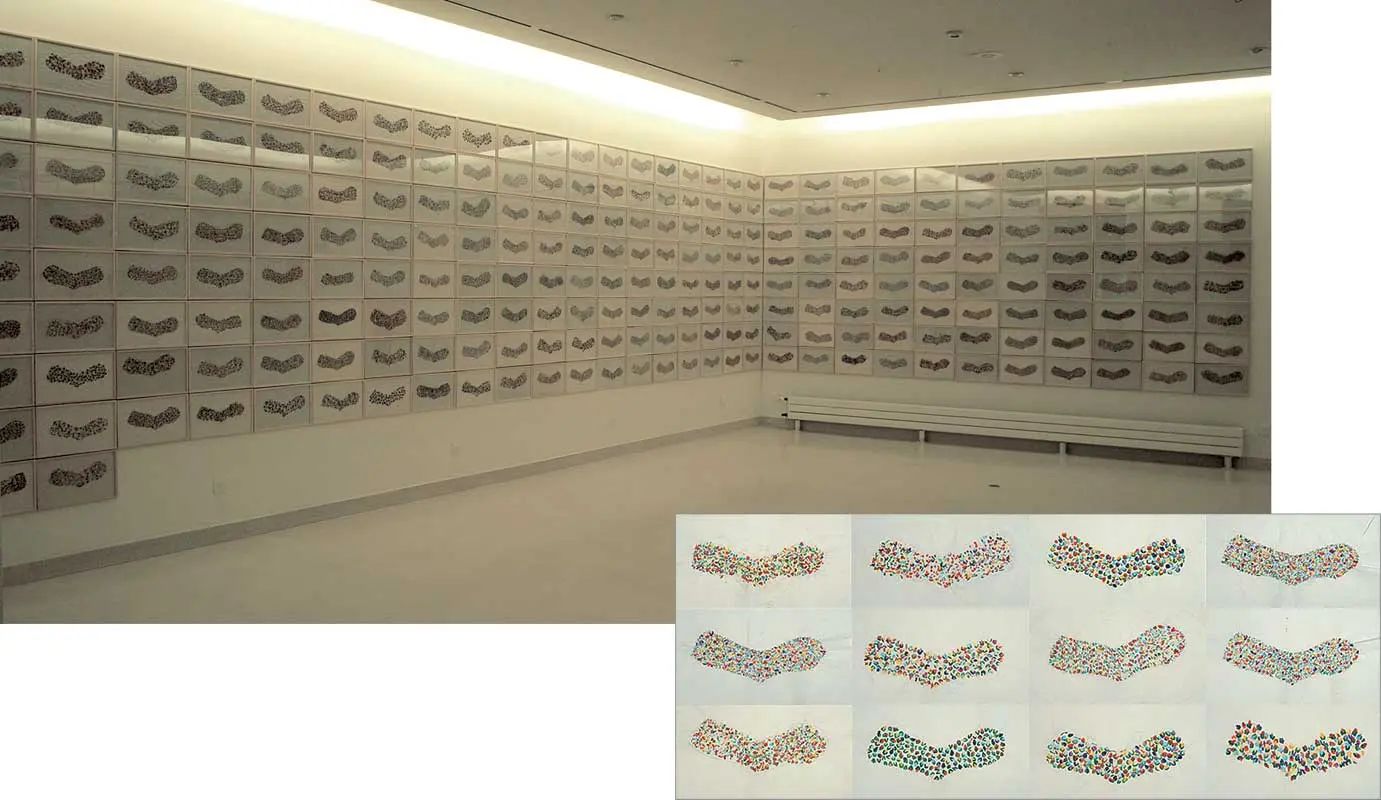
Each knitting, however, has its own frame in order to individualize the work and the existence of each woman as a knowing transgressor, as if life was seen through Julieta’s own universe and the universe of each of the artisans, trapped within the anonymity of both textile industry workers and prisoners. It is impossible to dissociate this work with the macabre case of the hundreds of maquiladora workers murdered in Ciudad Juárez with the greatest of impunities over the last decade. Each embroidery is a freeze-frame homage to each one of those women whose disappearances and murders are yet to be solved by the Justice system.
The video Camisa de su madre presents a field of flowers. This new floral inspiration emerges from the blouse worn by her mother in Julieta’s memory as she thinks about her during her captivity. Her mother ignored for a long time the fate of Julieta. The floral motive becomes a fetish object, Julieta’s way of holding on to her mother’s warmth, to hope in the face of an uncertain existence.
Julieta Hanono seeks alternative languages, a way to find an emotional distance, as she did by choosing a new tongue, French, after her exile in France, which allowed her to let go of the past, of the language of her youth, without pain, and made it possible for her to say the “unsayable” and to reaffirm her conquest of what had happened to her. The show’s catalog includes an anachronistic and eclectic compilation of texts by Julieta in both Spanish and French, mixing childhood memories where the feelings of being trapped in relation to the adult world are combined with reminiscences of her time in prison, without rage or resentment, as if confusing clues where reality is fiction and fiction becomes reality. The image is inverted and the viewer arrives at the work free of direct references.
Julieta returned to the place where she was held, El Pozo, an old prison in Rosario, as part of the activities of the city’s Museo de Arte Contemporáneo. She invited Human Rights organizations, the Madres de Plaza de Mayo, and the HIJOS. Through this Dionysian transgression, she enters the site of her torture, filming her own feet as she returns to the past in this abandoned building, room by room, as if entering a subterranean world that holds the memory of what took place there. The video camera is her shield, the compass that allows her to go back. El Pozo was later projected at the Museo Reina Sofía in Madrid.
El Pozo helped her conceptualize the idea of a tunnel that takes her to the matrix of her mother in a return to the moment of gestation. The tunnel becomes a speculum to the mother’s insides. Julieta captures this transgressive gaze in Túnel, where the hole, tunnel or passage created by the gynecological instrument is photographed inside her own body, offering a vision of a journey into infinity and claiming that Julieta gives birth to works of art rather than children.
Pico Ibáñez’s Pulso en la tiniebla, Julieta’s favorite song, invokes the creative energy transmitted by Hanono’s work, it is a heart that pulsates in substance. This is not testimonial art, an art of protest or thesis. It is rather an introspection through self-referential stories, secrets, and dark, terrible memories that become the motor driving the work thanks to art’s alchemy.
TATIANA VILLEGAS