
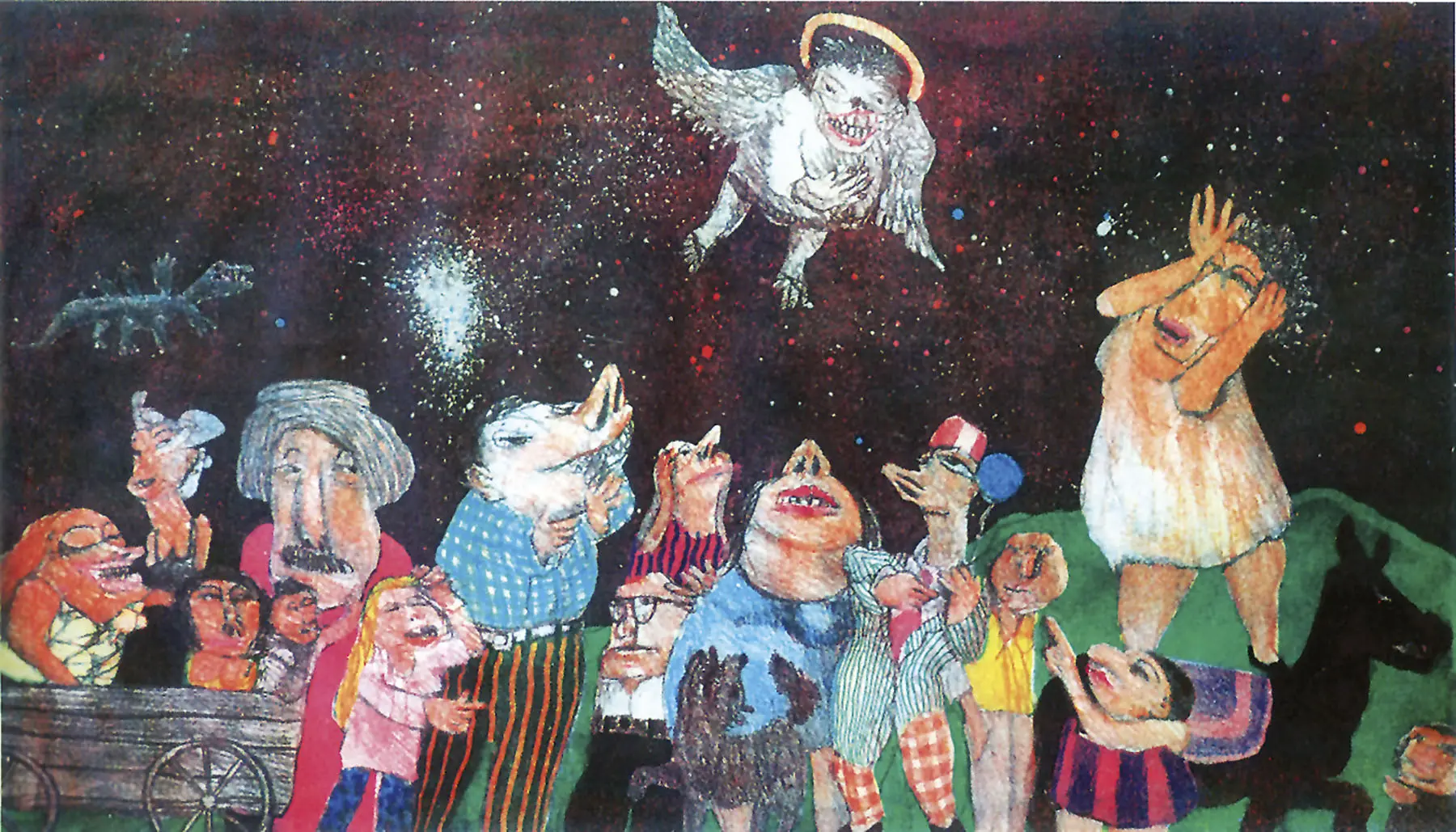
This national institution, one of only two museistic entities consecrated to the life and work of Cuban visual artists, has put together a program of events to commemorate the 85th birthday of the creator responsible for the existence of this institution named after him: a prominent painter, drawer, professor, and collector who died in 1981.
This year-long tribute to Cabrera has included several temporary exhibits, among other events that are taking place at this Museum-Library. Some executed by the artist were of a personal nature: Todos los Recuerdos de Sevilla (All the Memories of Seville), an exhibit of erotic paintings that was the central event of the homage, and Pasión por lo Humano (Passion for the Human), which presented little known works from his epic period, images that are also included in a 2009 calendar.
Also exhibited were creations by Cabrera interacting with works by other artists, such as at the exhibit La Conciencia del Testigo (The Witness’ Conscience), which totaled 50 works including engravings, paintings, drawings, and assemblages. Characterized by its expressionistic poetry, the exhibit brought Cabrera together with two other masters of the Cuban visual arts – Antonia Eiriz and Tomás Sánchez – among the more than 130 exhibits complementing the most important visual arts event in Cuba: The Havana Biennial.
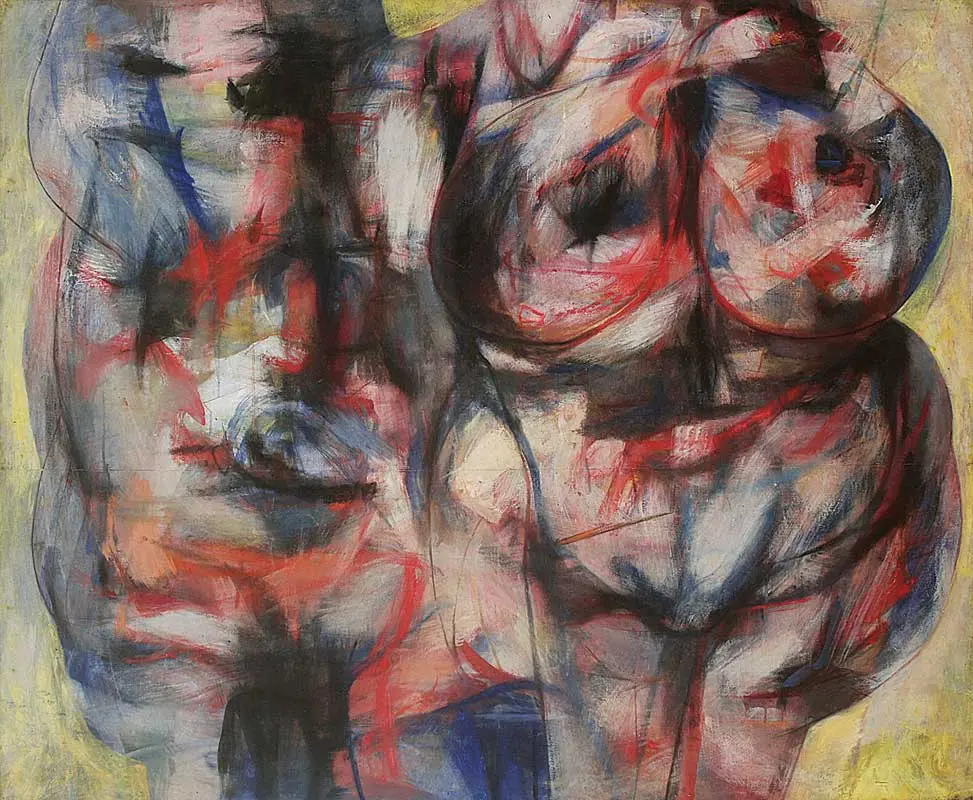
Within the context of the maxim guiding the 10th edition of the Biennial: Integration and Resistance in the Global Era – an attempt to resort to intelligent shields to defend Cuban identity and history against the nullifying effects of political and economic globalization and internationalization – La Conciencia del Testigo represented a special milestone for several reasons: One, historic-artistic in nature, it demonstrated the authors’ personalized and contextualized (for the most part) assimilation of an internationalized artistic tendency that mainly took place during the decade of the Sixties: The New Figuration or “the expressively grotesque.”
A trend searching for the most torn and aggressive emotional expression, it has emerged during different periods in art history and bearing different names – expressionist realism, abstract expressionism, neoexpressionism, among others – and found fertile terrain in the spiritualities of Cabrera, Antonia, and Tomás, who were at this point tormented by situations not merely artistic in nature.
A close friend of Antonio Saura – emblematic painter of a new figuration, who also visited Cuba and exhibited there – Cabrera conveys in this exhibit an expressionist poetic usually attributed to the 1965–1970 period. It was then that this great drawer, also influenced by Willem de Kooning, distorted figures to the point of rendering them unrecognizable.
Nevertheless, during an earlier period of his artistic carrier – the so-called epic period that began in 1961 – the artist was already violently transforming the human figure, magnifying attitudes and scales in order to express the revolutionary violence (and, in the main, the virility) of the historic-social moment that immediately followed the Cuban Revolution. Also, during a later period – from 1970 on – Cabrera maintained an expressionist vein that was present in his erotic period (as this was known due to the theme covered), which took shape in the rendition of dismembered joints or in extremely forced postures, of a brutality that is fitting in the passionate displays of sexual coupling, but which is also softened by the poetic aura surrounding the levitating bodies.
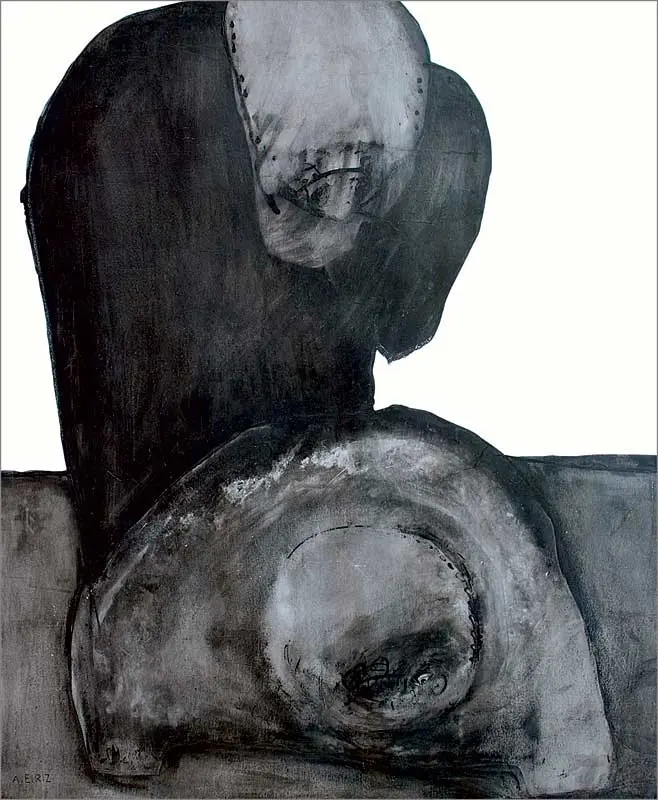
Graduated, as was Cabrera, from the San Alejandro National School of Fine Arts, Antonia Eiriz (1929–1995) was always very radical and anti-academic. Like Cabrera, she also experimented with abstraction. But while Cabrera – an accomplished colorist and superior draftsman – found it difficult to relinquish the empire of the line, Eiriz began to show a preference for broader traces and more organic strokes. Not totally neglecting the use of the line or of formal distortion, Eiriz nevertheless rendered – in an evolution excellently exemplified in this exhibit – tectonic forms and masses, such as forests in a belligerent manner, an evolution that also shaped her heteroclitic and formally rustic assemblages.
Eiriz installed a workshop in her home to teach and manufacture papier mâché folk crafts, some of which are displayed at her current home-workshop, while Cabrera preferred to continue collecting and importing folk objects fashioned by the regional creativity of communities from various countries, many of which are permanently exhibited at his museum-library. Both he and Eiriz were teachers in Cuba during the 1960s. She left a very strong expressionist mark on her students, Tomás Sánchez among these. A promising student, Sánchez, like his teacher, approached power conflicts and massification in an unrefined manner, but he did not insist as much as Eiriz on the “discursiveness of the scream,” the latter attributed to Edvard Munch.
During the beginning of the 1970s, Sánchez’s engravings (represented in the exhibit) demonstrate an interest for rural environments. This was a prelude to his inclination toward landscape that would move from the background to play a central role in his work, as critics have noted. Were not the anti-ecological dumpsites he exquisitely painted later somehow expressionist in nature due to their damning and lacerating implications?
Sánchez participates with recent pictorial landscapes in a central exhibit of the Havana Biennial titled Punto de Encuentro (Meeting Point). Twenty-five years ago, this extraordinary artist won the Amelia Peláez National Painting Prize during the First Havana Biennial and an Honorable Mention the following year. Some years after Cabrera was awarded (40 years ago) his first Honorable Mention at the Joan Miró International Drawing Prize, in 1980 Tomás would win the Drawing Prize of that same competition with an ink landscape.
Tomás met Cabrera and admired his work. Both were also close friends of Eiriz, who was awarded Honorable Mention at the 1961 São Paulo Biennial, and to whom the exhibit La Conciencia del Testigo has been dedicated to commemorating the 80 anniversary of her birth. Thus, the exhibit had other reasons for being: one of affection and to pay homage, and another to evaluate and promote the artistic heritage of Cuba. Many years had passed in Cuba since works by Sánchez and Eiriz were exhibited in such a vast manner. These works brought together for this exhibit come from both private and public collections. It was an effort that became an event never before seen by the general public.
ISRAEL CASTELLANOS-LEÓN