
The exhibition Tangled Alphabets: León Ferrari and Mira Schendel, organized by the Museum of Modern Art (MoMA), highlights the works of two Latin American masters. By presenting their first museum retrospective in the United States, MoMA acknowledges their participation in the development of the visual arts scene in Brazil and Argentina and their significant contributions to the development of contemporary art. The show includes more than two hundred works, many of which are being presented for the first in the United States.1
Interestingly, Ferrari and Schendel never met. Nevertheless, it is possible to establish coincidences and parallels between their lives and their works and to present a joint exhibit that emphasizes language as a functional component of their art.
Before reviewing the retrospective, it is important to consider some biographical information. Mira Schendel, whose name at birth was Myrrha Dagmar Dub (Zurich, 1919–São Paulo, 1988), was born in Switzerland and moved to Italy with her family as a young girl. She resided there until 1939 when she was forced to exile due to the anti-Semitic persecution. After World War II, she migrated to Brazil where she began to work as a ceramist and a self-taught painter. At the beginning of the Sixties, she introduced language in her work using letters as texture. Schendel produced thousands of works on paper in which she expressed her interest in the written gesture and the search for transparency in the matter.
Although she was not a member of Brazil’s Neo-Concrete movement, her work reflects its philosophy and shares the idea of self-knowledge present in the works of her contemporaries Helio Oiticica and Lygia Clark. Schendel was also inspired by Concrete Poetry and studied both eastern and western philosophies. Her artistic explorations show an interest in movement and instability, for the ephemeral and the precarious, which she transmits in minimalistic pieces made of fragile materials such as rice paper. Throughout her career, Schendel remained sensitive to art’s ethical dimension, and considered art the most radical expression of the human condition.2
On the other hand, León Ferrari was born in Buenos Aires in 1920. He moved to Italy in the Fifties, where he produced ceramic sculptures inspired by European abstraction. Upon his later return to Argentina, he began to experiment with wire sculptures and works on paper, in which organic and gestural forms constituted simultaneously an abstract repertoire and an exploration of codes, calligraphies, and writings. By the mid-Sixties, Ferrari began to use cryptograms in an effort to reject the automatism and the reproduction associated with several artistic techniques, long before the British group Art and Language (1969) launched a similar proposal.3
In 1965, Ferrari exhibited La civilización occidental y cristiana (Western Christian Civilization), a readymade in which the image of Christ appears crucified on an FH-107 bomber. The installation which criticized the Vietnam War was censured, and the exhibition closed due to the disapproval expressed by the Catholic Church. Since then, Ferrari has dedicated himself to challenge the religious dogma present in the pictorial tradition. As a politically active artist, it is important to mention his participation in the group Tucumán Arde (Rosario y Buenos Aires, 1968) and his manifesto El arte de los significados (The art of meanings) (1968).
In 1975, the political repression, persecution, disappearance, and death of relatives and friends, forced him into exile. He moved to Brazil where he made performances with works in metal and experimental music. Upon returning to Argentina in 1991, Ferrari began to make religious collages whose subject matter struggle between spiritual memory and collective trauma. Throughout his career, Ferrari has used multiple techniques including ceramic, sculpture, drawing, assemblage, engraving, postal art, painting, sound, and cinema. Concerned about the artist’s ethical role, he continues to combine his interest in avant-garde forms with political criticism.
Tangled Alphabets: León Ferrari and Mira Schendel present a double journey through more than four decades of artistic expression. Divided into five galleries, the works are displayed with a flexible chronology in a sort of visual game in which the creations of both artists engage in a dialog. From the beginning, their works show similarities. Ferrari’s ceramics (1960) illustrates the influence of the abstract movement and his interest in the female body. Although the retrospective does not include Schendel’s ceramics, these are represented in her abstract still lives. From the curatorial perspective, the interaction of these early pieces enriches the exhibit and predisposes the visitors to look for similarities among the artists’ works.
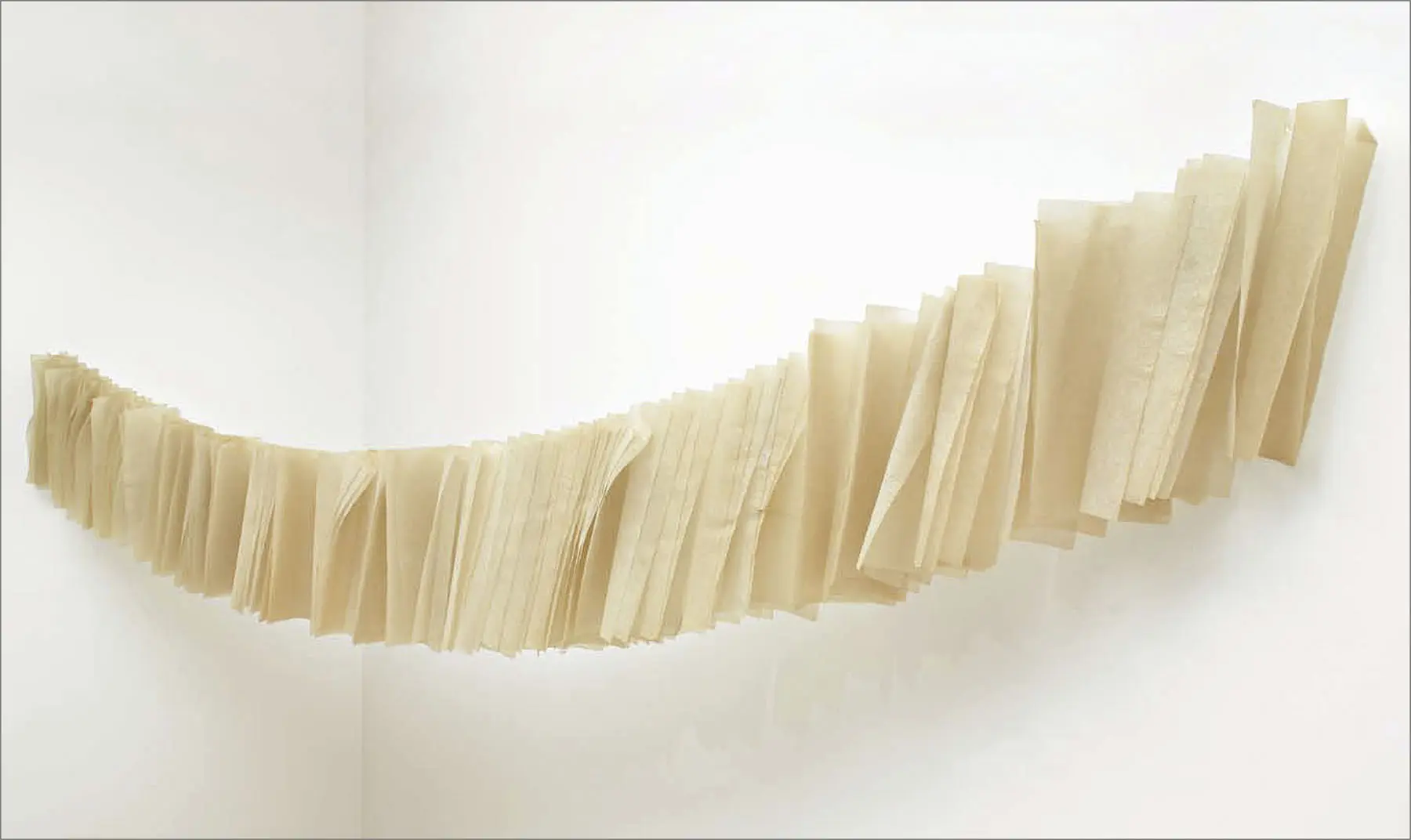
Schendel’s installation Trenzinho (Little train) (1965), hangs on one of the corners of the gallery. The work, made out of sheets of Japanese rice paper threaded on a nylon line, looks like a line of washed clothes drying out on the sun or a delicate curtain made out of veils. The shadows reflected on the wall give the piece a ghostly aspect, reinforced by the subtle movement caused by soft airflows. The installation, one of Schendel’s most iconic and emblematic works, illustrates her search for matter’s transparency and reflects her interest in philosophy and theology.
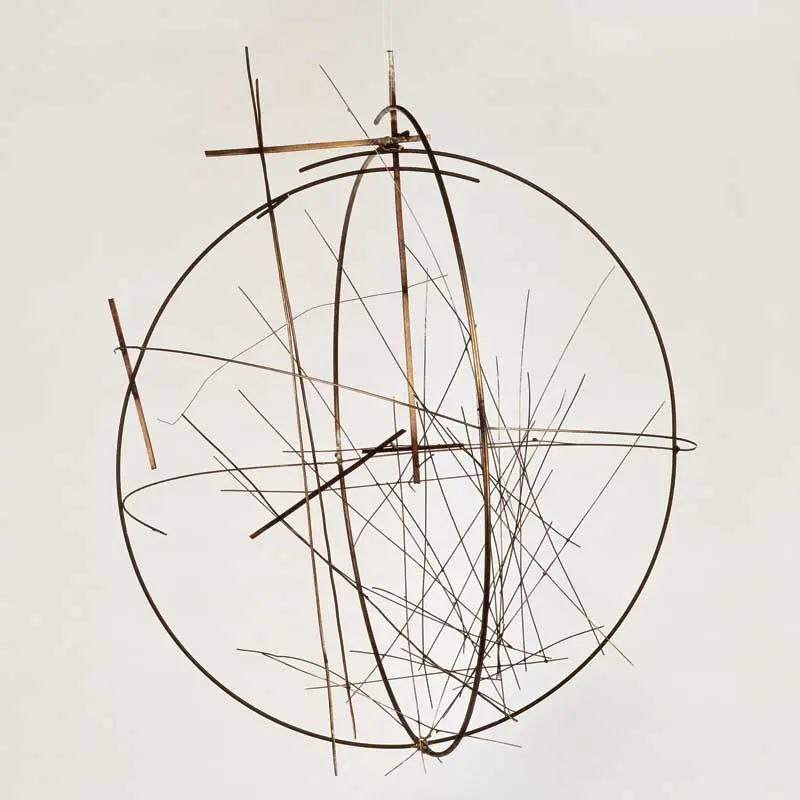
Gagarin (1961), inspired by the Soviet cosmonaut who became the first man to fly around the Earth’s orbit, is Ferrari’s first hanging metal sculpture. The piece makes reference to the Cold War and shows the artist’s interest in cosmology. Although there are similarities between Gagarin and Trenzinho, they are both held by threads and their titles are inspired by means of transportation and technology, they are very different. Her piece is made with a delicate material, almost ethereal, whereas he is made with a strong and cold medium. Trenzinho is a graceful piece that inspires subtle sensations, while Gagarin is loaded with political connotations that reflect Ferrari’s commitment as a critical artist.
Although these philosophical differences continued throughout their careers, their art evolved in a similar path that allows formal and conceptual parallels. The second gallery is more complex than the first one, not only because of the evolution of the works but also because of the way they are displayed. By combining several series of hanging pieces by Schendel with some of Ferrari’s major metal sculptures and calligraphic drawings, the gallery becomes a big installation that illustrates the artists’ interest in using letters, words, and sentences as subjects matter.
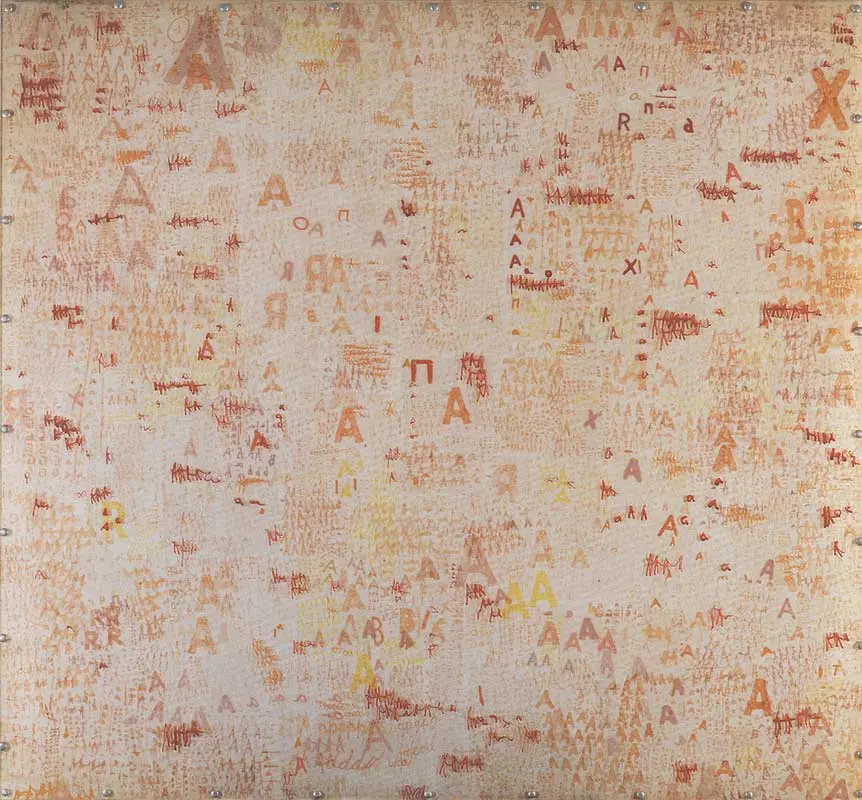
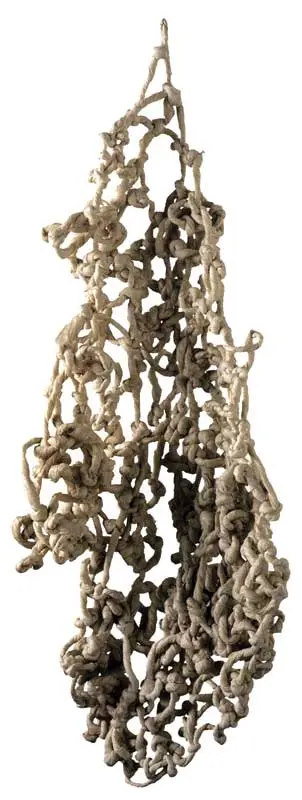
Six Objetos gráficos (Graphic objects) (1969) by Schendel guide the viewer through the gallery. These complex abstract pieces, made of signs and writings traced on delicate sheets of Japanese paper and framed between translucent acrylic sheets hanging from the roof, illustrate the way the artist uses language as the subject of her works and shows her interest in researching the transparency of the matter. In Droguinhas (Little nothings) (1964-1966) Schendel utilizes Japanese paper in an unconventional way. Instead of using it as support for written forms, she transforms it into a malleable material to make organic structures made out of knots. These structures of changing and motley forms can be hung from the ceiling, placed on the body, or displayed on pedestals. Each knot of paper represents a word and all knots are connected, forming sentences belonging to an unknown and abstract language.
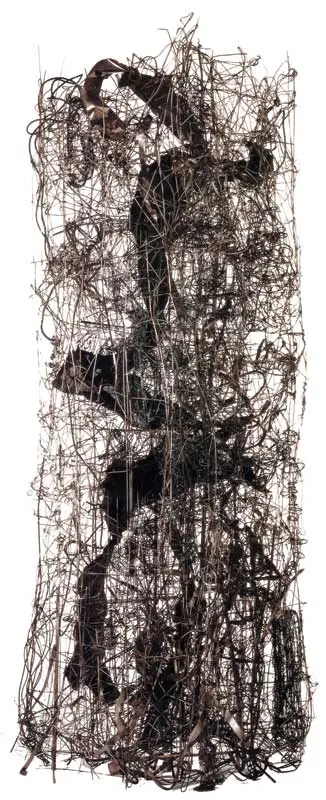
It is precisely the linguistic element that constitutes the common denominator between Schendel and Ferrari. Torre de Babel (Tower of Babel) (1964), Ferrari’s first large-size sculpture, is made out of knots of woven metal, welded pieces, and entangled wire. The sculpture is inspired by “babelism,” a belief that suggests that individuals are built by many layers of experiences and memories and that ideas must be reconsidered and reinvented on a regular basis.4 The sculpture’s knots of steel, bronze, and copper become, like Schendel’s paper knots, words, verbs, and languages that like in the story of the Tower of Babel, represent confusion and chaos.
The same kind of chaos is represented in Manos (Hands) (1964), an assemblage in which Ferrari combines drawing, entangled wires, small paper hands, and drawing on glass. The work is quite complex, not only because of its multiple of layers but also because of the variety of mediums used and the way they are displayed inside a box. The small hands seem to be fighting and grasping the wires, while the copper wires look like human red hair caught in a storm. This complex and entangled work transmits the confusion of real-life experiences. From the aesthetic point of view, it is important to note the way in which Ferrari spins the wires in this particular piece. Groups of threads emerge from dense knots forming a confusing labyrinth, which is complemented by written indecipherable texts located at the bottom and on the glass cover of the piece, making an echo of the piece’s visual chaos.
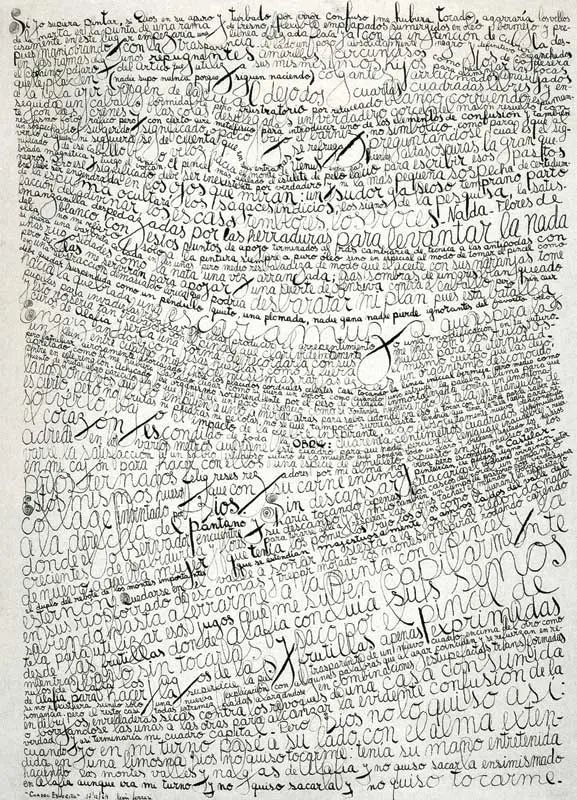
These texts, in some cases legible in others illegible, play the main role in the drawings Ferrari begins to make in the mid-Sixties. El árbol embarazador (The impregnating tree) (1964), Quisiera hacer una estatua (I would like to make a statue) (1964), El día que aparecí muerto (The day that I appeared dead) (1964), Milagro en la OEA (Miracle at the OAS), and Cuadro Escrito (Written painting) (1964), are part of a selection chosen for the exhibit. Written painting, a text drawn on paper in Ferrari’s distinguishable handwriting, describes a nonexistent painting and expresses the artist’s argument against religious dogma and the deification of painting. Instead of painting the object, Ferrari describes it with words and those words are what constitute the work. For some critics, this piece is considered the first example of conceptual art.
It is important to clarify that, unlike conceptual artists, Ferrari and Schendel conceived their works as unique actions in which the language played a fundamental role because of its presence and its materiality. In other words, it was the visual aspect of the language, more than the use of it as a vehicle to transmit concepts and ideas, that predominated in their works. For example, in Sem Titulo (Achilles) (Untitled-Achilles) (1964), Schendel writes in capital letters a fragment of a religious poem. The black letters of the poem and the white letters of the name Achilles written over a dark canvas and superimposed to a door’s lintel are more important as formal and pictorial elements than as a means to tell a story.
Throughout the years, Ferrari continues making endless calligraphic drawings that are a fundamental part of his artistic expression. In some cases, he creates new symbols, like in Heliografías (1981-1982), where letters are replaced by small people and objects related to hygiene, including urinals, bathtubs, toilets, and sinks, which allow him to create abstract compositions.
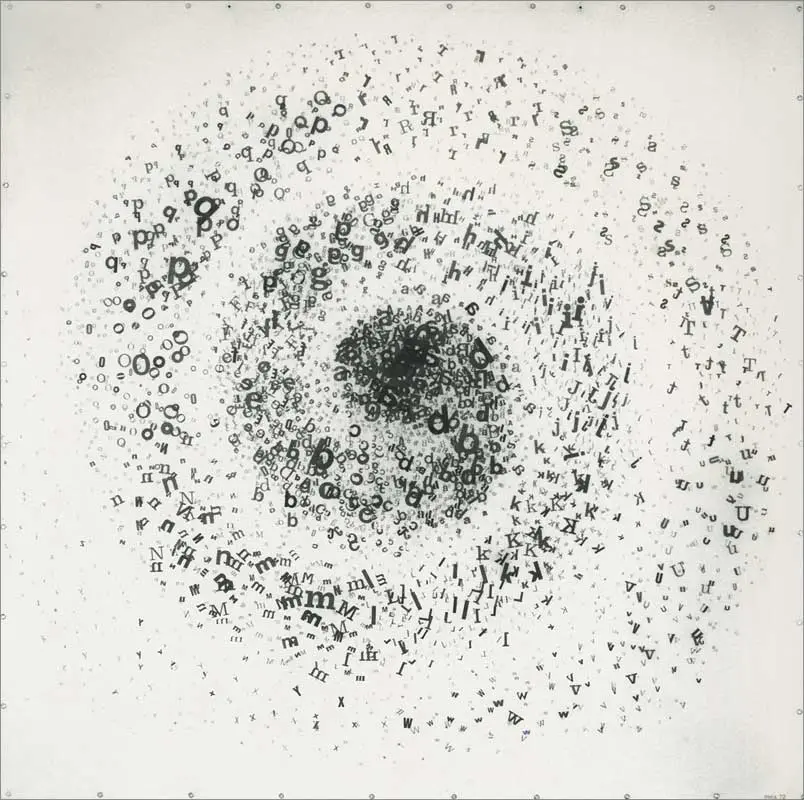
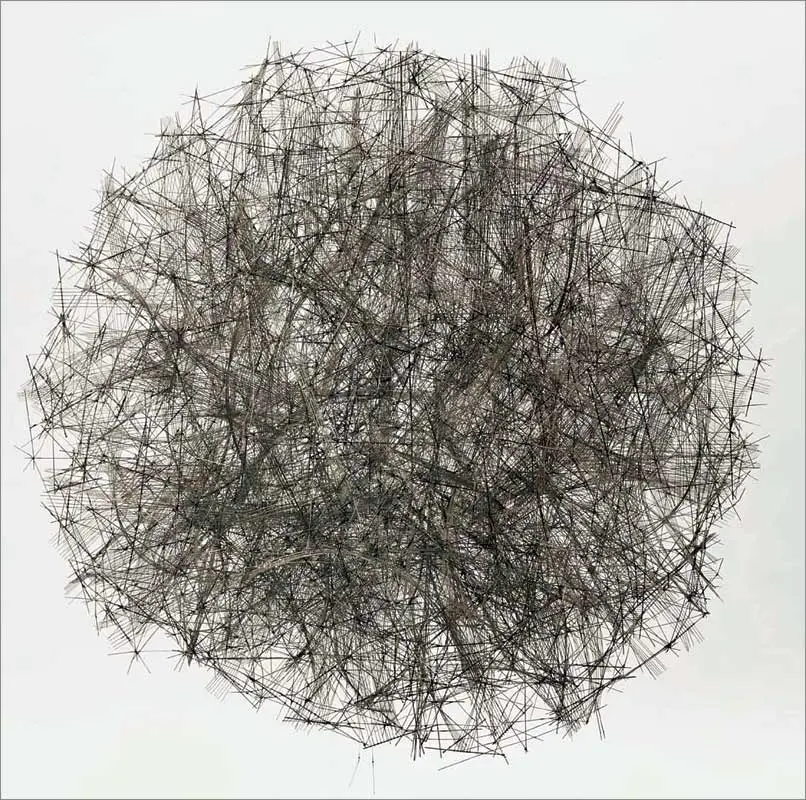
Ferrari continues making metallic sculptures. Planet (1979), made out of the mass of stainless steel and inspired by his interest in cosmology, is shown together with Schendel’s Untitled from the series Objetos gráficos (Graphic objects) (1972), a work on paper framed on acrylic sheets that shows a spiral form of letters evoking an explosion, a metaphor of the creation of the cosmos. The constellation of letters explodes from the black center of the drawing and evolves in a dynamic spiral form that dissipates towards the outer part of the image, making an echo of the words by Brazilian poet Haroldo de Campos.
Both Schendel and Ferrari were inspired by poetry’s symbols and forms and were friends with well-known poets, Haroldo de Campos, in Schendel’s case, and Rafael Alberti, in Ferrari’s case. One of Alberti’s poems inspired Ferrari’s work Sin Título (Sermón de la Sangre) (Untitled, Sermon of the Blood) (1962), a drawing in which two bands of delicate lines form a labyrinth of gestures and knots.
Politics, history, and religion are the main themes of the works shown in the fourth gallery of the exhibit. The largest piece is an installation made of nylon threads that hang from the ceiling and fall all the way to the floor and reminds us of Jesus Soto’s kinetic Penetrables. In Ondas paradas de probabilidade (Still waves of probability) (1969). The nylon threads fill the space with a weightless and transparent matter. A biblical text that accompanies the piece explains the artist’s intention: To emphasize the spirituality of the work by comparing a large translucent volume formed by thousands of nylon threads to God’s word.
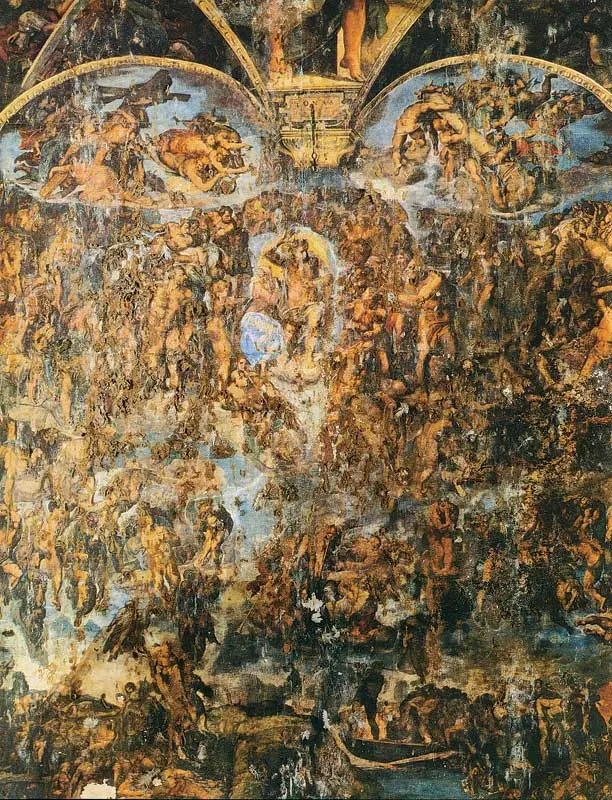
Unlike Schendel’s, Ferrari’s works are figurative and charged with multiple subtexts. In Juicio Final (Last Judgement) (1994), a reproduction of Michelangelo’s famous fresco covered with caged bird excrements, Ferrari uses the latter as a form of “writing” to cover the religious images, which in this case make reference to the concepts of sin and hell. This form of calligraphic camouflage is a clear reference to the rejection Ferrari feels against the Church and a critic of images of terror and torture present in religious iconography. Other series, such as Relecturas de la Biblia (Rereadings of the Bible) (1986-1988), also represent images with irreverent subtexts whose sexual connotations and political denunciations openly criticize the government and the Catholic Church.
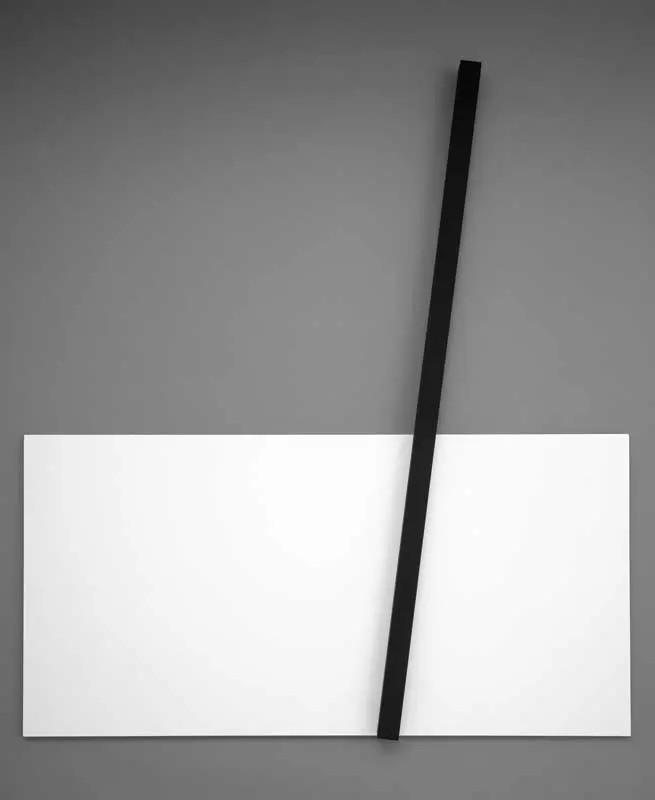
The retrospective ends with the last series of large-scale works painted by Schendel, Sarrafos (Splints) (1987), a series of oversized monochromatic canvases traversed by black wooden sticks which represent unfinished frames, and four recent sculptures by Ferrari, Sin título (Untitled) (2006-2007), made out of polyurethane and plastic. Whereas the Schendel’s represent an art capable to evoke silence by means of abstract planes, Ferrari’s is a critic, a howl that denounces the Church’s doctrine and criticizes politics, which he considers responsible for the human genocide represented by the abstract accumulation of femurs, vertebrae, and ribs in Huesos (Bones) (2006), and the destruction of the environment, represented by the contamination in which small plastic trees are placed in Árboles (Trees) (2006).
At the end of the story, Schendel finds the transparency and the spirituality she looked for, while Ferrari continues clinging to the earthly world so he can pursue his activism and his critical attitude, making works that denounce and create conscience.
NOTAS
1. This exhibit was organized by Luis Pérez-Oramas, Estrellita Brodsky Curator of Latin American Art, with the assistance of Geaninne Gutiérrez-Guimarães, Curatorial Assistant, Museum of Modern Art (MoMA).
2. Luis Pérez-Oramas, explanatory text posted at the entrance of the International Council of Modern Art Gallery.
3. Julieta Fombona, trad. “León Ferrari” in Mari Carmen Ramírez and Héctor Olea Inverted Utopias Avant-Garde Art in Latin America (New Haven and London: Yale University Press and Houston: The Museum of Fine Arts), 564.
4. Luis Pérez-Oramas, explanatory text.
FRANCINE BIRBARGHER
Independent writer and curator.