
When one stops to think about landscape renderings in art nowadays, it is rare that the first thing that comes to mind is a contemporary art piece. Normally the likes of Romantics like Caspar David Friedrich or emblematic painters like Turner or Cézanne get there first, but Marcelo Moscheta’s (32) solo show, Gravity, at Galeria Leme in São Paulo, came to add a breath of contemporary to the landscape motif. From March 2nd to April 4th, 2009, a gigantic dwarfing moon drawing hung within the modernist lines of the striking exhibition space at Galeria Leme designed by master architect Paulo Mendes da Rocha. The setting heightened the soft majesty and emblematic tone of the meticulous graphite drawing on PVC (2.4cm x 2.4cm) of one of the most organic symbols for expeditions, which still remains pertinent today – the moon. Opposite it, Maré, a series of 3 projections at ground level showed different still images of waves on a beach, inextricably grounding the moon through its conceptual reference to the effect on tides. The constant hypnotic hum of the slide projectors brought back memories of a quieter and simpler time when mechanics and technology weren’t necessarily about speeding up the pace of things, but about enabling the re-discovery and visit of something divine removed from its original context but triumphantly represented through iconic references of itself. Part of the empathy came from the movement the still images gained by being slightly different and the timing of the projections, thus even being stills, they danced at one's feet like waves rippling onto the shore. And the hum, before you knew it, had evoked the memory of the sound of the sea in the same way a seashell does – magic, especially since the enablers of this mind’s eye expedition, the cables, and mechanical implements were clearly visible, for the show just as much as the poetic, simple images that re-contextualized the sea and by default also the moon.
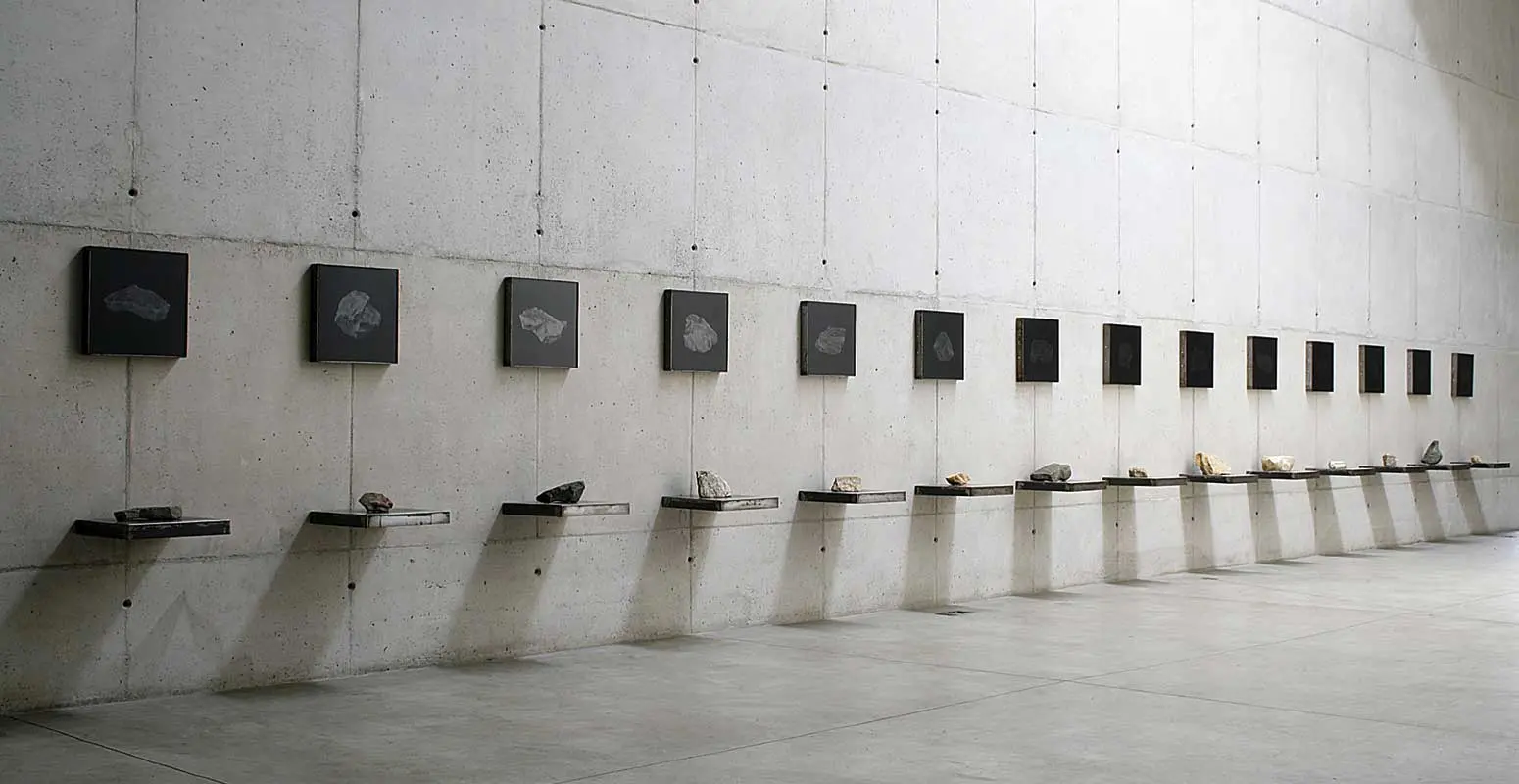
To the side on an adjacent wall, a line up of 14 rocks and drawings, Pedras, brought nature into the archaeological realm. Set on iron plinths, the rocks hovered almost weightless, beneath drawings of each one of them. But, these were real rocks handpicked by Moscheta from the countryside region of Joaquim Egydio near Campinas, where he lives and works, and for which he annotated and presented the precise coordinates of where they were found. “I like to think about how we fit into the context of the world and its landscape, and the organization of nature,” says Moscheta. The organization reproduced in a museum setting is not far from what happens in the world, which is naturally classified, distinguishable, and traceable. But what happens when you remove something from its original context and furthermore, what happens when you reproduce it? Moscheta’s exhibition raises questions surrounding the very nature of representation as much as it does about presentation, experience, and context. Opposite the rocks, a series of 20 small lightboxes hung on the wall, cables on display, showing what resembled the snowy peaks of generic mystical mountains. The impact of something so small and man-made representing the unruly element of nature was striking. Size matters in this show. Albeit a large drawing, the moon too is a miniature of nature, as is the series of lightboxes, Summit, and the projections of “Maré´.” Across the road in Leme’s project room, the dark space housed a series of 62 lightbox photographs of rocks organized in a circular mechanical-looking structure hanging in mid-air, at eye level. Here, rocks float and confront gravity, their weightlessness is disorienting to the point of evoking vertigo. If gravity is what keeps the organization of the natural world as we understand it today, the lack of it induces a whole new sense of organization, which in turn sheds light on the fact that each of us in our microcosms lives through and is governed by a unique, independent and perhaps unavoidable sense of organization. It may be that landscape painting was a channel of the expedition and revealed wondrous, harmoniously rendered distant lands, but through Moscheta, landscape renderings work the reverse expedition, one that unveils our berth, that which is close and supposedly reachable, yet still out of our grasp. In Gravity, Moscheta re-organizes the world, re-sizes, re-presents, and re-contextualizes. This is the world according to Marcelo Moscheta.
CAMILA BELCHIOR