
A lot of myth has surrounded and probably also inflated Max Ernst (1891 -1976) since the era of Dada. An obviously intelligent guy, well attached to the avant-garde circles of his time and with famous art women as his wives or lovers (Peggy Guggenheim and Dorothea Tanning among the first; Leonor Fini and Leonora Carrington among the second), he always seemed to me to be an overrated artist uneasily surrounded by a grand operation to sustain an inflated reputation. Ernst was an often heavy-handed painter who was at his best when making small drawings, collages, and watercolors. The arc of his life-long career probably peaked in the early 1920s. In 1919 he became the leader of the Cologne branch of Dada (a late branch in the history of the movement) and then a Surrealist in Paris (Andre Breton cited his later Dadaist work as the starting moment for Surrealism in 1924).1 Ernst broke with Surrealism in 1938 when Breton asked him, unsuccessfully as it turned out, to end his friendship with French poet Paul Eluard over dogmatic differences on politics and aesthetics. Though Ernst’s basic aesthetic allegiances remained intact, his break with Breton coincided with a slow downturn in his work. His sculptures from the 1940s onward became too heavily inspired by tribal art and his paintings grew to be increasingly trivial. An exhibit of his later work organized by the Jewish Museum in New York in 1966 proved particularly depressing.
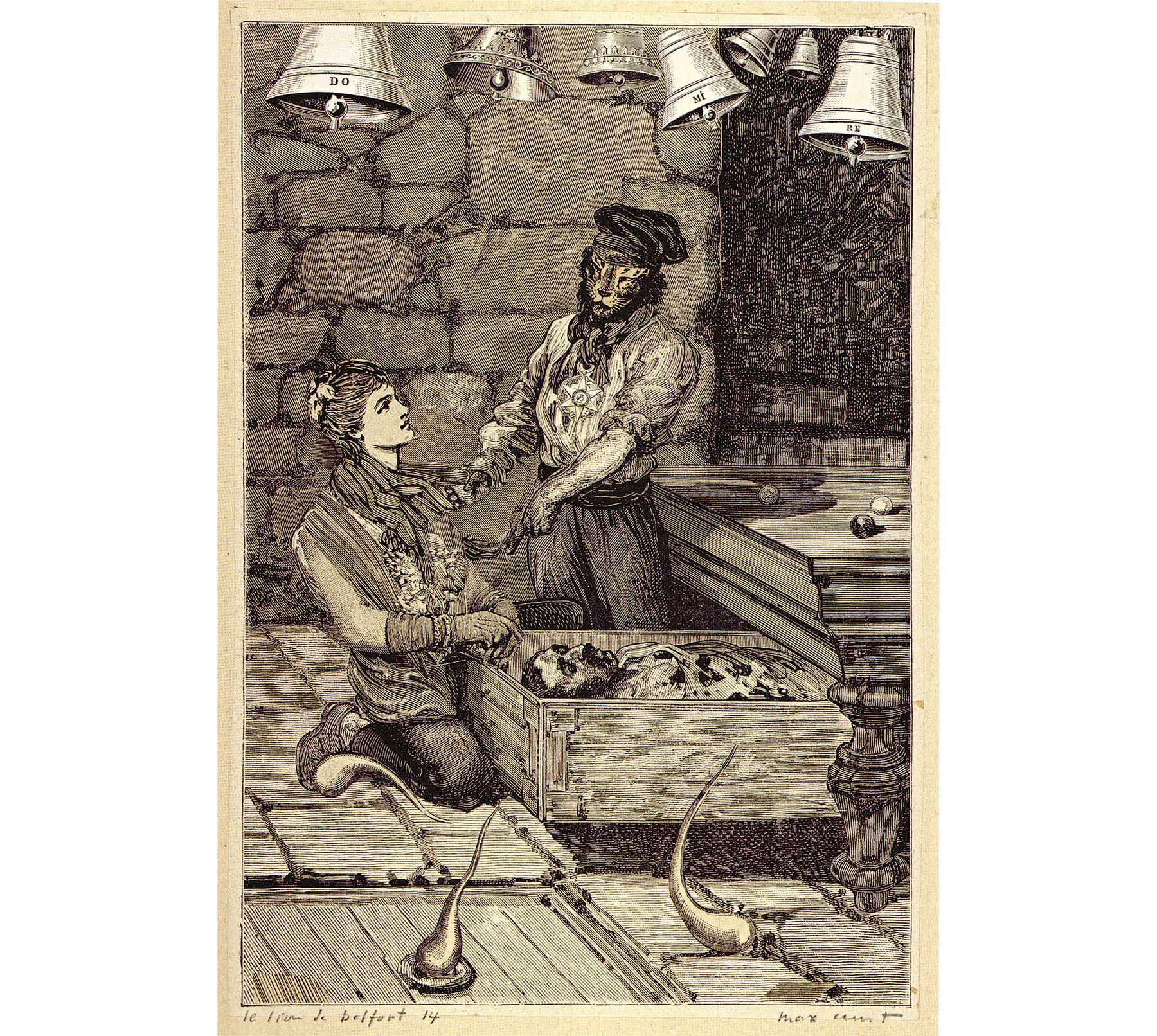
Yet, there is one body of work that always stood out and will ensure Ernst’s stature in twentieth-century modernism: his Une semaine de bonté (1933). A vast and ambitious graphic novel, Une semaine de bonte is a series of collaged fragments of nineteenth-century woodcuts (taken from periodicals), creating an amazing world of fantasy both hallucinatory and threatening. The series was shown in its entirety for the first time in an exhibition that had its last station in the Kunsthalle in Hamburg. The exhibition was assembled by Werner Spies, the leading authority on Ernst’s career in general as well as on this aspect of his work.2 The only other time this series was on view, albeit technically incomplete, was in Madrid in 1936. On that occasion, even though the full series of 184 pieces were available, five ended up excluded from the exhibition. The organizers undoubtedly feared that the “blasphemous” content of these images might provoke reprisals from the Catholic Church, which retained political power even under the secular Spanish Republic.
Une semaine… was not Ernst’s first collage series. It was preceded by two others: La femme 100 têtes in 1929, and Rêve d’une petite fille qui voulut entrer au Carmel in 1930, and also by some single collages produced even earlier. Une semaine…, however, is the one that qualifies as a true major visual epic, representing Ernst’s collage work at its best.
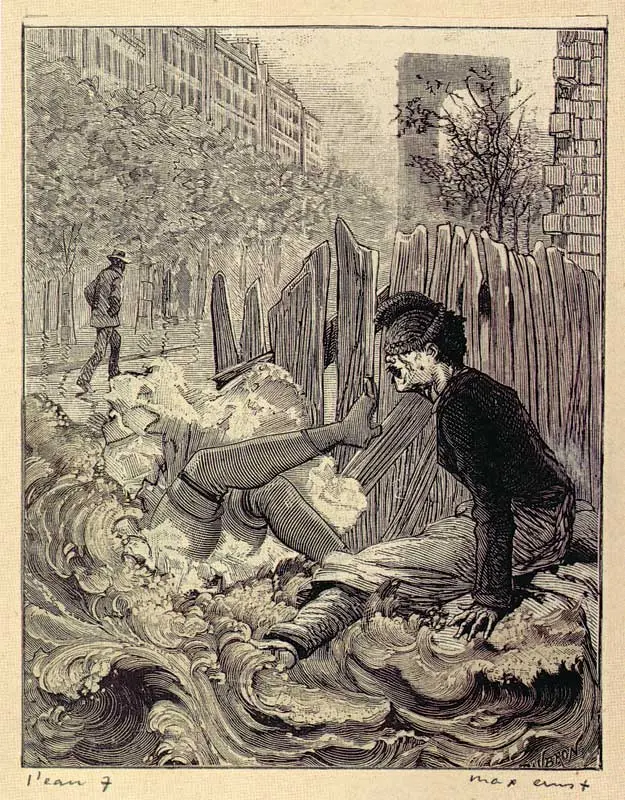
And yes, still today, the series is capable of upsetting viewers. It is somewhat blasphemous, quite sadistic, and to a degree misogynist. Yet it is also poetic, evocative, and stunningly well done. It shares the spirit of Les Chants de Maldoror, in a fitting homage to Isidore Ducasse (1846-1870), the Uruguayan-French poet known as the Comte de Lautrémont, who is acknowledged to have been the unwitting father of Surrealism.3
In general, the visual world of Ernst tends to be less interesting than that of his colleagues. What keeps popping up in connection with Ernst in art history has more to do with his technical contributions than with any visionary breakthrough. He is credited among other things with having invented “frottage” (the rubbing of a soft pencil lead over a paper lying on a wooden floor, 1925), and “grattage” (scraping through layers of paint), and with reviving decoupage (the gluing of cutouts on objects). And while he certainly didn’t invent collage, Une semaine… is remarkable for the way he manages to build up his collaged fragments into a completely seamless and coherent piece. The finished work reflects the obsessiveness and rigor of a technical perfectionist. Sometimes the results have actually been mistaken for wood engravings by the artist.
To fully understand and appreciate Une Semaine…, we need to talk about the history of technique. Around 1790 a British ornithologist, Thomas Bewick (1753-1828), revolutionized printmaking by popularizing wood engraving as opposed to the better-known woodcutting or xylography. Traditional woodcuts use the face of the wood with the fibers lengthwise, the same way wood is used in carpentry. Wood engraving, instead, uses the cross-section of the planks. The fibers appear as dots which allows for the use of metal engraving tools to incise the images. Wood engraving presented three great advantages. It provides a non-directional surface similar to a metal plate, it is easier to incise than metal, and it survives much longer press runs than traditional woodcuts since, under the pressure of the printing press, the fibers act like columns instead of beams and resist breaking. The technique had aesthetic consequences since it allowed for the use of burins with multiple teeth capable of creating many parallel lines in one cut. The durability of the printing block made possible large editions of illustrated periodicals. At a time in which photographs could not yet be mass printed, and to satisfy accelerating demand for the rapid communication of information to a large audience, the printing industry developed a repertoire of effects--a kind of “objective” visual language. This shared language allowed many engravers to work on fragments of a single image which were then fit together by a master cutter. Thus an image illustrating the news could reach the press before losing its currency. Over time the process generated a very conventional form of imagery, something that served Ernst very well. He had a rich trove of old French magazines of the nineteenth century to cut from, illustrations of different stories illustrated by many authors, most of whom have been forgotten (Gustave Doré being one of the few whose name has endured). Ernst obviously selected his fragments and built his collages with extreme care to maintain atmosphere, design, and texture. The illustrations he most often used were from stories about sadistic crimes and sexual perversions; as visual imagery, these illustrations were at the far edge of what law and custom would allow in their time. Thus, much of the atmosphere that Ernst developed in his work was already latent if not explicit in the material he chose. This may have inspired him to conceive of his work beyond the raw material with which to continue his experiments with the technique of collage.
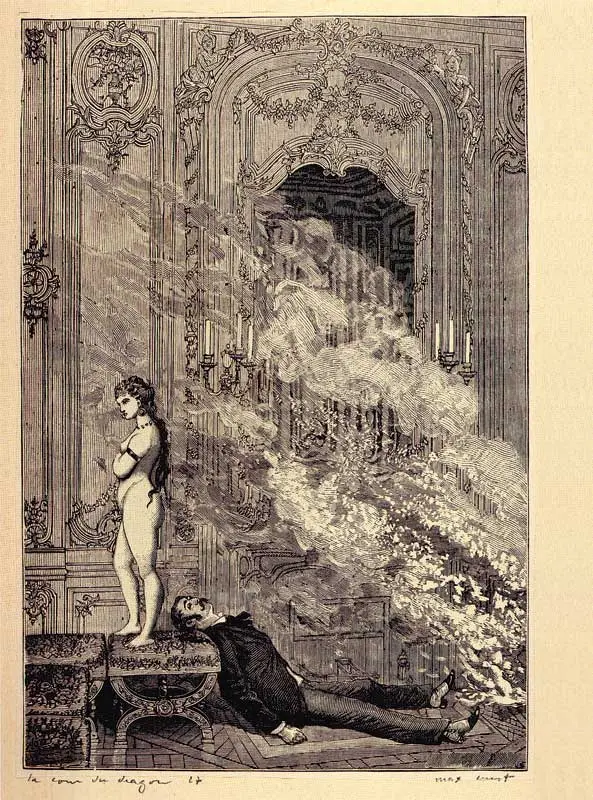
In any case, Une semaine… conforms to the general trappings of Surrealism. There is no clear narrative line, the images seem to reflect a process of (not so) free association, and everything prompts the viewer to create his or her own story. It is the recurrence of some of the chosen images that gives Ernst’s seal of authorship and opens him to charges of sadism and misogyny.
The original collages for Une semaine… were intended for reproduction by a commercial printer and not for exhibition. This explains why they were exhibited only on rare occasions. Their purpose was to produce Ernst’s own graphic novel booklets. The stark black and white imagery allowed for line printing clichés that were cheaper than halftone clichés used for the reproduction of photographs and needed less care during printing. Halftone reproduction only became popular in the 1890s, and until the digital age required specialized supervision. The wood engravings also had the added advantage that when glued together the seams between fragments were less visible.
The concept for the series was based on low-brow literature, on what Ernst deprecatorily called “novels for maids."4 The complete title, Une semaine de bonté ou les sept elements capitaux played on the seven capital sins, on the seven days of the week, and on Ernst’s personal definition of elements. Each day had its volume, although when they were published in 1934, the last three were fused into a single one for reasons of economy.5 Each volume had a cover in a different color, a feature that was respected in the exhibition in Hamburg, to good effect. Each volume was presented in its own room and with the walls painted accordingly.
During the summer of 1933, Max Ernst spent a vacation in a friend’s castle in Vigoleno, near Piacenza. He arrived with a suitcase full of magazines and completed his series in three weeks. Spies points out that speed was an essential part of the process.6 What appears as rush and thoughtlessness was a strategy. It allowed Ernst to have an uncensored dialogue with the images where his decisions would be informed by direct and instinctive reactions to what the pictures were suggesting. In that sense, he was rather faithfully following a surrealist recipe.
As seen today this series has an aura of nostalgia. One feels in the presence of a strange past populated by suggestions disguised as old-fashioned customs. In his essay, Spies denies there is nostalgia in Ernst’s work. He points out that the aesthetics of nineteenth-century wood engraving and pulp novels had disappeared from collective memory by Ernst’s time; that none of Ernst’s colleagues refer to them either in their own work or in discussing Ernst’s work, and that Ernst’s objectives lay elsewhere. This isn’t entirely persuasive, for contemplating these collages, one cannot help but feel a very strong pull into an alternate world with an antique tincture. In light of this, it is hard to accept that Ernst was uninterested in the past represented in the imagery and atmosphere of an earlier aesthetic. And he seems to have had a consistent fascination with the “look” distinctive of earlier imagery. Since 1920 he had been making use of older images, painting over and altering them. One should also consider that Dada in particular was an artistic attitude focused on the present (a consequence of the trauma of the First World War) and that modernity in industrial printing was already fully accomplished.7 Long before Une semaine… a critical distance from mechanicist perceptions had been achieved, in part due to contributions by Ernst himself. Taking all this into consideration, it would seem reasonable to conclude that the source-material Ernst chose for his collages was a deliberate way of returning to other times, with all the evocations this implies. Maybe he was the only member of his generation to empathize openly with that world.
The whole process undertaken by Ernst is one of appropriation. He appropriates illustrations that were designed to stimulate (or to limit) imagination in reference to a text, and with these he created a new (implicit) text, generating yet newer flights of the imagination. He appropriates both spaces, with its distinctive atmosphere, and the techniques and rules with which it was represented. In cases where, beyond the assembling of fragments, there is a direct intervention in the image – for instance, the occasional scraping– it is done to cement the identity of the found images in their seamless coexistence within the space of the main containing image. His fragments are cut with extreme care, so as to avoid rough edges that might reveal signs of tampering. In the rare case where transitions are required, he follows the existing patterns by scratching in appropriate lines. In many of the depicted rooms (like stage settings) there are carefully composed works of art that come from Ernst’s imagination and refer more to cubism than to the nineteenth century. Yet, the fit is perfect. Ernst here seems to work more in the spirit of counterfeit than of making art.
Ultimately Ernst wants to make believe that his final images are real nineteenth-century pulp images. He keeps the technical appearance as credible as possible, he maintains the atmosphere, he distills violence already present in the originals, and then he merges his possible personal problems and unconscious opinions into all of that. As much as a creator, in this series, one could define him as a manipulative observer. All this makes the denial of nostalgia implausible. It would actually seem that he wants to share the nostalgia with us so to create a point of entry into his personal experience. This could lead to painfully revelatory work, but fortunately, his personal experience remains elusive. We only know it is there because we know we are being manipulated.
Apparently, as a child, Ernst had a cockatoo. On the same day, his bird died, at age 14, a sister of his was born. The recurrence of the image of birds in his work may be a consequence of this event. Many other images are also repeated, possibly because of his process of association but also due to the limitations of his source material. Either way, this is not necessarily a weakness. The repetitions provide both a rhythm and a hint of narrative consistency. Both allow the viewer to persist in the daunting task of looking, room after room, at all 184 pieces.
The truth is that Ernst’s series, as he originally conceived it, looks best in book form. The exhibition, in all its undeniable handsomeness and perfection, is mostly of scholarly interest. The work is accompanied by vitrines with copies of the magazines he used to produce the work and previous publications of the series. The exhibition is the product of painstaking research, a project fully justified by the work on view, and what is presented to the viewer is the full package of investigation.
Quite logically, the catalog for the show operates in a different dimension, exceeding the exhibition. The book is a valid and the best possible substitute short of having the originals at home for slow inspection. And, by carefully reproducing the collages as the works they are (in the actual size and with the color of the aged newsprint), it goes way beyond the original publications by Ernst. As an added bonus, the book contains Spies' definitive essay on the topic. (Besides being a first-rate scholar, Spies was a friend of Ernst and focused his research and much of his discussions with him on this set of works). The publication actually elicits the attention that Ernst may have desired when he started his project. Viewing the exhibition is like reading a book with each page behind glass and hanging on a wall. The catalog presents us with the right vehicle, made in the absolutely best way possible.
The first reaction one has when seeing Une Semaine…, in spite of some of the precedents in Ernst’s work, is to declare it the culmination of his career and to isolate it from his other works. However, the series is more than that. Une Semaine… really provides us with a key to understand Ernst’s full career. In a manner of speaking, all his work is the product of piecing things together. He projected other people’s images on his canvases and traced them; he altered found images and, as stated before, he lifted stylistic elements from other cultures.8 From the perspective of copyright dogma, one could say that to some extent Ernst lacked scruples. But one also could interpret his attitude as being that of a true disciple of Duchamp. The ready-made is reinterpreted and expanded and so also are notions of appropriation. Ernst poked holes in the hitherto unassailable notion of authorship, and in that was useful in taking the Duchampian aesthetic beyond Duchamp. The uneven quality of Ernst’s work made this path a perilous and often unsuccessful one. Une Semaine… is there to justify his risks and failures.
(Edited by Selby Hickey)
NOTES
1. In 1919 Ernst encounters both the work of de Chirico and Klee, which leads him to break with his own sometimes Chagall-like expressionism.
2. Max Ernst. Une semaine de bonté, Die Originalcollagen. Albertina, Viena, 2.20 – 4. 27. 2008; Max Ernst Museum Brühl/LVR, 5.10 – 9.7. 2008; Hamburger Kunsthalle, 9. 19. 2008 – 1.11. 2009. The catalogue with the same title is by Werner Spies, Dumont Buchverlag, Germany.
3. It is often mentioned that among artists Ernst was one of the first readers of Freud’s books. However, it would seem that Lautrémont was a bigger influence.
4. Werner Spies, p.13.
5. Spies, p. 14. Une semaine de bonté (“ä week of kindness”[A Week of Kindness]) was a slogan used in 1927 for social action by the philanthropic organization “La Semaine de la Bonté,” Spies, p.15.
6. p. 28-29.
7. Ernst commented that he had died on August 15, 1914. William Camfield, Max Ernst, Dada and the Dawn of Surrealism, Prestel, Munich, 1993, p. 41.
8 Walter Hopps suggests that Ernst was the first artist to use a projector for this purpose. (“Preface,” Max Ernst, Dada, and the Dawn of Surrealism, p. 12).
LUIS CAMNITZER
Emeritus Professor at the SUNY College, Old Westbury.