
Cuban art can sometimes be identified with the symbolic story of a country affected by the political or social events that are part of its history. For artist Maykel Linares (Caibarién, Cuba, 1979), personal information replaces the collective experience and becomes the notes for the chaotic and multicolored biography of an individual who experienced several dissimilar lives. This is confirmed by the title of Linares’ first solo exhibit at the Luz & Suárez del Villar Gallery in Madrid. It is titled M.P.D., the acronym for Multiple Personality Disorder. Nevertheless, his work does not reveal itself as maddening evidence for that pathology, or as the effort of an amateur in therapy. We are presented with an experienced craftsman who uses a “mental disorder” as a situation that permits him to appropriate any media or technique, to incur in private situations and experiences, without turning the museistic experience into a “confession.” This is perhaps the reason for the freshness and total ease with which Linares employs photographs, drawings, paintings, and installation.
The exhibit is simply disconcerting due to the disparity of media used and the differences among the works. There is not an inkling of a congruent stance on behalf of a particular “style” to connect the work to the Pleiades of Cuban stereotypes and works so well projected internationally. The simplicity with which fluctuations are assumed indicates a deliberate desire of appearing as everybody and nobody at the same time. There is no doubt that something unites these, and it is the “elegance” and cleanness as a group, that we should not confuse with a “minimalist” approach. What is surprising is that these are images and objects that border on every day, like sorts of little musical notes we recognized, with a certain degree of irony, in rituals we shared at some point in our lives.
The center of the space is occupied by a baseball supported by a base that permits axial rotation, such as that used in a terrestrial globe. El Tamaño del Mundo (The Size of the World, 2008) is paradoxically a sphere that alludes to male genitals and also to the most popular of Cuban pastimes. From its small roundness, it structures the visual field from which invisible lines depart to connect to the other pieces and, thus, to the experience narrated. This is no accident. Baseball is a “national symbol” in a country that believes in politicizing sports and idealizing all things masculine. Therefore, the small bronze sculpture by the wall depicting a flaccid penis is in high contrast with the stiffness of its material and the highly explosive testicles in the shape of grenades.
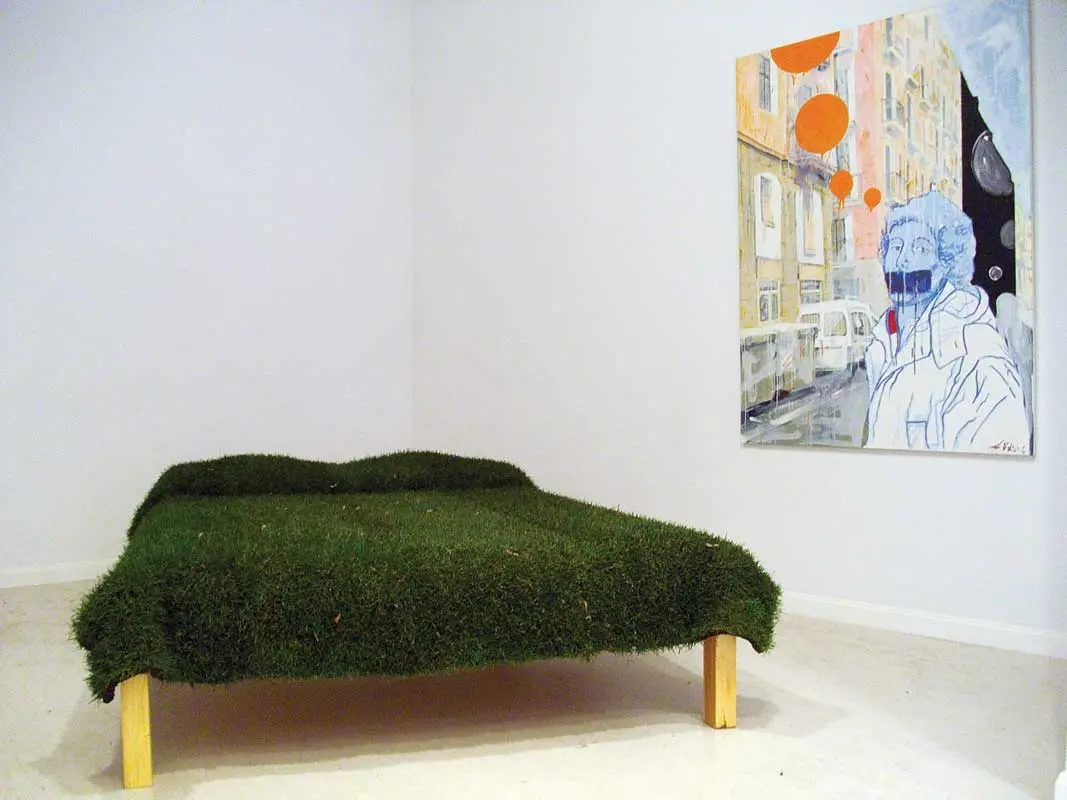
Highlighted at the rear of the exhibition space, there is a bed covered with fresh grass on a mattress fashioned of bricks and with a clay pillow that will harden with the passing of time. Motherland is the very obvious and yet subtle title of this work. It speaks of a place where we can grasp a plot of identity, but this place is the bed on which to rest the body, and its geography is no longer of importance. This does not concern the collective fluctuation of identities anymore, but rather one’s personality, setting its strategies on the line in order to adapt to changing situations without collapsing.
Painting and drawing are playful disciplines here. In the case of drawing, the exercise becomes more abstract and metaphoric. On the other hand, the painting is all about the joy of colors and a clear reference to pop art “washed” with overt drippings and photographic framings of urban scenes. The characters are young and have existentialist gazes; their expressions and language are reduced to the emptiness of the “globes” transformed into floating colored circles. Linares hides in his subjects, whether as the wall painter altering the London landscape into something Caribbean, or conversely, a Latino who adapts to the cosmopolitan art world and embraces it without hesitation. A case in point is Linares’ nearly abstract photography, where objects are magnified and acquire the elegant banality and sensibility of the English world. Only titles such as Insomnio – showing an ashtray full of crushed cigarette butts – or Yesterday – a triptych of photographs of an amplified fried egg – “betray” him.
There is no doubt M.P.D. is a refined argument or exercise on the existential condition of the nomadic artist. Linares uses multiple personality disorder as a strategy to create works and situations that are subtly constructed and seemingly removed from his personal history. We are before a potential criminal exercising a controlled expression of his own pathology through the obsessive reconstruction of his past in every day of the present. There is no nostalgia here, but in its stead, irony, and good art. How fittingly the phrase by Ana Mendieta describes Linares: “I know that if I had not discovered art, I would have become a criminal.” There is no doubt that Maykel Linares will add to his many personalities, one of a consummate perfectionists.
DERMIS PÉREZ