
“History is a territory that is conquered and owned,” says Pablo Helguera, and we could add: geography can be a tool to build narratives to justify and dissect land grabs, social engineering, and human clashes with nature. Since Homer’s Iliad and Odyssey, considered by many as the origins of geography, this is a discipline that uses the information we have (factual and sometimes mythical) of lands and peoples to create maps, models, and other systems of representation. Pablo Helguera’s (Mexico City, 1971) show, Committed Explanations in Geography, welcomes the visitors with the piece, Past and Future (2007), two side-by-side texts were written phonetically: “the past is a foreign country,” (coined by the British writer L.P. Hartley); and “the future is not what it used to be,” (from French writer and philosopher Paul Valéry). The use of the phonetic alphabet positions the visitor as a foreigner, as a disoriented traveler struggling with alien languages and strange cultures, while searching through a labyrinth of anachronisms, or as a tourist in a quest for the ultimate exotic experience.
With these very well-known quotes, the artist seems to isolate the concept of time from history, emphasizing its links with geography, and turning it into a flexible material which can be revisited (even played backward) — like Land Tender The (2009), a backward reading of an excerpt from James Agee’s book, Let Us Praise Famous Men, over Aaron Copland’s The Tender Land suite playing backward as background music), or even captured — as the songs and texts in a Native American language preserved in primitive wax cylinder recordings, in Conservatory of Dead Languages (2005).
The pieces selected for this show, created between 2002 and 2009, seem to be reflections of Helguera’s ambitious The School of Pan-American Unrest Project, a multimedia experiment in collaboration with a wide variety of organizations and individuals, a participatory piece which included a nomadic forum or think-tank initiated in 2003 that crossed the Americas by land — from Anchorage, Alaska, to Ushuaia, Argentina, in Tierra del Fuego. This trip was meant to rediscover whatever is left of the continental unity utopias but also was an opportunity to connect ideas with geography.
Helguera establishes parallels and dialogues between different epochs and distant places. In Punitive Expedition (2002) the artist retells the story of General John Pershing’s failed military expedition of 1916, in search of the revolutionary leader Pancho Villa through the Sonora Desert in Mexico. But instead of images of that border region, he illustrates the piece with photos of the Afghani landscape from roughly the same period. Pershing’s adventure reflects in many ways the lofty, misguided, and revengeful endeavor of Bush’s War on Terror, and ultimately was a similar failure. In both cases, the most advanced war technology of its time was worthless against the mobility and ingenuity of a band of guerrillas. Instead of capturing Villa and bringing him to justice, the American troops became unwelcome, but nevertheless profitable, visitors who sustained a thriving boom of bars, whorehouses, and all sorts of services. Also, Pershing’s strategic blunders provided stories and anecdotes that would enhance and become part of the legend of the colorful Centauro del Norte. The artist focuses on the ironic contemporary echoes of this invasion but is also interested in rescuing the historical memory of the fleeting community that was spawned as a collateral effect of the military action which, we could infer, in turn, was a lasting influence in the area.
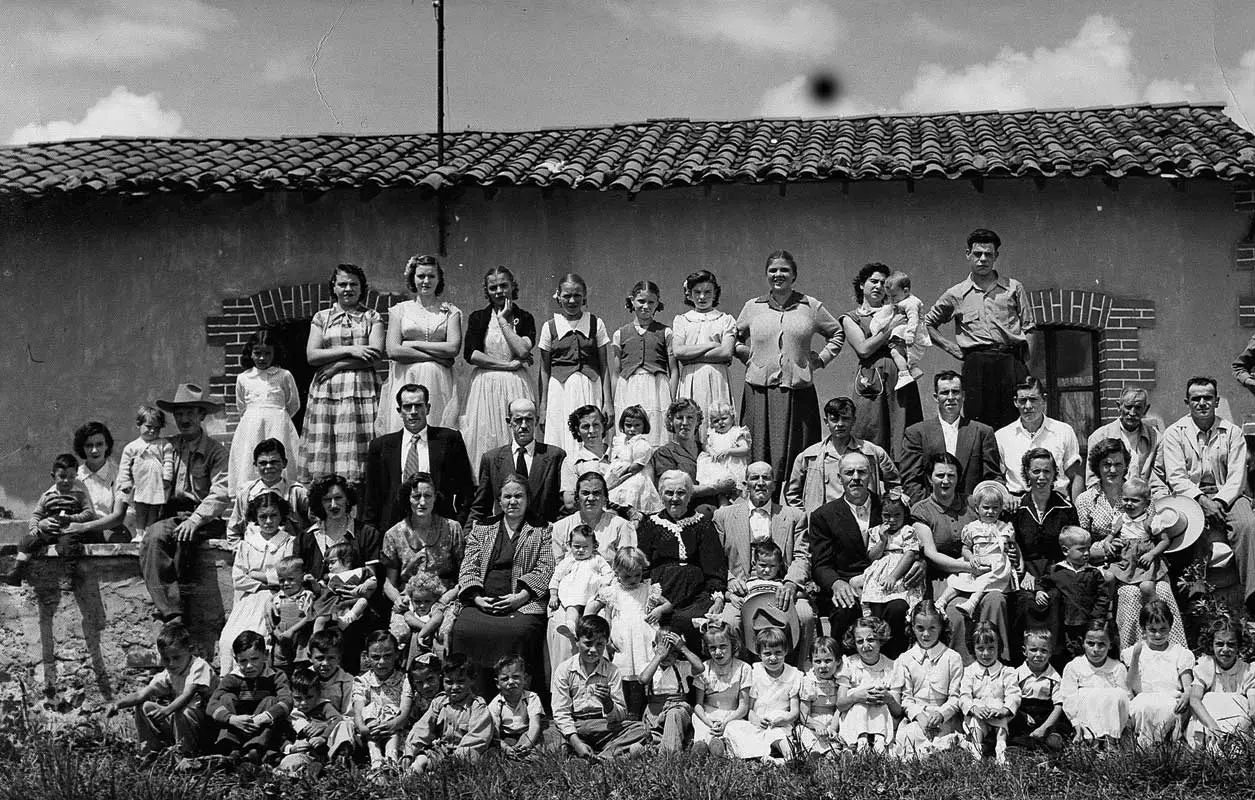
The artist’s work deals with worlds in extinction, cultures crushed by the weight of progress and change. There is an unavoidable element of nostalgia in some of his pieces, but at the same time, this is work that thrives in the last breath of vanishing traditions, ideas, and peoples. In some former works, notably his book The Witches of Tepoztlán, Helguera fuses history and fiction, creating playful and confusing narratives and re-imagined realities. But Helguera can also transform himself into a documentarian, an ethnographer, a sociologist, and a geographer. Here he does so through three videos dealing with the disappearance of cultures. The first, Chipilo (2008), is a series of interviews with members of the Italian community of Chipilo, Mexico, descendants of the immigrants from northern Italy who were invited by the pre-revolutionary government of Porfirio Díaz in 1882. In an effort to populate some areas of Mexico, the dictator, well known for his obsession with everything European, intended to change the genotype, enrich the culture, and improve the economy of the region. These Veneto speakers are the remains of a failed utopian social experiment, a somewhat benign one if you compare it with other mass mobilizations in history. The community remained isolated as a population anomaly and never fully adopted the national identity. The story of Chipilo intertwines with the Revolution because the relatively affluent community was attacked in 1912 by presumed rebel forces. Chipilo was, in a way, a victim of geography because it is located in what was a vital area traveled by troops and rebels. The video Marie Smith Jones (2008) is an interview with the last native speaker of the Eyak language, historically spoken in central Alaska. Ms. Smith Jones, the last full-blooded Eyak died on January 23, 2008. Another victim of geography, the Eyak language was under pressure, even before the arrival of Europeans to Alaska, by the migration of the Tingit people and the Alutiiq people. It‘s a very powerful sensation to see the last survivor of a culture fade before your eyes. The third video, Watervliet (2007), documents the history of the first Shaker settlement in America, located close to Albany, New York. Shakers have almost disappeared but their traditions, besides their pacifism and their hardcore belief in total celibacy, are considered closely linked to the core of the American identity.
Helguera’s efforts in cultural preservation are not the transparent work of a straightforward social scientist, but an artistic reflection on meaning, memory, community, and loss. Besides his research and factual approach to the subjects that interest him, Helguera has included a selection of his subtle, elegant, and moving collages dealing with dépaysement, maps of places, ideas, artifacts, and people that syncretize feelings of otherness, Saudade, and exile, sensations that the Mexican-born artist seems to know all too well.
NAIEF YEHYA