
The Fort Lauderdale Museum of Art presented Pablo Picasso CERAMICS / Carlos Luna PAINTINGS between October 2008 and February 2009. Some insisted on seeing this show as controversial, an attempt to place the work of the contemporary Cuban artist on the same standing as those by the avant-garde master. In truth, the exhibition curated by Annegreth Nill was a magnificent opportunity for the museum to display fifty artworks from a sixty-six-item collection of Picasso ceramics donated to the institution by the hotel chain magnate Bernie Bercuson in the early 1990s, selected by Luna himself (as Artist in Residence at the MOAFL in 2008-2009) following criteria based on the thematic connections between the Malaga-born artist’s serial ceramics and his own large-format paintings.
But above all, it was well-deserved recognition for an artist who, despite his relative youth, displays a notable artistic maturity, derived from his intense creative activity centered around the exploration of a highly personal visual discourse rather than a slavish adherence to the latest fashions in the art market. Therein, in my judgment, resides the show’s greatest significance, because, beyond the curatorial concept (which justified the pairing of both artists’ works on their evident thematic and symbolic coincidences), Carlos Luna is an artist of Modernist vintage, a kind of “neo-Modernist” in the postmodern age — or altermodern, according to the new definition launched by curator Nicolas Bourriaud at the most recent Tate Triennial. This is due to the way he carries forward his artistic practice, attached not only to classic materials but to a conception of style that in a way replicates the Modernist way of composing and conceptualizing in the visual arts, where creation is primarily a pretext for the exhaustive investigation of form and color, while his theme and content function more like a support, a backdrop for the exercise of formal excellence. The elements in his compositions are distributed in space according to the classical Golden Rule, and achieve impeccable feats of balance built like filigrees of small shapes that act as a background for the main figures, whose volumes are assembled in metallic-looking (Cubist?) planes that in some cases are resolved in cold hues and in others in warm ones, which regularly reflect the color of the surrounding elements, following the techniques of the great pictorial kitchen: layers of meager color on grease, scratched, scrubbed and painted over until they reach that magical density that characterizes the painting of the Renaissance.
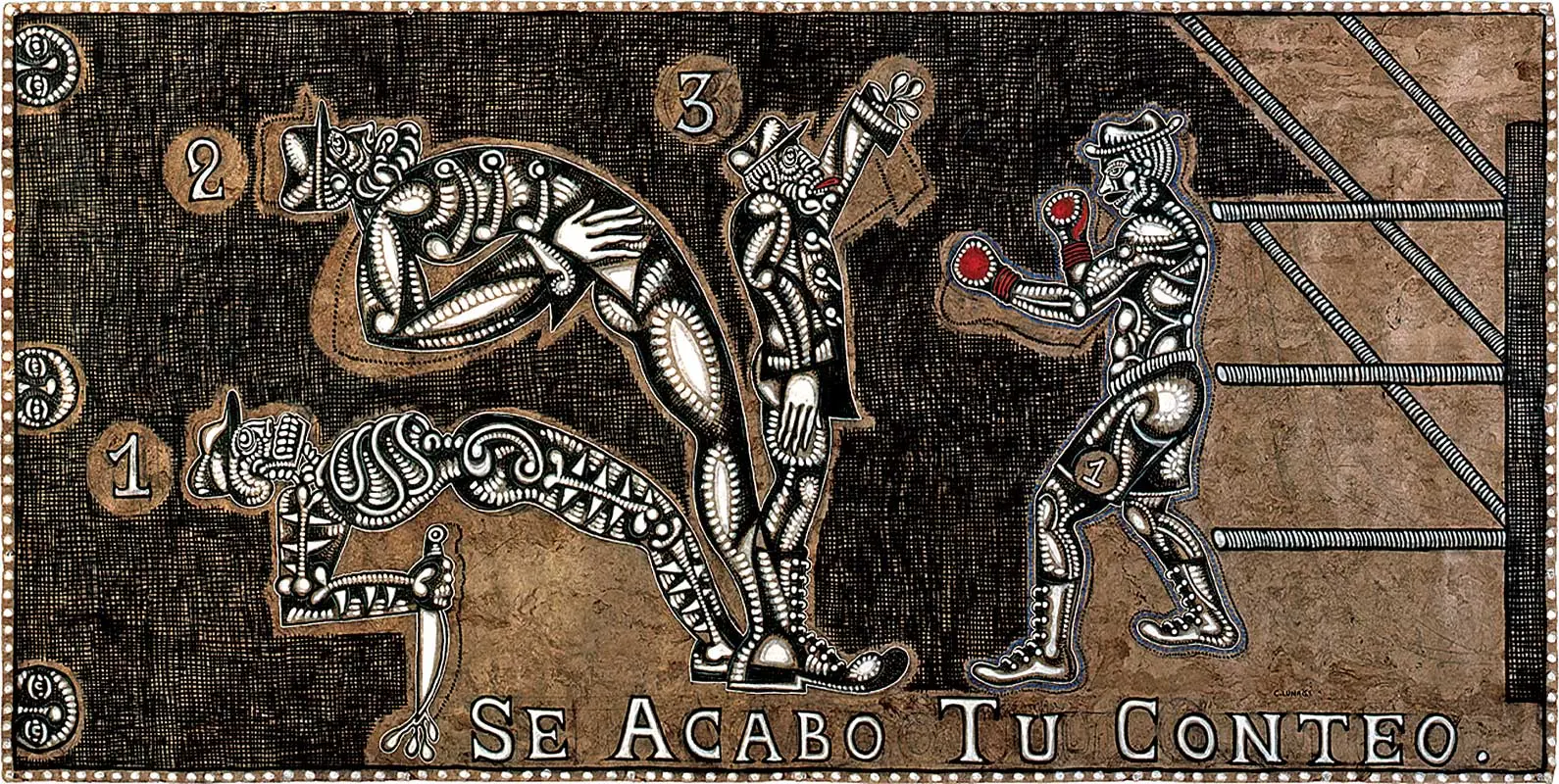
Luna’s works are hyper-Baroque tableaux that perfectly embody the Latin visual taste, marked by horror vacui, the irrepressible need to fill every space. At the ideo-thematic level, since the late 1980s his art has explored themes from popular Cuban culture (mostly rural, unlike his cohorts’ dominant urban topics) by means of a visual narrative that mixes the vernacular with eternal universal archetypes such as sex and death; or themes derived from his experience as an exile, such as the obsessive representation of his island homeland (at times embodied by a caiman); and the iconic figure of Fidel Castro — who has become a veritable taboo for many artists — which he has treated in a rather explicit and bold way, be it as a cut-off talking head or receiving a protective count as he falls backward, knife in hand, after a knock-out blow by the mustachioed character Luna uses to emblematize the people, a kind of contemporary Liborio, a direct descendant of the Juan Pampiro Timbereta created by Cuban folklorist, researcher, and draftsman Samuel Feijoo. Luna’s art also reflects an open connection to Mexican culture (he lived in Mexico for several years after leaving Cuba, and is married to a Mexican national) in the amate paper he uses as support for his drawings, the recursive presence of Aztec symbols such as the skeleton, and his deployment of capitalized oral expressions within his compositions (Aquella pinche circunstancia, Hay manito, Pinche la tuya); although in other instances he mixes popular Cuban speech with English and even Spanglish (Hello Guajira, Latin Lovers, Empingated).
This exhibition included El gran Mambo (366 x 488 cm. / 144 x 192 in., 2006), a mural-scale polyptych that is considered Luna’s masterpiece thus far, not only due to its monumental size but also for the way in which it exemplarily synthesizes his poetics and summarizes his existential, cultural, political, and mystical obsessions — Afro-Cuban religious symbols that appear, more or less openly, in almost all of his works. Thus, although this mambo could be alluding to the popular Twentieth-Century dance and musical genre of the same name, its meaning seems to be closer to the Bantu word to refer to matters, events or incidents expressed in song, a meaning that is emblematic of Carlos Luna’s entire oeuvre: a song to our culture, our life, and our miracles.
RAFAEL LÓPEZ-RAMOS