
How you see the world is not only a projection of one’s values and codes of conduct but also a result of how one understands and places oneself within a matrix. Walking into Rodolpho Parigi’s first solo show, at Galeria Nara Roesler in São Paulo earlier this year, felt a little like walking into a neutral chamber with a free access pass to a handful of gateways leading not too distant exotic lands, but too familiar contexts with dramatic refreshing twists.
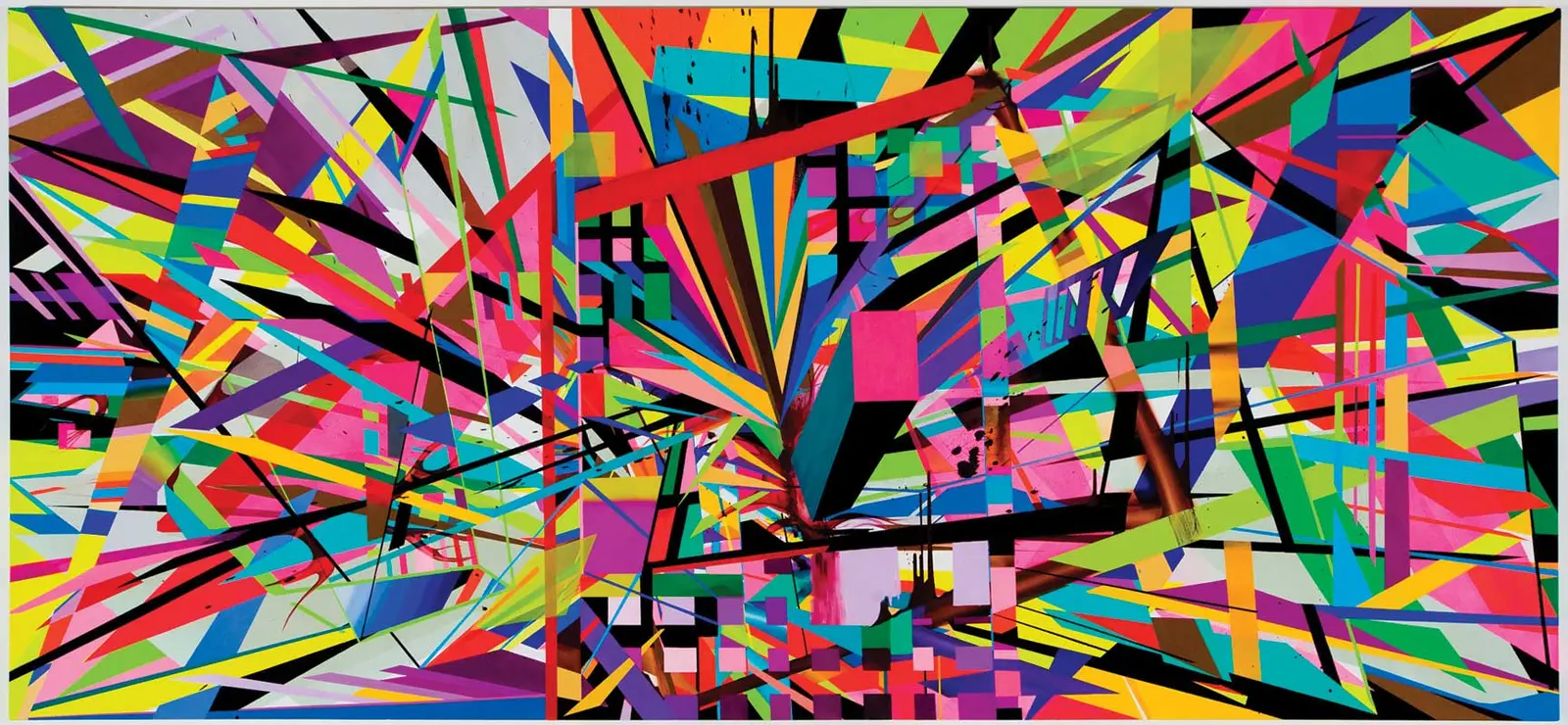
Immediately drawn to the back wall of the main exhibition space, to the 5m wide triptych known as Waves (2009), it was only after taking several steps back, but not too many, that the drawing force and rhythm of the multi-sectioned canvases eased off, making it possible to remove oneself and begin to trace a route through the details – taking in the foregrounds and backgrounds –that make a whole out of the fragments, and what make this more than just a vibrant geometric painting. An image originally generated on the computer, a first for Parigi, and reproduced faithfully, Waves is a painting about painting; precision, layers, transparencies, points of perspective, relationships; dialogues in the paint. But it is also a painting about living. Living in an age where information travels so fast it’s old before you hear the end of it, where images and external stimuli sometimes have an impact long before you’ve even experienced them fully; where impatience is the norm, Waves synthesizes a speedy multi-layered life in urbania, punctuated by gaps. Communicating in a way that depends on an unconscious belief that we are able to predict the next element, what is behind the veil or the waves of consciousness we have in the euphoria of 21st-century life. A life of fragments, a drive never quite fulfilled but believing it’s captured.
Only recently graduated from art school (FAAP in São Paulo), two years ago, Rodolpho Parigi (31) has rapidly become the local art circuit’s object of desire. Not only is his work in the fast lane, but he has also contributed invaluably to the rekindling of interest towards young contemporary painting, along with a group of peers, with whom he formed the 2000e8 group. Parigi’s work exists on the edges of what we recognize and assimilate, of consciousness, on the brink of reality. This is painting constantly reinventing itself, assessing, renegotiating and questioning its nature, course, and surroundings. The most recent oils resemble what could be a fragment of a speedy image captured while cruising at high speed, in a car, in a dream of living in a megalopolis like São Paulo. Inspired in the past by artists such as Franz Ackerman, and Julie Merehtu, today, the impact of Sarah Morris seeps through.
Parigi´s earlier works, a series called Límite (Limit), focused inwards, a sequence of explosive organic forms limited for the most part by the canvas, which contained the single-planed energy from oozing out beyond their frames, an antagonistic parallel with Adriana Varejão, another inspiration to Parigi, and the innards that pour out in her work. The Límites existed in isolation even though their bodily qualities were familiar and accessible, they were also phantasmagoric, but it was their saturated colors however that captivated the eye. In Límite 8 (2007), the only one included in the Concrete Blonde show, the organic forms start a shy dialogue with the geometric, which at this point seems suppressed by the volume and contortions of Parigi’s signature fluorescent pink – pink fluor. The body here is splintered and contaminated with foreign matter, an external force, and influence fragmenting the bulges of bodily life. On the adjacent wall, black and white India ink drawings have the color kept from them heightening the sexual tension through the isolation of the contained energy in the form itself, instead of by the canvas.
Moving through the first room, back towards Waves, gold on black draw the eye into the much more delicate and intricate drawings, which like astrological maps invite you into a calmer more contemplative space, a mystical zone of creation, constantly moving, readjusting. Exercising lines both to trace straight-edged and curved volumes, these hang free in a void, forming a coded matrix negotiating relationships and possible combinations. The counterpoint metadilemas (2009), a series of fluorescent pink and green collages, refer directly to Brazilian artist Hélio Oiticica and his Metaesquemas, Geometric in nature, the sliced out pink in them reveals the acidic green and their absence makes one wonder if they were not thrown onto the canvas, albeit conceptually, Faster Pussycat (2009). It is in Concrete Blonde (2009) however, that the fragments come to ahead. Elements seen in other works are renegotiated here to construct a celebration of life in the metropolis. Architectural forms rise from the pit of geometrics and paint splatters dishevel the saturated color planes heightened by the black; the layers and transparencies evoke a world of computer-generated images and speedy interactions absorbing splinters of life and rearranging them in a matrix, questioning the structure and essence of life and of painting.
CAMILA BELCHIOR