
The second individual exhibit in Paris by Sergio Vega (Buenos Aires, 1959) – following his first exhibition in the French capital at the Palais de Tokyo, in 2006 – is titled Parrot Theory. It consists of a group of works that include videos, drawings, digitalized photographs, and site-specific objects and installations. This new proposal by Vega is part of the exploration in which he has been immersed since 1995: themes associated with Paradise Lost, inspired by a text by Seventeenth-Century Spanish chronicler and historian Antonio de León-Pinelo, who placed the Garden of Eden in the Center of South America.
While the myth of Atlantis has existed from the time of the Greeks, it was really during the Middle Ages with the discovery of America that Europeans began to associate it with their imagined New World in the form of the utopic El Dorado (Spanish for the Golden One). The European transposition of their imaginary and their fantasies into the New World (myths, chimeras, monsters, etc.), and the “magic” of the Americas that was generated as a result of this displacement gives way to a stereotyped and exotic legend that has won over many writers and painters even to the present day. Seemingly serious in his approach – an attitude that in itself is an object of ridicule – Sergio Vega mixes things up and not without humor: he rehashes an archetypical image that embodies the European desire for exoticism – the parrot – and utilizes it as an emblem to announce the historical awakening of the South (and its domination over the North). By relying on scientific and literary texts, by transforming the parrot into a central element of the plot, turning it into the symbol for victory (in contrast to the Eagle, which stands for imperial domination), Vega develops an intellectual and aesthetic narrative around the “fetished” figure of the Parrot. This proposal may appear to be ambiguous, because the Argentinean artist retraces the route traveled by the discoverer – but in the opposite direction – seizing one of the most overexposed and abused icons that exist in this colonizing quest for exoticism. But this is a parody first and foremost, in which the image-cult of “submission” by the colonizer this time around is transformed into a “weapon of reconquest” by the formerly colonized. Sergio Vega deconstructs, reconstitutes, speculates, criticizes, and demonstrates using irony. Is it possible that through this theory of the impossible he is actually able to reclaim the “paradise lost”?
At the center of the exhibition, the pretense of a “Parrot theory initiation curse” titled Parrot Theory is a handwritten text on three classroom blackboards. It articulates conceptual and historic arguments articulated in connection with three concepts: color-mirror-language, underscoring the dialectic that unifies these three fields that according to the artist represent the parrot’s identity. Equally serious and extravagant, Vega’s proposal is nevertheless stimulating and full of inventiveness in relation to the role of artistic creation and also, perhaps by extension, to art in Latin America.
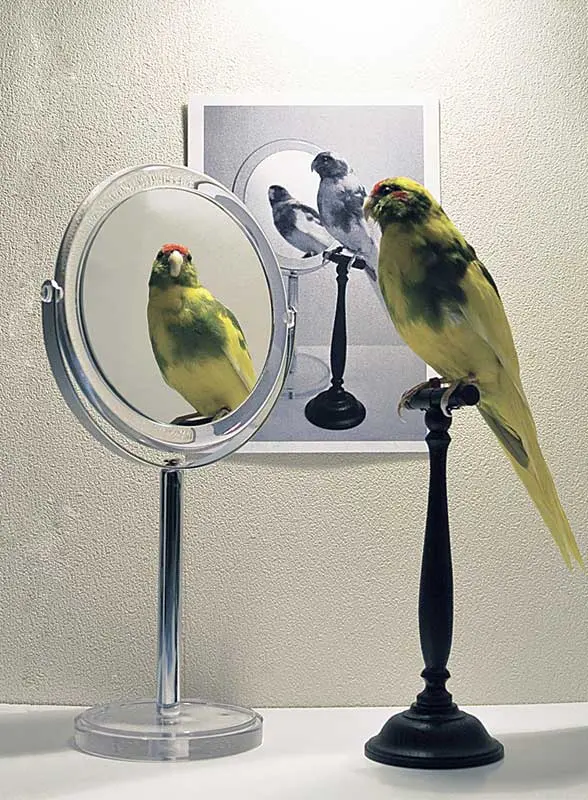
Sergio Vega is not content with simply pointing to the first consubstantial characteristic of the parrot’s mimetic nature. He expands this to culture and ideology and makes these new dimensions the core of his imaginary thinking. Vega speaks of the “parrotification of culture,” the “victory-parrot,” or the “parristic strategies.” In this play with words and meanings that he visually concretizes (because for him, visual sensations can generate interest in the concept), it is perhaps necessary to turn oneself into a sort of “chameleon” and admit – from the perspective of this ludic and reflexive exercise – that any change can be reduced to simple repetition. Because everything is subjected to mimesis, the parrot must be placed inside a mirror effect (El Loro de Borges [Borges’ Parrot], photographic montage, mirror, stuffed object, 2009, 30 x 18 x 14 cm) before being reincarnated, partly, into the Winged Victory of Samothrace, which exchanged its traditional wings for the feathers of a flamingo (La Victoria Post-Colonial, 2009, acrylic on resin, 53 x 30 x 24cm). With regard to the photograph, this copies itself in a series of impressions with gushes of ink in Parrot Color Chart # 2, 3, 4, 5, 6, 7, in which Sergio Vega faithfully reconstructs each pixel, coloring the parrot’s feathers as the artist re-transcribes the colors into a pictorial geometry reminiscent of Mondrian. In the video Genesis According to Parrots (2005), Vega readopts a biblical discourse to transform it to fit the discourse related to the parrot.
This renaissance of Latin American culture incarnated in the parrot metaphor had already been approached by other artists with different words and images. Joaquim Torres-García did so in his famous drawing Nuestro Norte es el Sur (Our North is the South, 1936), as did Alejo Carpentier in the prologue on Magical Realism included in his novel The Kingdom of This World (1943), and more recently, Roberto Matta, with a series of etchings inspired by Mexican codices titled Le Verbo Hommerica (1980, portfolio of 6 black, white, and gray etchings, published under the same title), just to mention a few. Sergio Vega approaches the dismantling of a world in which repetition and individualization – themes of globalization – have “deserted” nature and humans. The palpable, colored, and complex image of the parrot he proposes must bring about a “rematch” in which nature wins over the supposed Savior Culture established by Colonization. To Vega, this tropical bird is an “allegory of the post-colonial avant-garde.”
CHRISTINE FRÉROT