
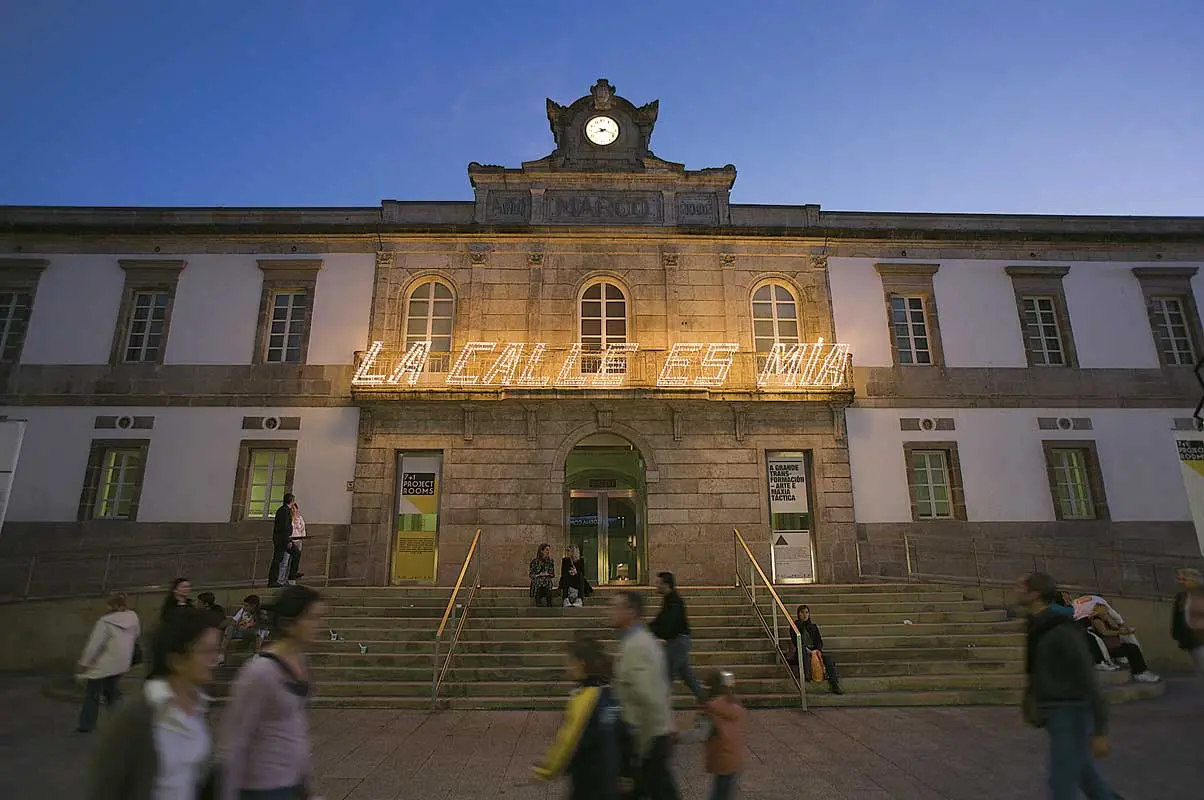
“The street is mine” reads a neon sign at the front of the old Palacio de Justicia and jail, transformed today into the Museo de Arte Contemporáneo of Vigo (MARCO). This slogan mobilizes a statement of today’s art that seeks, as in the 1960s and 1970s, to free itself from the constraints of the white cube with site-specific works. The irony is that the phrase was uttered in 1976 by Manuel Fraga Iribarne, Vice-president and Minister of Government, and, appropriated by Spanish artist Fernando Sánchez Castillo (Madrid, 1970) it is contextualized into a new situation, within institutional parameters.
And this situation, paradigmatic to today’s art, demonstrates the ability developed by art institutions to re-locate themselves to space from which it is possible to exercise critique and to seek new experiences closer to the viewer. 7 + 1 Project Rooms, curated by Gerardo Mosquera and produced by Vigo’s MARCO, fall within this trend to adjust artistic discourses that were otherwise contestational or experimental in their original context, into an assimilable presentation for the general public.
The very idea of the “project room” makes it possible to use space intelligently for the curatorial intent of presenting a solo show by each artist with a “free and experimental spirit,” as part of a collective project.1 7 + 1 ends up being 9, since, independently of the free and theme-less curatorial “intervention, it signals a tendency towards a kind of art and curatorial practice. Mosquera says, “Although the artists selected come from different countries and possess different poetics, experiences, and ages, they share an inclination to debate social issues (politics, power, violence, matters of gender, the urban environment…) and at the same time to investigate art itself, its resources and morphologies, as means to build and deconstruct complex meanings.”2
The ground floor of MARCO has a panoptic design where the old independent prisoner cells, alternating with patios, radiate from a circular scrutiny and control space. The work of Mónica Bonvicini (Venice, Italy, 1965), surprising in its evocativeness and tension, was placed here. Identify Protection (2006) demonstrates the artist’s mastery of architectural space, by re-situating six leather harnesses hanging in a circle that evokes bodies. Highlighted by incandescent cold-light tubes suspended in the center from a jumble of chins and the use of industrial materials, their simplicity reinforces a potent metaphor for our bodily relationship with the environment. The shining vinyl surface used to cover the wall returns our reflection in a funhouse-mirror effect, while we are taken by surprise by the harnesses’ spasmodic motion.
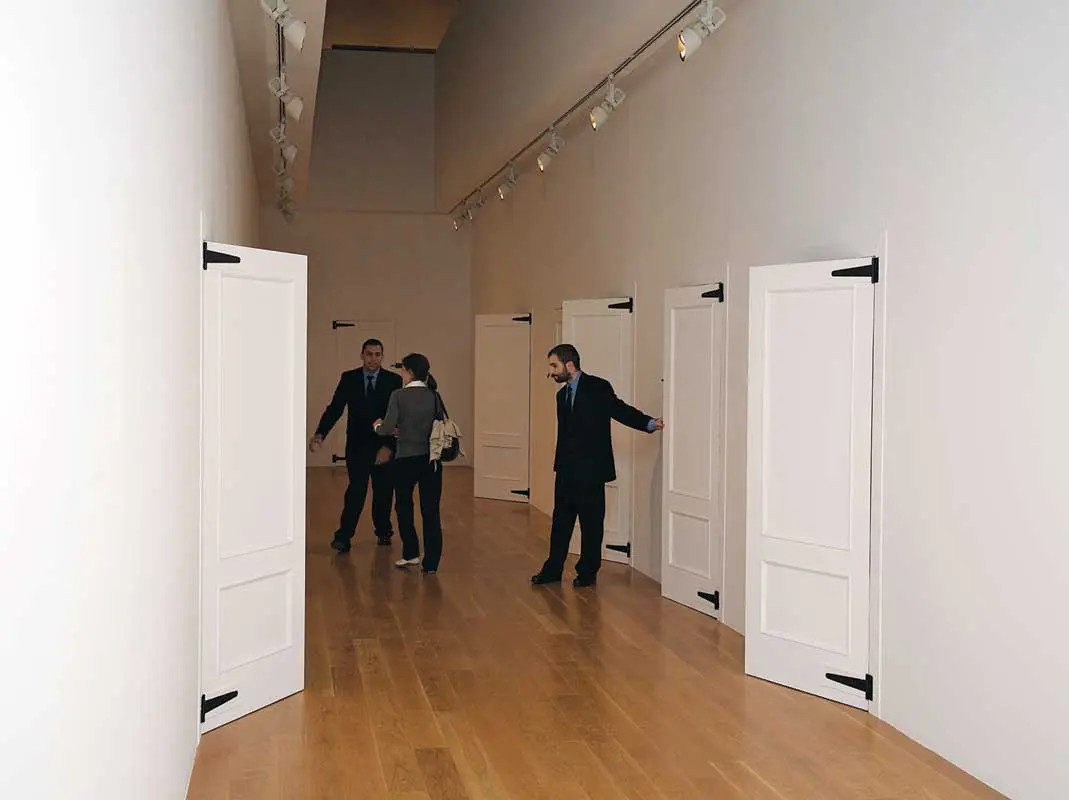
That relationship with the experience of the body in space and the meaning of architecture is brilliantly resolved in an installation by Tania Bruguera (Havana, Cuba, 1968). Her appropriation of art’s formal discourse (installations, performance, or what she termed behavior art) allows the Cuban artist, in Trabajo socialmente útil (2008), to give new meaning to the architectural space and create a powerful metaphor for the use of power at the symbolic level, through the viewer’s physical and psychological experience. In one of the galleries, formerly a group of cells for prisoners, ten spotlessly white doors open up to spaces that are claustrophobic and dark to our unaccustomed eyes. Each one of the “cells” represents a historically known political prisoner who “inhabited” it. A blind “guard,” wearing the proper uniform, opens for us whatever door we choose and locks us inside, one minute for each year the prisoner spent without freedom. Inside, the only furniture are a chair and table. On the latter awaits a book written by the character. Bruguera has referred to this work as an “experimentation with the idea of visibility. I want to create a direct relationship between what we think is the non-vision of the blind (which we think of as darkness, an absence of light, a black space) with what the viewer will experience (darkness, absence of light, dark space…) As if we were entering the non-vision of political power, but instead of imagining it we are experiencing it because the viewer will have to find her way in those conditions for a pre-established amount of time.” 3
Each installation provides a different experience for the viewer in the modified spaces, be it by making them feel immersed in the work or by its spectacular stagecraft. Under this premise, they force us to shed our shoes in order to traverse the enormous space, white-carpeted and lit only by a display case containing a small object: a match. The Terrorist’s Apprentice, by Kendell Geers (South Africa, 1968), overwhelms us with its simplicity. But we are even more impacted by the violent images in his video T.W. (rock) (1972), where a group of people lynches an individual while we hear, through headphones, the drowsy voice of René Magritte speechifying about art. The sensation of emptiness, the vertigo of the images, and the indifference of the world all question the role of art in the face of violence.
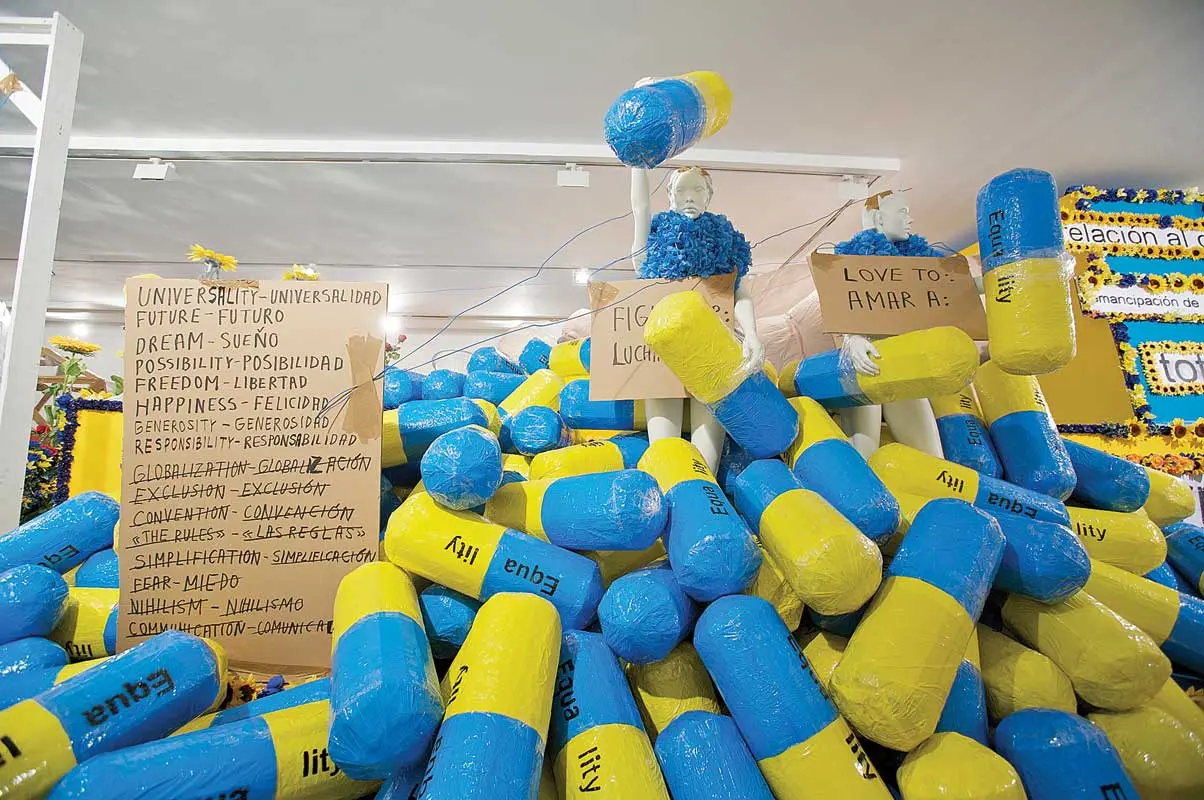
Another highly staged work is Equality Float (2008) by Thomas Hirschhorn (Bern, Switzerland, 1957). Commissioned by MARCO Vigo, this spectacular piece is a veritable kitsch carnival that mixes plastic flowers and chairs with mannequins, disco balls, a giant pair of hands-on each side holding a medication capsule, and advertising billboards precariously built-in papier mâché. Known for the structure of his fragile works and for his philosophical referents, Hirschhorn creates a float/monument to the contemporary world, its debate centered around the in-equality and duality of language and action, symbolized by the number of giant bicolor (yellow and blue) capsules inscribed with the word “equa-lity.” Building on his experience as a graphic designer, Hirschhorn’s “scaffolds” become a platform for political, social, and cultural commentary.
Equally impactful is the ready-made presented by Jorge Perianes (Ourense, Spain, 1974) a mountain with living flora that is characteristic of the Galician landscape, resting at the base of which we find a cleanly cut fragment. The literalness of the citation forces us to rethink our relationship with the landscape and to wonder how much does economic and cultural colonization influences our perception of it.
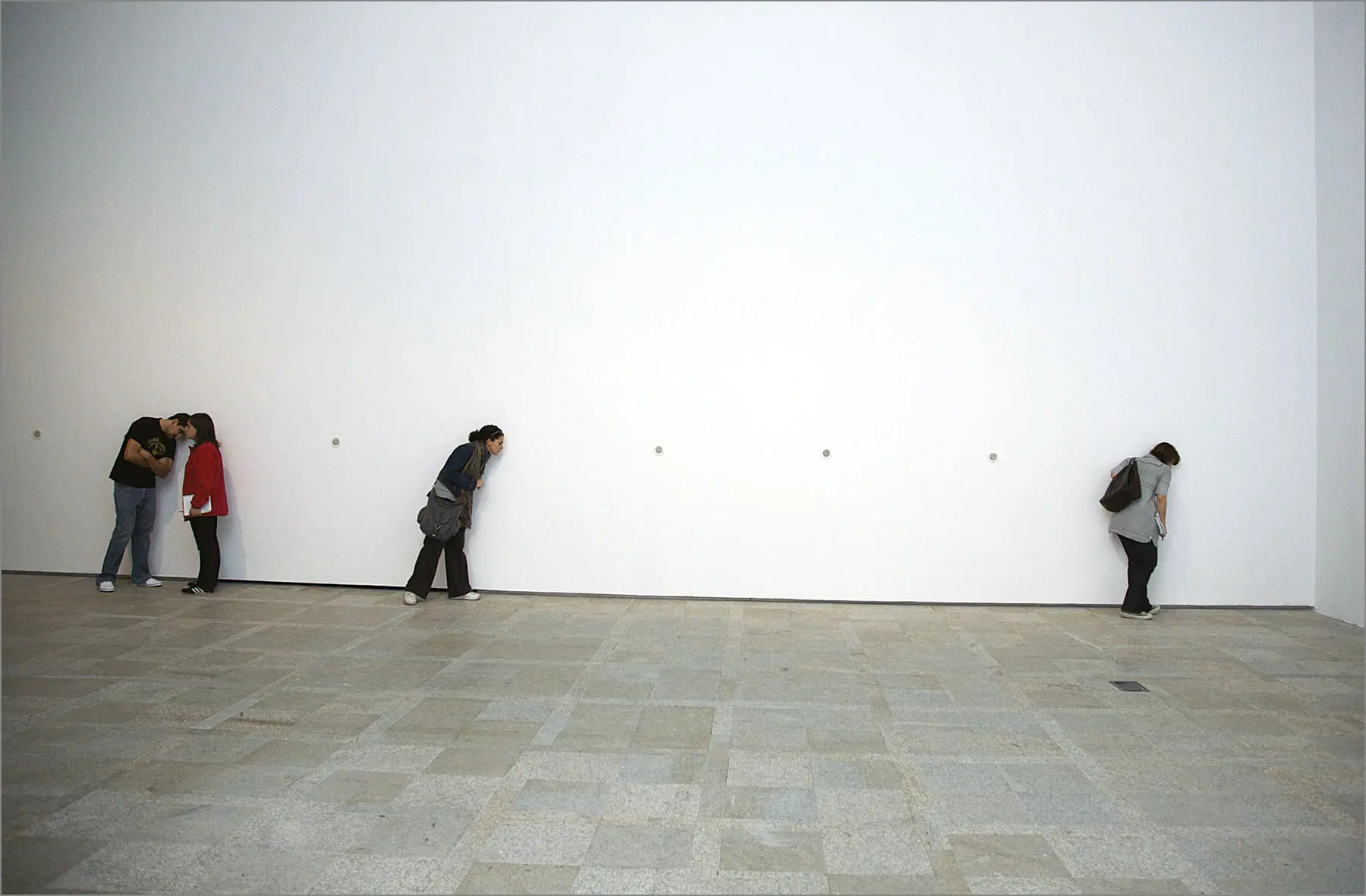
But not everything is as grandiloquent or visually overwhelming as the installations just reviewed. In the simple yet no less impactful work of Teresa Margolles (Mexico, 1963) a line of 24 discretely placed speakers on a white wall force us to bring our ears close in order to hear everyday city sounds. Margolles has recorded the echo left in locations where the corpses of murdered women were found, with the victim’s name and case number she places on the wall. The presence of death in anonymous sites, sites that are unknown yet familiar to us, point to the vestiges of violence there where it was committed.
The various typographies projected as flash animations and with a Jazz soundtrack by the duo known as Young-Hae Chong Heavy Industries (Young-Hae Chang and Marc Voge) also speak of violence. The End is the halting last dialog of a couple that ends in physical aggression, suggested only by the sequence of words and the emphasis of the typography. A true exercise in economy of means (their projects are designed for the Internet) with extraordinary visual effectiveness.
7 + 1 Project Rooms offers something more than a listing of well-known international names. It is an exercise in the selection of works of art that fit MARCO’s particular space, which, without establishing an argumentative line, becomes thus a kind of Babel of this interconnected world, where nothing can be alien to us.
NOTES
1. From MARCO’s press release describing the project’s curatorial parameters.
2. Mosquera, Gerardo. Curatorial text for the catalog (work in progress.)
3. From the exhibition information displays that accompanied and explained Tania Bruguera's works.
DERMIS PÉREZ