
In the October 2008 exhibit titled Del Trazo al Volume (From Trace to Volume), we witnessed an essential transformation in the work of Agustín Bejarano that had already been in the making for some years. But particularly in the aforementioned exhibit, his transition from two-dimensionality into the sculpture/installation universe and the inherent change of spatial dimensions that this represented, revealed an artist who is otherwise mindful and willing to renovate his aesthetic approach periodically, as he is always open to new experiences to guide his artistic trajectory. His new individual exhibit, titled Sedimentos (Sediments), is running concurrently with the 10th Biennial of Havana (CENCREM, March-April, 2009). On this occasion, Bejarano presents a large number of three-dimensional pieces, the majority of which were created to interact harmoniously and intelligently with the site’s environment. But there are another two characteristics that single out Sedimentos and confer upon it an additional appeal: on the one hand, the inclination that the artist demonstrates for unconventional, atypical materials and supports such as resin, bagasse, fiberglass, and cow leather, among other everyday materials that are re-contextualized here and given a new meaning; on the other hand, there is the quasi artisan stamp in the rendering of the works and the influx of popular art in the operatives employed. Thus, textures acquire vital importance in this group of works, as these flaunt numerous protuberances, depressions, and projections. The tactile experience herein emulates the visual universe.
From a thematic point of view, once again humans and their existential conflicts comprise the central part of the stories revealed in the exhibit. The anthropological sense of creation would appear to be a medullar axiological premise in Bejarano’s art-above-everything approach. But to whom is the artist referring? What archetype of a human being is revealed in Bejarano’s work? It is a sort of nomadic little man, always on the move, who does not know of a permanent port. This is an individual whose destiny is defined by his itinerant ways, perpetual movement, isolation, and solitude. Some of the exhibit’s more recurrent iconographic symbols (also present in the rest of the work) lean toward this direction: boats, airplanes, stairs, doors that open, and wings, among other implements that suggest movement and locomotion, which serve this tireless traveler in carrying out his utopias, in consummating his yearning for movement and mutability. It is possible to speak of a sort of antihero who is continually seeking to escape, to abandon. The Exodus. But why an antihero? Are not we those who remain behind…? The line between the heroic and its opposite tend to blur within a context in which absurdity and irrationality border upon the surreal, in an injurious environment that subjugates and deafens.
Nevertheless, at times this self-centered and silent little man wavers, hesitates, second-guesses the actions he is about to carry out. This is evident in the work titled La Tarde (The Afternoon), in which the subject appears downcast, absentminded, immersed in some thought as if he were on a boat amid an alienating stillness. Everything appears to indicate he is not up to the task placed before him, that he is afraid of the crossing. It is difficult to say with certainty; maybe it is simply a necessary instant to gather strength. It is perhaps the lapse leading to the outward journey. In any event, the work is a shrewd metaphor for certain dual, ambivalent (or antithetical) states: The here and there, living or staying, stillness or movement, the island or the sea…The character represented debates precisely such extremes. The key to his future lies in making a decision.
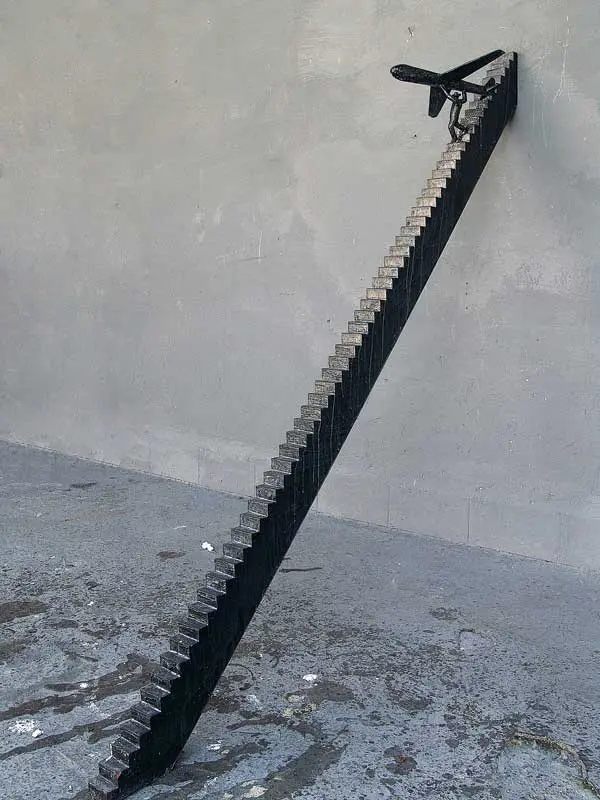
The eagerness to travel has reached such levels that our little man is capable of carrying an airplane on his back and throwing himself down the stairs with it, as illustrated in Bejarano’s work titled Volando a Oscuras (Flying in the Dark). There, the action takes a tragicomedic turn – unwisely executed – that is the result of a markedly paranoid and impotent state of mind. The existing disproportion between the dimensions of both figures places the fact within the dimension of a hobby, a pastime, and therefore alludes to flying as amputation and an implausibility. It speaks of illusions that have been shattered.
The desire to evade does reach more dramatic levels, such as in the case of the work titled Equilibrista (Tightrope Walker), in which we observe the little wanderer on a huge wall, overlooking the abyss. Is this suicide? Just playing a game on high? Our traveler appears to be afraid of many things: of life, of group relationships (we always see him alone), of difficulties at sea, and of the passing of time. This is evident in works such as Alpinismo a los 40 (Mountain Climbing at 40), in which we discover this character immersed in the chimerical job of stopping the clock of our lives. From the beginning, this has been one of Bejarano’s cardinal artistic preoccupations: anguish over the finitude of our existence, in connection with the ungraspable nature of the temporal dynamic. This is surely a character constantly seeking refuge, for ways to escape, which can be the inside of a bottle or of a coffeepot, among many other unexpected and unsuspected spaces; similar to that sort of “black hole” high above in Los Ritos del Silencio CCCXCIII (The Silent Rites CCCXCIII), where the character ascends the ladder standing on his hands with a lighted lantern. As we observe this work – like nearly all other works by this artist in which stairs are depicted – one cannot help but ask where this character comes and where he is going. It is precisely this vagueness and uncertainty that the works confer that makes Bejarano’s work so highly suggestive.
The knife is another relevant symbol in the exhibit. Once again, the play with proportions serves as an indicator of the frailty and vulnerability of the individual in the face of the eventualities and risks that surround him. A really interesting work that illustrates this Sabiduría (Wisdom). It is an installation in which we observe the character reading comfortably atop a huge knife. What does this work insinuate? Is it saying that knowledge rests on the basis of danger, or even worse, of violence and subjugation? Is it suggesting that discernment is the best palliative to compensate for the barbarity of our days? Or, is it implying that on observing such barbarity, the best thing to do is play deaf and occupy oneself with “reading,” while the world crumbles beneath us? From any viewpoint, we are in front of a tremendously sharp and witty proposal that is filled with subtleties and provocations. It is a piece that makes us seriously consider the role of intellectuals in the midst of the complexities of contemporary societies. It is a question of whether we must, in fact, remain in our “glass urn,” or leave the reading for another time and come out fighting.
PÍTER ORTEGA