
The diversity found in today’s art determines, in a way, all interested readings that can be made of such seemingly limitless expanse; yet in spite of this fact it is possible to glean some significant shifts in its direction, balanced against those interpretations that specialists and critics have established as the topics of interest for contemporary artists. In the specific case of Latin America, with the topic of the city as a site of permanent confrontation, de-territorialization, and exclusion having been extensively revisited, artists seem interested in quests that take them away from the reiterated notion of identity and gamble instead for the construction of new paradigms. That project reveals once again the presence of knowledge as a guide for the creative process, as support and foundation for contemporary conceptualizations. This intent was clearly on display in Alfredo Ramírez’s latest show, February 12 through March 25, presented at the Centro Cultural Chacao — an alternative space in Caracas— under the title Hilo de liebre.
With a recognized twenty-year career of continued, insightful work, Ramírez has deepened his commitment to systematic exploration in art. His work in recent years reflects a direction and follows precise ideas. From a persistent study of the human form, which allowed him to understand it as a whole, as a topological form distinct from a scientific analysis that sees it as a sum of systems, the artist moves forward on a more complex path, exploring the realm of physics and the exhilarating territory of the human mind. Similarly, he turns to the past in order to verify theories or rediscover guiding laws. This amalgam of interests, needs, and experiences converges on the works that comprise the present show and signal a shift in direction but not in the artist’s proposed intent.
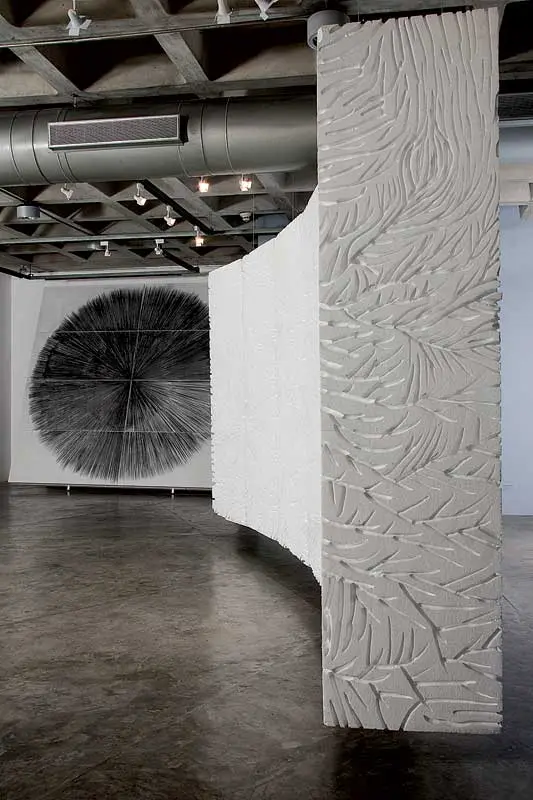
The Centro Cultural’s small exhibition area held just five works in different formats and a variety of materials, a visually interesting selection that articulates perceptual relationships with space. Space expands with the same force that seems to flow from Linterna 120, 2009, graphite on canvas, a large cone seen in projection, a convergence of lines on a point that is origin and end of their respective trajectories defining its “reading” and molds its aesthetic impact beyond the original intention. As the artists explain, it results from a personal analysis of the big bang, to which all physical phenomena that determine reality necessarily connect, and which, in consequence, governs our existence. In the end, it is a question of establishing relationships of proportionality and regularity.
With Hieronymus Albrecht, graphite on canvas, 2009, Ramírez connects through their first name two characters who were contemporaries and share a looming presence in the history of art: Jeroen Bosch and Albrecht Dürer. The interest is centered on the Golden Ration, investigated by both Bosch and Dürer and reinterpreted by Ramírez from a contemporary standpoint. His triptych proposal takes into account the structural aspects of The Garden of Earthly Delights, and the result is an abstract work where the orthogonal relationships and the various directionalities that complement them produce a new approach that can be understood as constructivist in kind.
1274-27.5, 2009, can be recognized as a key work in the exhibition, given its dominant presence. It combines a series of features that give it such character: format, materials, technique. Its organic formalism and moderate expressive value remind us of Ramírez’s pictorial work from some years ago. And what we could call the work’s integrity, the reason why this work was created with these elements, summarizes the artist’s creative trajectory: a personal history that is re-interpreted in sustained practice and in the same way rebuilds, under new paradigms, experience itself. In sum, the object becomes the axis of the conceptual discourse that shapes the exhibition and the spatial order that regulates it. The answer offered by this work points towards codes and processes that reveal changes and transformations in living organisms. Ramírez’s recent work is articulated on the basis of intently observed and studied models, and as the artist points out, “these models are supported on the calculus of proportions that serve as their regulating structure as they grow. The size of each is limited by a moment relative to those proportions so that the models could eventually have minimal or giant dimensions.”
FREDDY CARREÑO