
Allora & Calzadilla’s Stop, Repair, Prepare (2009) at Gladstone Gallery examines the contradictions between collective optimism and individual cynicism. A hybrid with roots in performance, intervention, fluxus, and happenings, the work focuses on the potent combination of aesthetic form, critical synthesis, and empirical experimentation. The first and only material object one sees in the gallery is a performer standing in the middle of an early 20th century Bechstein piano, playing variations of Beethoven’s Fourth and Ninth Symphonies, followed by the choral finale, Ode to Joy. Allora & Calzadilla hired various musicians who play standing, upside down, and backward, alternating throughout the exhibition, each performance lasting for about 50 minutes. The piano was reconfigured by a specialist from Berlin, Ben Stallman, who cut a hole in the piano, removed the middle strings, and shifted the foot pedals, placing them backward in order to be accessed by the performer from inside the piano. With the strings removed, the performer uses the disabled keys to create rhythmic percussive sounds during intervals.
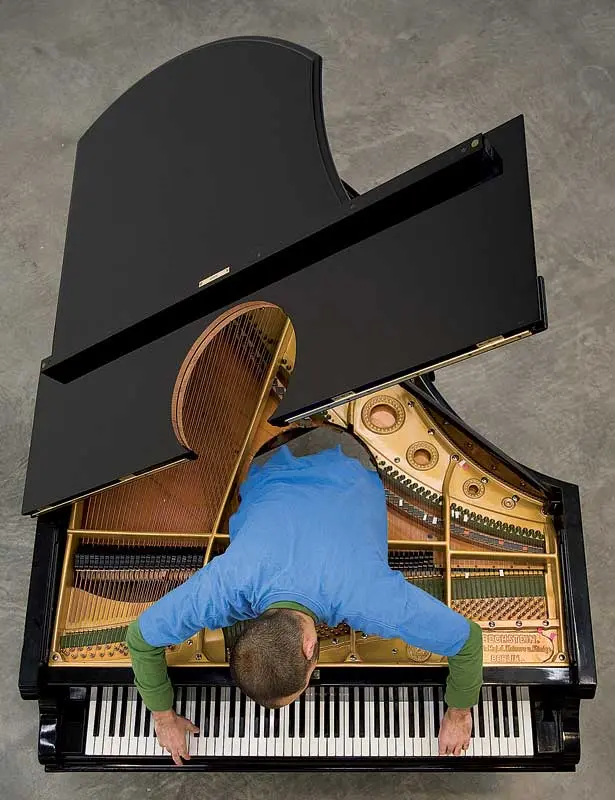
Allora & Calzadilla’s emphasis on fragmentation, from the formalism of the cut-up piano to the variety of musical performances, alludes to the holes of collective nationalisms associated with various political histories. The selection of Beethoven’s Ode to Joy as the audio component of the piece comments on the diverse and contradictory histories associated with the anthem. Based on an ode by the German poet Friedrich Schiller, it celebrates an ideal of unity and forgiveness of all mankind. In 1938, the piece was performed as the high point of the Nazi music festival, and was later used to celebrate Hitler’s birthday; in 1985, it was adopted as the official anthem of the then European Community and was performed when the European flag was raised for the first time in front of the Berlaymont building. Ode to Joy symbolized the fall of the Berlin Wall in Leonard Bernstein’s 1989 production, and since 1993, it has served as the anthem of the European Union. In Taiwan in 1996, the anthem celebrated the people’s victory during the inauguration of the first democratically elected head of state, Lee Teng-hui.
The piece takes on its own significance at Barbara Gladstone Gallery as the performer pushes the wheeled piano throughout each room of the gallery. The anticipation of collective motion led by the piano on wheels mocks the very ability of engagement that the music portrays. Interactive works, as in the case in Stop, Repair, Prepare, do not intend to amuse or entertain, but to provoke, creating tension and chaos. In conventional musical performances, the audience sits on demarcated seats, offering clear views of the performance. In Stop, Repair, Prepare, the lack of demarcated spaces is crucial in its critical engagement with the audience, as it enables a sense of dialogism, of the carnivalesque, resisting the monological idealism of the meaning of the music. The audience must become complicit with the performance, listening while not always seeing, walking while not always participating, experiencing but not always fully engaged. Is this what is expected from the viewer? Must viewers engage in the optimism of brotherhood that the music expresses? Or must they parody their own sense of the collective? The politely moving audience at Barbara Gladstone is merely driven by appearances, like a stretched rope ready to split.
Here, both the interactive experience and the so-called art object are determined by necessary inconsistencies, inconsistencies that are produced in our own cultural models. The shifting object of art is always at the intersection between the piano and the performer, between hearing and viewing. This uncertainty of the object is also that of the subject, the individual in the midst of the collective. Collective ideals of brotherhood only remain viable on the level of appearances, or on the other hand—when appearances are no longer needed—on the level of catharsis. Here the choices are regulated by contradiction: Can one endure being burdened by discomfort in one’s own choice of space, or should one become more open to losing oneself in the organic mass? The trap then is that pessimistic individuality cannot be separated from collective optimism. As the viewer, the performer is also in a state of impasse: not knowing whether he embodies the instrument or is locked inside it. Regardless, he endures, playing upside down and backward, showing a sense of ease, a detachment seen in contortionists. He keeps busy, playing variation after variation. He obviously knows his music. But how many viewers can indeed understand the music? Judge the performer’s performance? Can one listen to music without making an aesthetic judgment? And yet, if not to be judged, can one perceive real meaning behind the volume and rhythm, intensity, or playfulness of these heroic songs without identifying them? Knowing their history? If so, the audience is inadequately knowledgeable, if only for the sake of appearances.
DENISE CARVALHO