
Under the sway of Igor Stravinsky’s music, artist Amalia Nieto and musician and writer Felisberto Hernández wrote a chapter on art and love in the River Plate’s most generous bank, in Uruguay, away from Old Europe where the Petruchka Suite (1921) was conceived in three movements for piano written by the composer on a commission from Arthur Rubinstein and which, inevitably, harks back to the images of the ballet that originated: Petruchka (1911).
Cartas a Felisberto is a delectable selection of works by Amalia Nieto (Montevideo 1907-2003), comprised of over one hundred vibrant watercolors and drawings that the artist painted on or attached to her correspondence with Felisberto Hernandez (Montevideo, 1902-1964) between 1935 and 1937, sustaining their romance while he traversed as a concert musician every corner of Uruguay and locations in Brazil and Argentina. The series, exhibited at the Centro Cultural de España in Montevideo and covered by an irresistible romantic patina, suggested pleasure in ideas and emotion in color, form, and line.
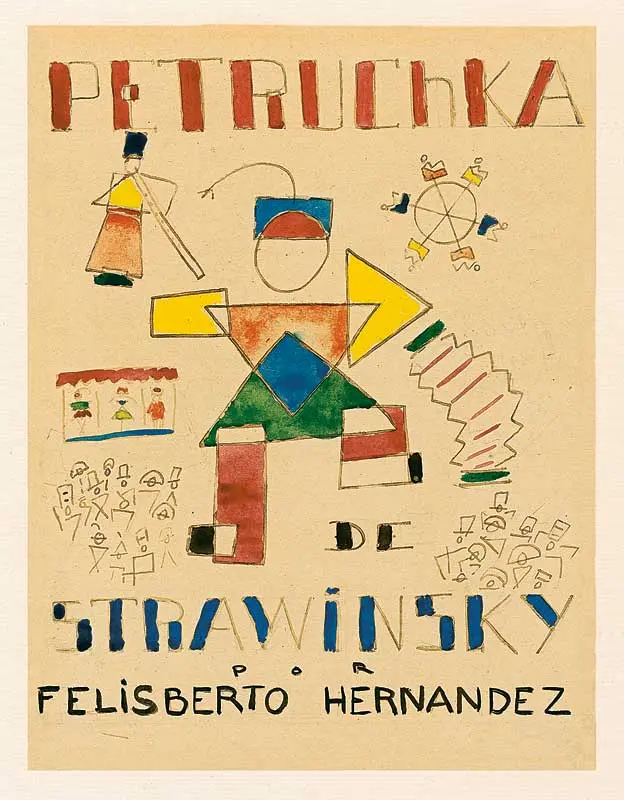
Despite the colorful chords and the festive ambiance that surrounds a good portion of the Petruchka Suite, it ends on a sad note. The character of Petruchka is a marionette that falls wildly and impossibly in love with Ballerina, who in turn is wooed by The Moor.
The watercolors and drawings in Cartas a Felisberto display the constructive and emotive mark of the Kazimir Malevich of the 1930s, a preview of which had already been seen in 1914 at the Independents Salon in Paris. It is evident that, during her first Parisian sojourn between 1929 and 1931, Amalia frequented the subtleties of the avant-garde, of modern art, through her teachers (some ascribed to fauvism or cubism, emerged respectively in 1905 and 1907) at the Grande Chaumière Academy and André Lhote’s workshop, and she was familiar with Russian geometric abstraction.
Nieto creates simplified, brightly colored, heart-tugging figures using assertive and at times jagged, simple lines that peek into geometry and traverse certain forms of abstraction and figuration. Pirouettes and certain magic in the small figures of the three central characters, alongside the flute-playing magician, are surrounded by the colors of a festival and the features of a small-town celebration.
Fantasies and construction exercises in these works “came out of the letters,” as the artist put it in an interview. Primary colors are dominant (as opposed to the grays, ochres, and pinks she would use later) in Amalia’s visions, where we intuit faces, couples, trapeze artists, clowns, ships, fish, still lifes, flags, houses that are painstakingly crafted and re-crafted.
But not all the illustrations center on Petrushka, even though the puppet’s face appears time and again. Included in this essential show are her well-known Homenaje a Felisberto Hernández (1936) in carved wood painted with oil, alongside Composición (1941) a painting that shows clear reminiscences of her passage through Estudio 1037 and the Asociación de Arte Constructivo, where she studied with the master, Torres García, who was also a friend. It was precisely Torres García who said, of Amalia Nieto’s work, that it “…attempted geometric art from a distance, and if she didn’t give herself to it, it was because the seductiveness of reality and the poetry of her inner vision made it impossible for her. Her spirit took something from every one of those essences in order to create art that is her own. And this is the art we can contemplate today.”
In a separate section, several displays presented the totality of the first editions of Hernández’s mythical works (Fulano de tal, El caballo perdido, Las hortensias and others), his manuscripts in a self-created, intriguing shorthand, programs and press reviews of his concerts, along with musical scores (including the Petruchka illustrated by Amalia), Amalia’s and Felisberto’s family photographs, as well as photographs of the protagonists of the 1930s cultural scene in Montevideo, which captured the interest of many visitors who remembered the pictures’ subjects.
The show — a true visual/literary/musical encounter — was curated by gallery owner Jorge Mara (from Buenos Aires), who also published, in collaboration with Montevideo’s Centro Cultural de España, a splendid catalog with all the works on exhibit. The catalog includes the valuable texts written by Julio Cortázar about Felisberto Hernández as a writer, and fragments of various appraisals of Amalia Nieto’s work, along with new essays. Among the latter, one by Sergio Elena Hernández, Amalia’s and Felisberto’s grandson, who on opening night played some of Felisberto’s works for piano and accompanied the conference by artist Miguel Ángel Battegazzore.
VICTORIA VERLICHAK