
Sombra Mirada (Watched Shadow) is the title of the retrospective that extends over the last two decades by Arturo Rivera (Mexico City, 1945), the first prize winner at the 2005 Second Beijing International Art Biennale.
Inaugurated this past March 13 in the main exhibition room of the Clavijero Cultural Center, which is located in the heart of the Michoacán state capital, the exhibit gathers a total of 44 works – including drawings and paintings – created in various formats and mainly on loan from several private collections, including that of Rivera himself, a graduate of the San Carlos National School of Fine Arts in Mexico City.
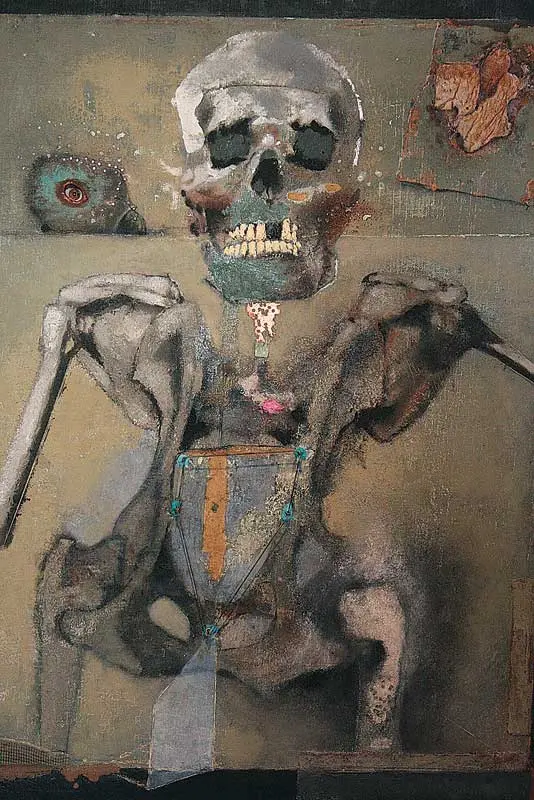
The undeniable great interest that this exhibit elicits stems from allowing the spectator access not only to recent paintings by Rivera but also a close look at some of the most emblematic works that he created throughout his artistic trajectory, which confers a certain anthological character on the group of exhibited works.
Nevertheless, curatorial neglect is noticeable in connection with the construction of discourse capable of indicating genealogies, building bridges, underscoring techniques, inciting unknown readings, and generating a multiplicity of directions surrounding the pictorial proposal by the so-called “painter of the terrible beauty.”
Thus, it is not until the end of the walk through the exhibit that we finally are able to see, clustered together in a corner, the magnificent graphite and watercolor works that belong to the Historia del Ojo (History of the Eye) series, which was created in 1990.
The unfortunate displacement of these twenty or so works (that include El Veedor [The Seer], Tiresias, La Dulce Espina Dorada [The Sweet Golden Spine], and Las Leyes de la Conciencia [The Laws of Conscience]) perhaps responds to the anachronistic hierarchization that regards drawing as painting’s poor relative; in any event, it does not contribute to exploring Rivera’s interaction with both artistic disciplines, or to detecting the central role played by the visual organ, which would define Rivera’s artistic production: art as a voyeuristic act in which everything is about observing while being observed.
This peculiar examination of the gaze expressed through hyper-realistic imagery immersed in truthfulness and detail achieves an impeccable and disquieting rendition in a couple of canvases that are included in the exhibit held at the large viceregal building.
The first is the 1999 work titled Ejercicios de la Buena Muerte (Exercises of the Good Death), in which Rivera – a former assistant of Max Zimmermann at the Kunstakademie in Munich – depicts himself lying on a sort of operating table or plank at a morgue. It is a composition that is greatly in debt to the famous painting The Body of the Death Christ in the Tomb (1521) by Hans Holbein the Younger, treasured at the Kunstmuseum in Basel, Switzerland.
The second work is La Última Cena (The Last Supper, 1994), a large-scale painting (196 x 303 cm) that depicts a group of regular-appearing people dressed in contemporary clothes, and an enormous rabbit placed above them that has been dismembered as a lamb would be for a traditional religious sacrificial celebration.
The rodent mammal, with all the hardship and martyrdom it embodies, is highlighted as the main character of the four works, which in turn form part of another series that is also part of this exhibit: La Muerte del Conejo de Durero (Death of Dürer’s Rabbit, 2007). Here, Rivera displays his passion for dissecting and disemboweling, in an aesthetic drenched in blood that nods both to sacrifice, as well as to liturgical symbols and the fleetingness of time associated with this big-eared animal; but, it may also underscore the Rabbit’s singular ability to sleep with its eyes open.
Likewise, several paintings from this period in Rivera’s artistic production reveal his recurring handling of cryptic themes, in works such as Casi Nunca (Almost Never, 2008), as well as of archetypes of pain, anguish, jealousy, eroticism, violence, and death; through the re-contextualization – with contemporary imagery – of deities whose origins lie in Greek Mythology, in works done in 2007, such as Hefesto y Afrodita (Hephaestus and Aphrodite), El Luto de Deméter (The Mourning of Demeter), and Hades y Perséfone (Hades and Persephone).
All in all, the exhibition also includes other recent works by this painter – regarded as a “realist of intensities” – in which certain indications of change transpire in connection with the artist’s formal preoccupations. For instance, the works Vacaciones de Herr Klaus (Herr Klaus’ Vacations) and Construcción (Construction, 2008) convey a de purification regarding the amount of elements represented, and a looser treatment of the trace in favor of the freer use of impasto and texturing.
However, El Kanato de la Horda de Oro (The Khanate of the Golden Horde, 2008) presents the characteristic elements of “apollonian” expression that is “dionysian” in content, according to the description Rivera himself offers concerning his work; on the other hand, in Horizonte (Horizon) and El Atleta (The Athlete, 2008), a sense of experimentation comes to the fore by resorting to the incrustation of metal fragments that communicate sensoriality and objectuality to the pigmented surface, eschewing strict two-dimensionality and the dominion of trompe l’oeil.
Against the current, Arturo Rivera continues to wager in favor of the rigor of the pictorial endeavor, with works that, as this present retrospective is witness to, continue to attract the public.
ARGELIA CASTILLO