
Materialista (Materialist) was both the name and the connecting thread of the most recent exhibit by Damián Ortega (Mexico City, 1967) that was held at the new experimental shed of the Fortes Vilaça Gallery from March 7 through 17. It consisted of a monumental site-specific installation that became alive and accumulated spatial potency and meaning at the locus that housed it. The first literal approximation to the work, presented by its title, tells us that Materialista refers to those who transport construction materials in a truck. And precisely, upon entering the exhibition space, this first impression is conveyed by the sculptural monumentality of an enormous truck suspended by steel cables fixed to the ceiling. The sculptural assemblage by Ortega decompresses the weight of gravity. Its structures, composed of materials that have lost their functionality a priori, are the result of experimentation and invention. Each discursive proposal by Ortega contains an unforeseen component randomly connected to the search for a fortuitous logic. This piece is associated with very specific aspects of the so-called “neo-sculpture,” and has a distant relationship with the work by Richard Serra, who for a long time has been working with the space, weights, and topology of a place. I will quickly make reference, in a key citation to two of Serra’s pieces: One Ton Trop (House of Cards) of 1969, made of four Cor-ten steel plates, and 5:30, also created that same year by the San Francisco-born artist.
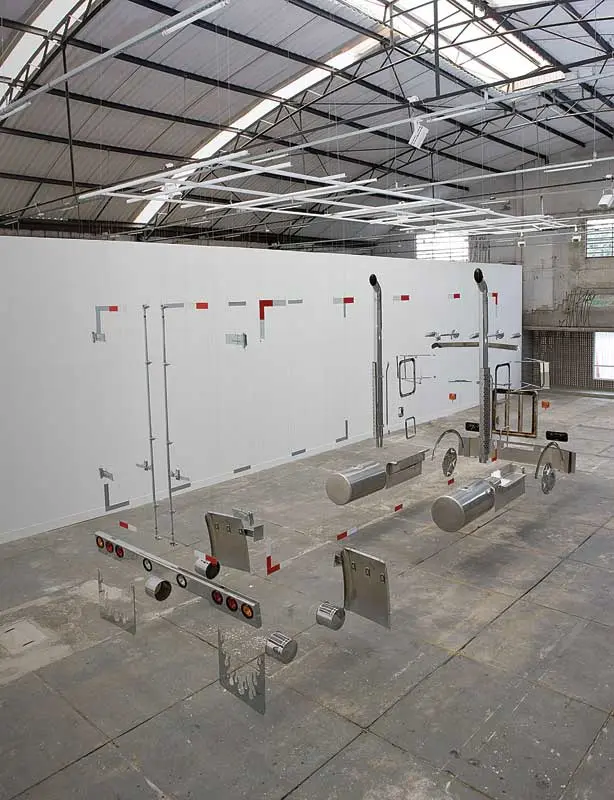
To a certain extent, Ortega points here to the elementary re-utilization of the force of gravity as the constructive principle of Materialista. In suspending a dismantled truck, the artist is conveying profoundly to the spectators that they are observing work with “no weight,” in which the forces are equilibrated, and the void existing in each objectual module contributes to reinforcing such anti-gravitational weightlessness. From the void to space, from the space to the site’s specificity, this works negates – due to its precariousness bordering on instability – the notion of a transportable object, its self-referentiality, and practical permanence as such. Materialista is a work in its purest form, in which the ponderability of the singular space creates a new level of entropy. It is in effect animation of the suspended enclave; therefore, it does not represent a calculable truth such as geometry, although its dispositio is orthogonal. But the piece does convey the feeling of a real presence in an isolated and frozen time. By manipulating several materials and their weight, this Mexican artist breaks apart the traditional sculpture to re-formulate concepts such as mass, equilibrium, verticality, horizontality, space, and intervened site. From this perspective, Ortega questions the principles of the axiomatic construction of sculpture and objects in the expanded field, as well as the idea of sculpture-installation. Let us consider the dimensions of the work: 800 x 500 x 270 cm. It is noteworthy that this is not the first motor vehicle that Ortega deconstructs and meticulously dismembers. In 2002, in his work Cosmic Thing, he did the same with a Fusca model Volkswagen, a sort of personification of late modernity for Latin America, which is in the same tenor as Fiat 600. Another important element in the individual exhibit by Damián Ortega is that the color of the material used and that of the work is the same. The artist is not interested in beautifying or “aestheticizing” the surface of his works by painting or polishing them. Here the no-color is self-significant and corresponds to the intrinsic qualities of the material employed. If, for instance, the steel is painted, then its natural process of oxidation, an essential and inherent property of the material itself, is impeded. On the verge of disequilibrium, this installation draws a new space; it outlines it, it “marks” it. It is conceived as a complex orthogonal structure, open, ventilated, and closely connected with the environment that houses it. It is actually an environmental sculpture. Therefore, the elements here of scale, dimensions, and placement are predetermined by the environmental structure of the intervened site. Ortega re-constructs our perceptual and conceptual universe in this type of three-dimensional, large-scope organization. Another important point lies in the behavioral visée of the work, where the spectator establishes a direct relationship with the sculpture and its context.
Damián Ortega has participated in, as an invited guest, the 50th International Biennale of Venice (2003) and has exhibited at the Institute of Contemporary Arts (ICA) in Philadelphia. A vast exhibition by the artist has just taken place at the National Museum of Modern Art - Georges Pompidou Centre in Paris titled Champ de Vision (Field of Vision). This exhibition was extensively reviewed in an article by Christine Frérot that appeared in issue 72 of ArtNexus Magazine.
I believe that Materialista is clearly a “socio-sculptural” act. It is enveloping, monumental, but also guilty of being intentionally cold and frozen. A prolific artist, Ortega, with his volumes and re-signified found objects, conveys a sensation of internal abundance, while he also appears to verge upon the limits and the thresholds of space. A paradoxical aesthetical experience, the work is something of a post-minimalist and maximalist proposal at once, which intertwines in the dualist sensation of being closed and removed from the body of the work. Is this perhaps an extension of the artist’s body? Is it about his interest in attempting inorganic materials in sculpture and the discourse of objectuality? This kind of objectual installation codifies, dominates, highlights, and submits to a scrupulous control of the conventions and norms of meaning found in contemporary works, as it pertains to their narrative “legibility” and their usual transgressive and disturbing power.
CLAUDIA LAUDANNO