
Geometric abstraction has followed two distinct trajectories in Colombian cultural production. On the one hand, it has been used in an illusionistic enterprise, in which representation and tropes play important roles. On the other, it has been employed by artists with strong materialist drives, who explore the nature of the constitutive parts of the objects produced as ends in themselves. The tradition of illusionism was inaugurated in Colombia by Edgar Negret and found strong proponents in artists like Omar Rayo and Manuel Hernández. Although illusionism and geometry seem like antithetical terms (some might propose that geometry was introduced into modernism precisely to squash any illusionistic impulses), this is a rather contemporary proposal, as the two have found common ground in numerous cultures, and geometry has acquired symbolic and mimetic dimensions. There is little surprise, then, in finding that Negret’s sculptures often lend themselves to be read as masks, totems, mechanical flora, and magical machines. And Negret himself, through the selection of his titles, seemed to have endorsed and encouraged this type of reading. He saw the geometric as a field in which narrative, representation, approximation, and analogy could play vital roles.
If Negret stands as the head of the illusionistic school, Eduardo Ramírez Villamizar can be credited with inaugurating a materialist tradition. In his early paintings from the late 1950s, Ramirez Villamizar already attempted to evacuate any external referents from his work. These paintings didn’t represent anything extraneous to the activity and the forms on the canvas. This mode of working became even more pronounced with the first all-white reliefs and sculptures of the early 1960s. These works did not have external referents, and their constitutive parts—particularly, their planarity—became their subject matter.
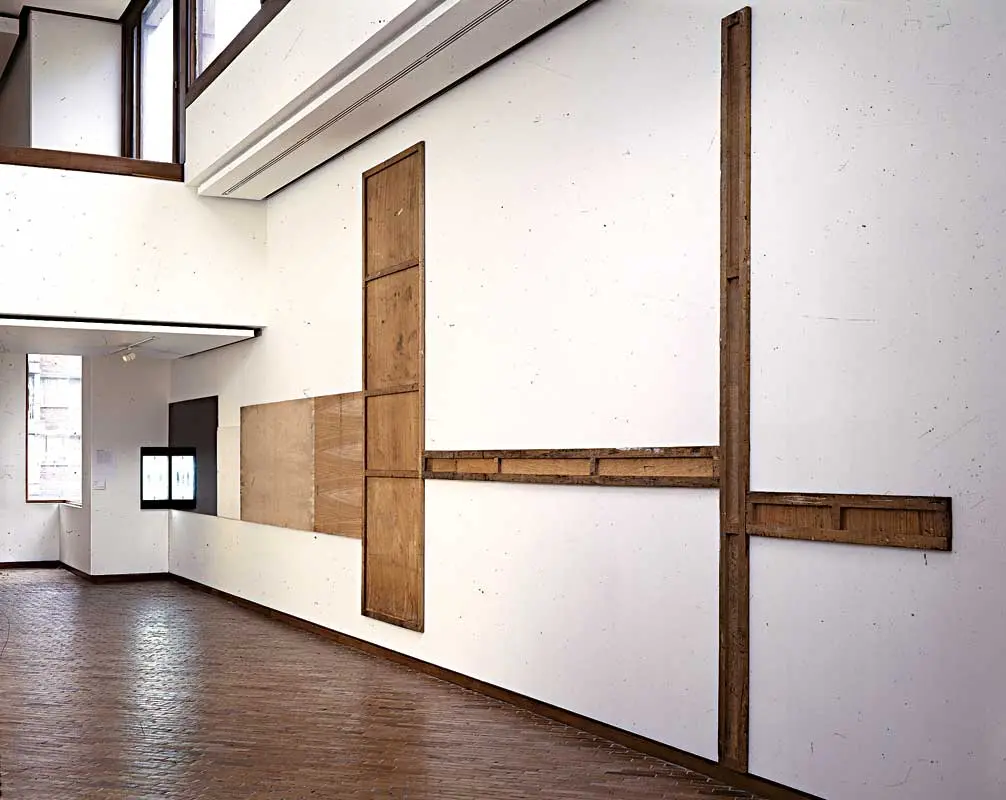
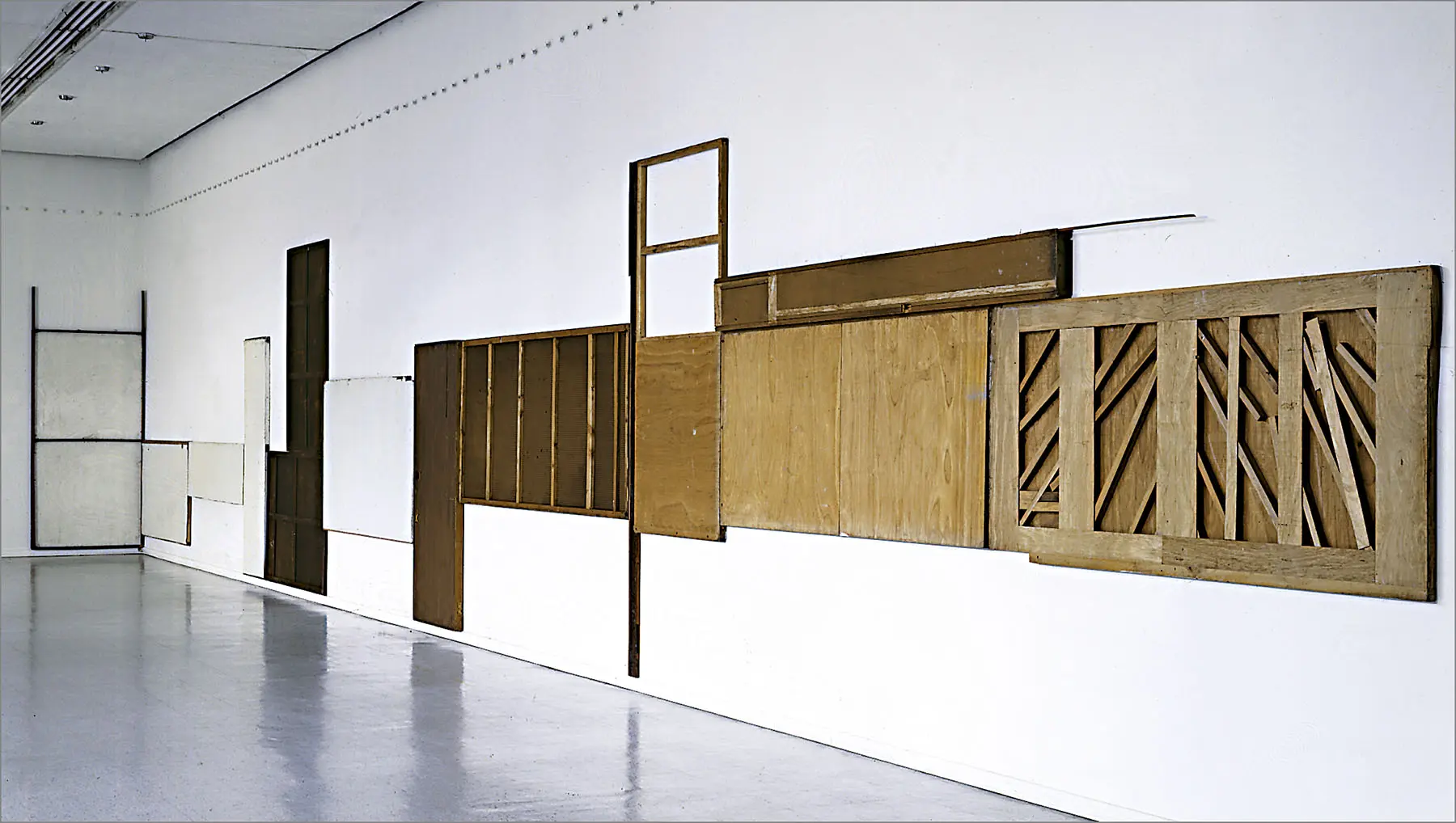
Like Manolo Vellojin and Carlos Rojas, who pick up where Ramírez Villamizar left off, Danilo Dueñas belongs to the materialist line of Colombian geometric abstractionists. Dueñas’s “paintings” have always produced jarring juxtapositions of materials—usually discarded ones—and processes that negotiate between accretion and subtraction without hiding the means of assembly. Often, screws and nails become major compositional elements. Against the sheen and seamlessness of the perfectly designed object that has become the totem of late capitalism, Dueñas’s work offers deep investigations on the way that his own scrappy objects are put together and generate complex formal structures.
Composed of broken bits of wood, fragments of cheap MDF, discarded furniture, and other “valueless” materials, Dueñas’s “paintings” possess an architectural ingenuity often engendered by necessity. As they thematize and focus the viewer’s attention on their components, Dueñas’s “paintings” often seem like the corners of a makeshift shanty or a flea market stall. While undeniably present, this referential dimension hardly detracts from the fact that these works are formally very exacting. Every gesture that went into making them seems deliberately calculated. The meshing of seemingly incompatible materials is planned; the geometries achieve the fruit of long deliberation. As much as they seem jury-rigged, Dueñas’s “paintings” are the works of a control freak. In fact, the irresolution between improvisational resourcefulness and compulsive exactitude animates them at their core.
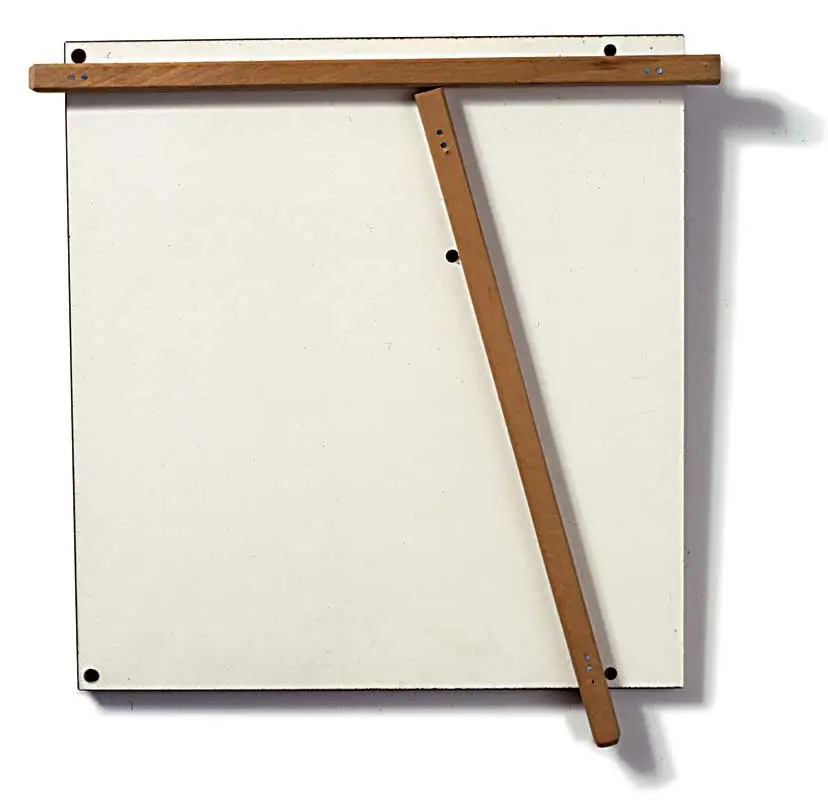
Although it is indisputable that Dueñas belongs to a materialist tradition—he began to claim a space within this lineage as early as 1989 with his Malevich in Poland—he holds an odd place in it. Unlike Ramírez Villamizar and others (Argentina’s Concrete artists and Brazil’s Neo-Concretists, for instance), who sought through their work to foreclose on the tired representational and tropological structures that have been the bread and butter of elitist aesthetics and who have served to represent and valorize the concerns and aspiration of a rather small segment of the social body, Dueñas seems to have a less polemical temperament. He works at more private levels. And this, too, may imply a politics—one of championing the difference and necessity of odd, deviant, and rigorous projects in the face of increasingly homogenous cultural landscapes of uninspired, synthetic pop—but it doesn’t seem to feed on grand schemes. In fact, this ability to leave his project uncontaminated by any literal engagement with the immediate social problems around it has cast Dueñas’s work as seemingly “out-of-touch” in the context of the socially engaged and positivist artwork that characterized the mainline of cultural production in Colombia throughout the 1990s and the beginning of this decade. And of course, Dueñas is still suffering from this: unlike his generational peers, he rarely represents the country in international biennials and large exhibitions. If he has been able to exhibit his work abroad, it’s because curators reared on the complexities of geometric abstraction have included him in exhibitions without regional themes or anemic and pre-approved visions of the cultural production in Colombia.
Dueñas’s intense interest in materials and composition has inevitably pushed him beyond the parameters of pictorial space. If his “paintings” have always existed at the edge of an undeniable objecthood, Dueñas’s presentation of them as paintings has left them comfortably settled within the referential and historical field of the medium. But one shouldn’t lose sight of the subtleties of Dueñas’s hanging style. There is a concentrated meticulousness to the way Dueñas spreads his “paintings” in space when he exhibits them. He quietly turns against the staid conventions of painting installation and presentation that have been guided by caution and emulate showroom displays. Dueñas almost always hangs his “paintings” in such a way that they have a dialogue with one another, making it difficult to discern if their meanings emerge from each of them or from the composition of the group. Or, they enter into an exchange with the architecture, often working against the geometry of the cube by activating corners, crossing windows, jutting into the viewer’s space, and violating the painting-to-architecture proportions that we are accustomed to, anchoring themselves to specific sites and spatial circumstances in the process.
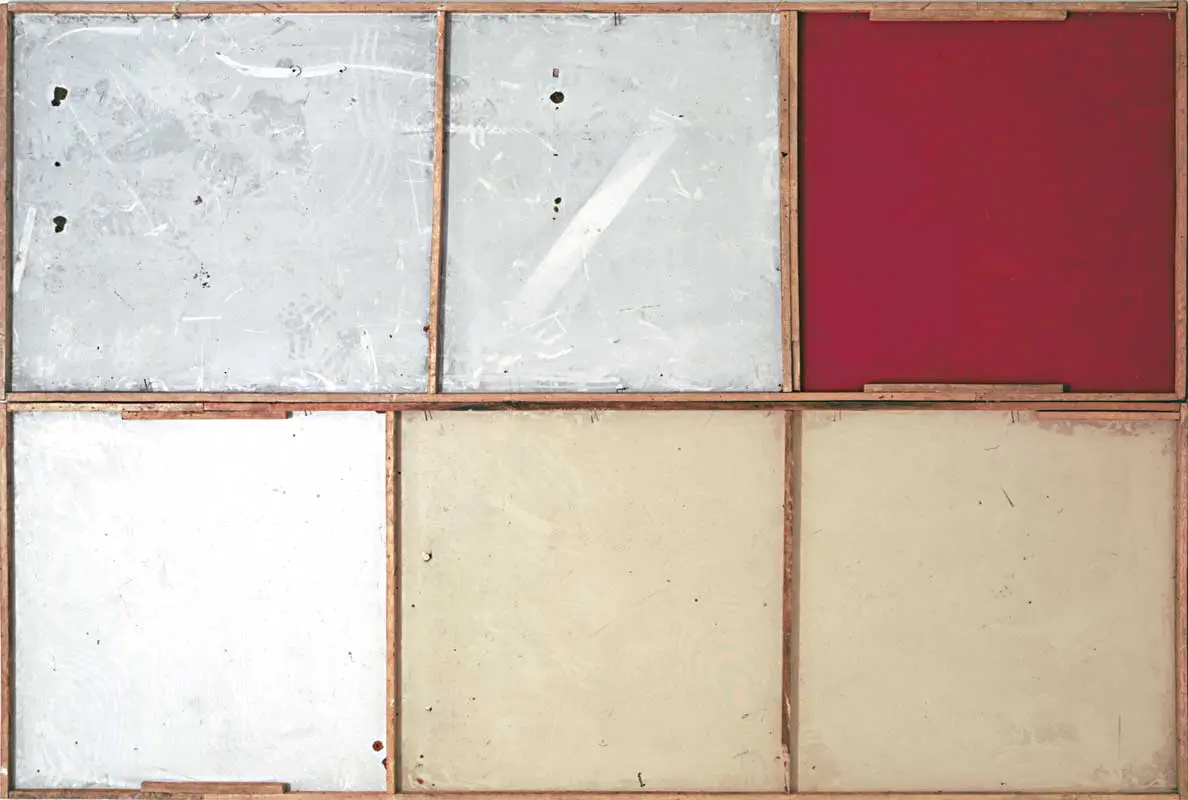
Dueñas’s understanding of the hanging of paintings as compositional exercises has historical precedent. There is little denying that his “strange” arrangements often echo those of the Russian Constructivists and Suprematists in particular. What is interesting is that this conjoining of idiosyncratic singularity and historical precedent follows a pattern that weaves together everything Dueñas does: the more his investigations seem to be quirky and personal, the more they find counterparts in significantly historical examples, without direct citation or coy emulation. In this way, his project takes on a Möbius-strip quality, whereby the grand geometric tradition becomes inseparable from his idiosyncratic and intense focus on materials and composition.
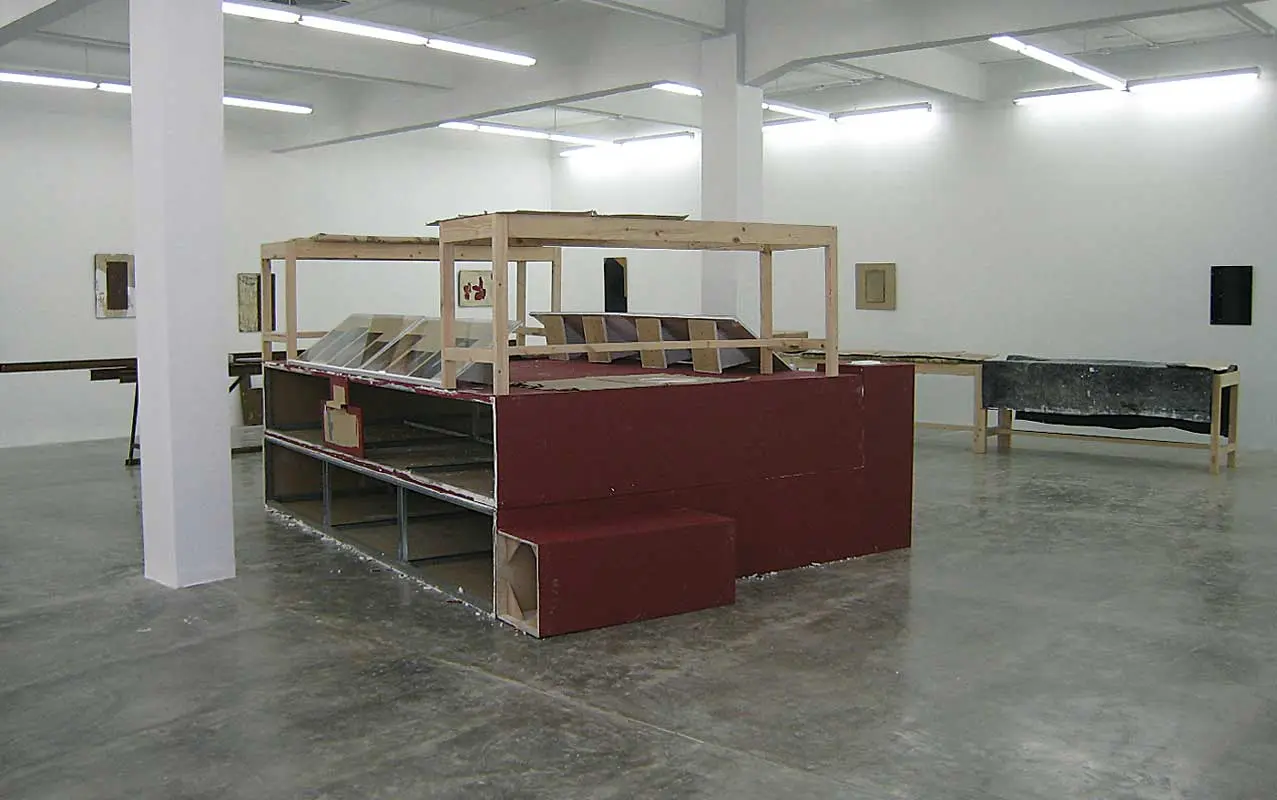
Given Dueñas’s concern for the arrangement of his “paintings,” the act of testing compositions in space seems like a logical step forward in his process of production. In exhibitions such as Without the Surrounding Words at the Museo de Arte de la Universidad Nacional (2001) and Ilegibilidad at the Alianza Colombo Francesa in Bogota (2005), he literally left the plane behind and claimed as his workspace itself and the relationship between materials and objects in it. Here, we again see that Dueñas is an idiosyncratic figure. Instead of using basic geometric forms as a unifying element that allows an easy transition from the painting to three-dimensional work, Dueñas leaves himself no such safety net. He has no language or syntax that can be translated from one medium to another. He begins and ends with materials, objects, and the compositions they generate when they are brought together. In every instance, he sets out to empirically test how things function formally in space, and, in the case of the installations, how volumes relate to the viewers’ bodies and existing architectures.
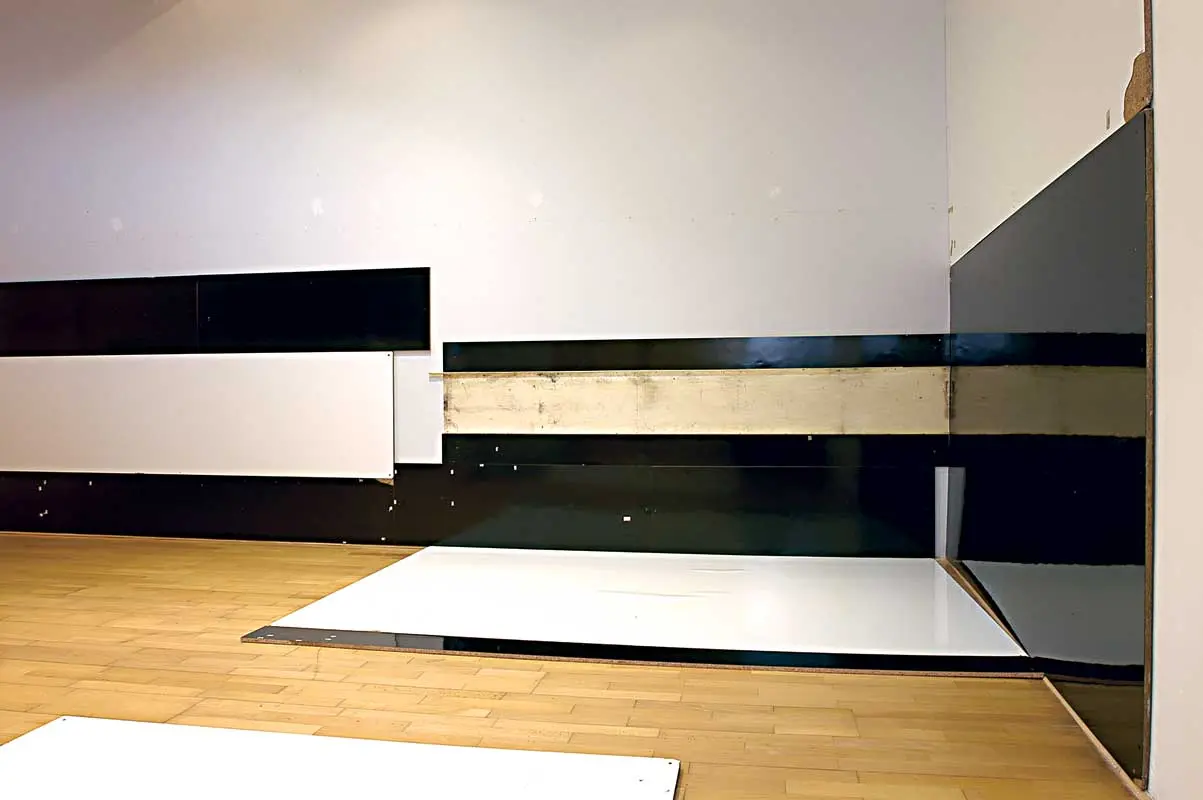
But, beyond Dueñas’s material investigations, there is always something extra. In the “paintings,” this excess occasionally echoes the improvised architecture of the favela and indirectly addresses existing socioeconomic realities and discourses. In the installations, on the other hand, the material and a formal investigation are trailed by a conceptual interrogation of the exhibition site itself. Since Dueñas always begins with materials that are already available, and the materials that have been most readily available have been those that are found in institutional spaces, his installations resonate with the tradition of institutional interrogation that has characterized a great deal of post-conceptual art. In the recent exhibition Dentro del Espacio Expositivo (2008) at Periferico in Caracas, Dueñas laid the gallery’s movable walls on their side to create a temporary construction; these walls stood as symbolic surrogates for the institution itself. Ever since Michael Asher removed the wall of the Claire Copley Gallery in 1974 and Christopher D’Arcangelo thematized it as an independent material and semantic component of the exhibition site in 30 Days of Work (1979), it is impossible to read the display wall as a neutral element. So, in a sense, Dueñas has it both ways. He deals with materials in complex formal relationships, but he also carefully considers whatever meanings they already carry and whatever critical positions they may call forth.
It should be noted that while Dueñas’s installations employ materials that have external referents, the artist never introduces one himself. When he turns a pair of gallery walls on their side, saves and displays a rag from the painting crew that prepared the space for his exhibition, or hangs a bookshelf taken from the gallery’s office, he never does it to introduce an illusionistic or mimetic element. He doesn’t stack the walls so that they look like an architectural model or allude to a natural structure. They are merely two walls, on their side. Their material integrity—including the semantic frames in which they function—is left intact.
It should be noted that the fact that external information creeps into the work, despite Dueñas’s own proclivity to work on a physical and formal level, is not a detrimental element. It simply leaves the work suspended between an exploration of the formal quality of objects in space and of the ideological structures of the exhibition space, called up by the materials and objects. This double-sidedness is fruitful in that it splits the possibilities for those who engage with the work. On the one hand, there is a micro-view of the specificity of materials and compositions, in the physical qualities at play; on the other, there is a macro-view that questions the structure and systems of presentation in the art world. But neither of these possibilities exists at the expense of the other. One can choose to either stay with the formal and material side or move to the more conceptual/critical interrogation opened by the objects’ function and context prior to their appropriation by Dueñas. Or, as a third alternative (and the more tempting one), the viewer can choose to move back and forth between the two options, to follow the contour of their entwinement and understand how a localized material investigation can lead to larger questions without surrendering its specificity and how these larger questions can fold back into and reveal how they are the result of precise investigations of materials in space.
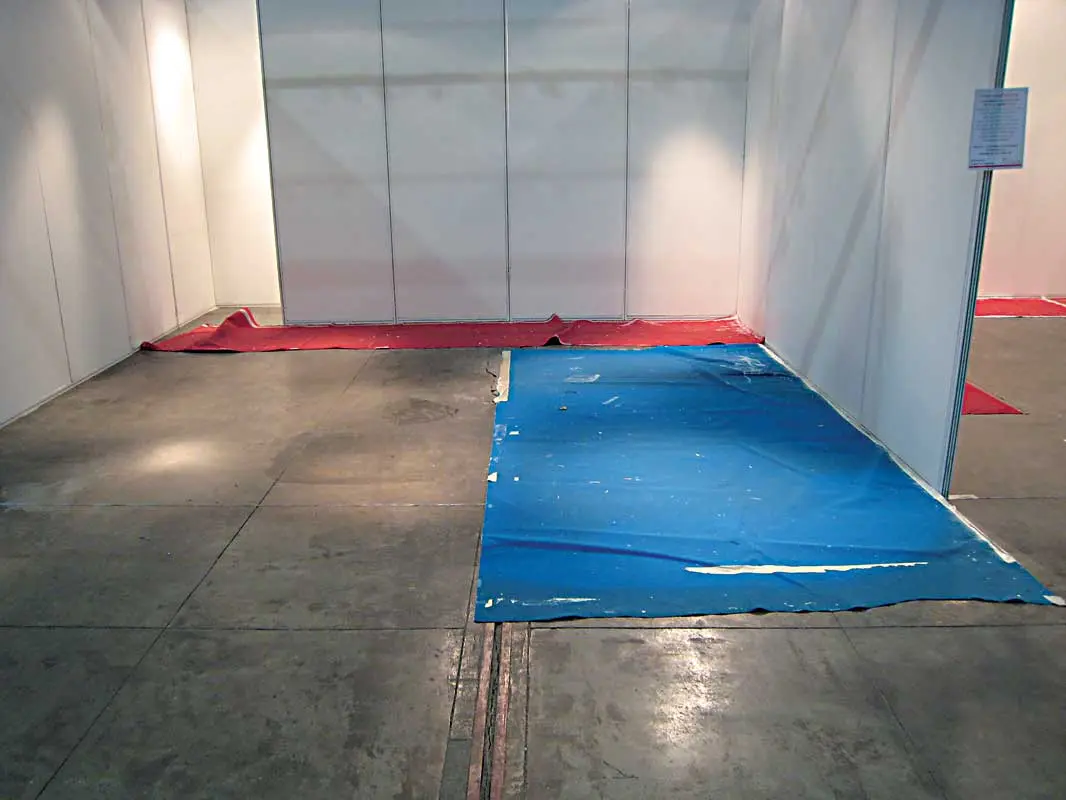
This Möbius-strip quality that allows Dueñas’s work to function simultaneously on two interconnected levels is illustrated rather well in a series of recent photographs, Fair Sculptures, or Found before the Fair, Installations (2008). These photographs, taken while the ArteBa fair in Buenos Aires was being installed, present a series of “found” sculptures that resemble Dueñas’s material groupings. The seemingly straightforward quality of these photographs as indices, however, makes their meaning more slippery than one would think at first. Of course, each serves as an index of Dueñas’s work, a fortunate discovery of an accidental composition of materials that uncannily resembles what Dueñas deliberately produces. But each is also an index of the setting in which they were found. The “fair” of the title, in English, signals both the quality of the object and the commercial context in which it is located. Exploiting both the condition of the photograph and the ambiguity that the title opens up, these photographs exist between straight documents of found doppelgangers of Dueñas’s constructions and indices of the sites of contemporary art production. And while Dueñas’s own tendency is to focus on materials and composition, there is something to be said for his willingness to leave the artifact open to whatever unexpected semantic and referential fields it may cut across. In a very real sense, Dueñas allows the objects he claims as his work to find their own paths in the world, even if they deviate from his focused interrogation of how materials juxtaposed and fused in surprising ways invariably add up to more than they should.
GEAN MORENO
Writer and artist based in Miami.