
What gives Florencio Gelabert Jr.’s latest projects an advanced edge is their increasingly more effective ability to condense a multiplicity of possible readings. To cite as examples, his show Intersections, which contributed to enhancing the opening of the FIU’s Frost Art Museum in Miami, and Birth & Accumulations, which opened more recently at Chashama Art Studios & Gallery, New York, a felicitous result of a fellowship granted by the Lower Manhattan Cultural Council. In both cases, we encountered a visual narrative that flowed by compacting spaces, resources, and criteria on a grid of questions about the erosive relationship between society and environment, a topic that has occupied the artist as he attempts to raise the contemporary subject’s awareness of predatory actions. In neither of these shows was the well-known essentialism of the sculptor’s work a constraint to the juxtaposition of conceptual levels within his proposals.
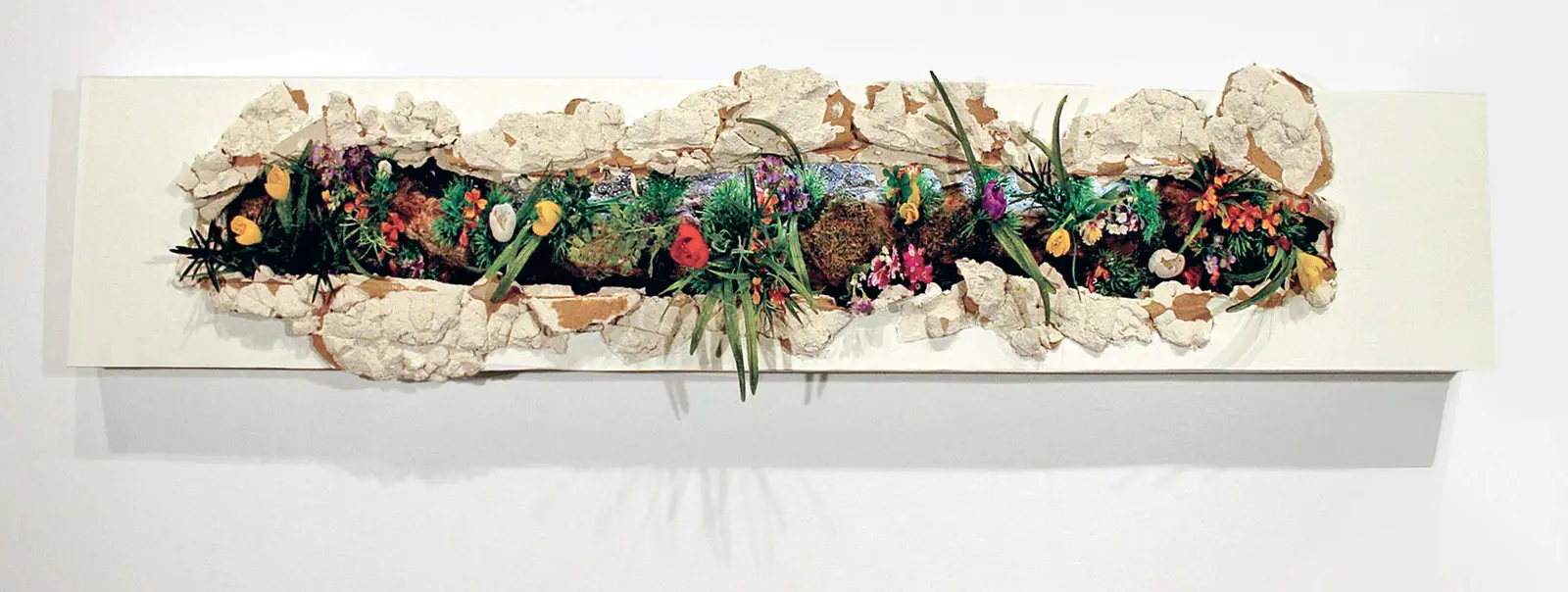
In Birth & Accumulations, a Gelabert that remains in tune with his preoccupations returns expertly to the curatorial strategy deployed at the Frost, where he articulated in an organic fashion a diverse, concise, and specific arsenal that was then formulated into a unitary body. The plan was, at its base, for each participating work to preserve its own impetus while being coherently incorporated into the staged concept. At Chashama—a more rough-hewn space—Gelabert contrived to produce a set where synthetic materials were the protagonists, in conjunction with a variety of visual supports and symbolic constructions, of a kind of puzzle made of ironies and subtle antagonisms that subliminally pointed towards a reflection about the symptoms of a continually assaulted ecosystem as it breaks down.
This fusion of art and passion for the natural world had long been the basis for Gelabert’s methodical investigations. In Birth & Accumulations, the frictions contained within the ecological polemic came to the fore through a counterpoint between matter and analytic attitude, made concrete in a peculiar, minutely processed aesthetics. The most visually striking aspect of this group of works was the vivacity extracted from inert substances. Fragments of fictitious landscapes, simulacra of vegetation growing from the wall interstices, appealing aquatic recreations record in video passed in front of us, and wove a colloquial network with enough margin for a reinterpretation for the young notion of the biotope.
To the structures conceived in this way, Gelabert added a degree of artificiality, as a kitsch element with parodic effects. His use of industrial materials such as plastics, papier-mâché, fiberglass, aluminum, plaster, etc., comes across as the intent to reproduce the natural element in a seditious key, after selecting materials that, precisely, poison the planet’s health. The recourse of using synthetic flowers or latex rocks in a cleanly abrasive art would seem to interdict the snob tendency to adulterate nature through frivolous processes that pollute the nobility of the habitat. This is why the skillful mimesis evident in Gelabert’s works really marks turning points towards other kinds of commentary, one that goes beyond the contentions of the figurative and is founded on the most deeply rooted ideology of modernity.
It is possible that Gelabert’s mordancy was inspired by the stiff California-style decorative style used by the Hollywood elite in the first half of the Twentieth Century, which put in fashion the imitation of the natural. We are talking about the rather mannerist ornamental paraphernalia that spread widely across the continent’s lifestyles and contaminated the vernacular sub-cultures of the Caribbean. The truth is that the parallel between fantasy and reality in Gelabert’s imagination ridicules a copy-prone mercantilism intent on reducing biodiversity to consumerist corniness. This attitude is interrogated in a forceful yet serene way in Gelabert’s proposal, with such an elaborate visual display that, in the end, a captivating naïf poetics attaches itself to the critical symbolism.
Gelabert’s fervor is a kind of energy distilled into a suggestive repertoire that leaves no room for the co-participation of the viewer, yet is filled with didacticism and abrupt turns. Nothing could be farther from diatribe than the affable works included in Birth & Accumulations. Each one of them has been conceived with the austere dignity that characterizes Gelabert’s work; this is a sculptor who seeks sensorial affairs with the evocative, albeit making it possible to read dissonances in his work, due to the implicit tension. At any rate, the decontamination of the spirit takes precedence here over an environmental argument.
On that path, the concept behind the art proposes to balance, through painstaking manufacture, the rock-hard blows of the discourse. The balance is achieved to the point that there are moments when the viewer clamors intimately for the docile material to congeal into a pleasurable verity, no matter how ephemeral, that could feed a more innocuous expectation for the Great Home. This reaction is inherent to the need for utopias when confronted with a severely depressed reality. Perhaps such is the climactic effect of the exhibition’s thesis, where Gelabert’s work ratifies in optimistic terms the idea that art can function as the intermediary in distances whose dissipation cannot be, at this point, postponed.
JESÚS ROSADO