
Between 1988 and 1998 he studied art at two important Caracas institutions. His interests always veered towards working in three dimensions; in connection with his earliest works (Alfa y Omega, and the series Formas templadas and Convergentes), he has said that sculpture “has been a true find in the interstice of my creative process, and it has provided me with an answer to enigmas about form and its configuration.” His work was exhibited for the first time in 2003 when he was included in the National Art Salon of Aragua, and since then he has participated in salons and biennials and has presented three solo exhibitions. Francisco Martínez (Venezuela, 1971) proposes, precisely, an open form moving in real and virtual space; this is why he speaks of a “development of the movement in space (…) which produces an infinite and unstoppable constant.” From the sculpture of winged shapes set on the floor, through the series Huella-objeto, to the Huella-retrato included in this show, the relationship between form and content, negative and positive, can be seen as the conventional summary of his proposal. A summary that connotes the grouping of linear three-dimensional elements, always presented in volutes, spirals, or rounded shapes.
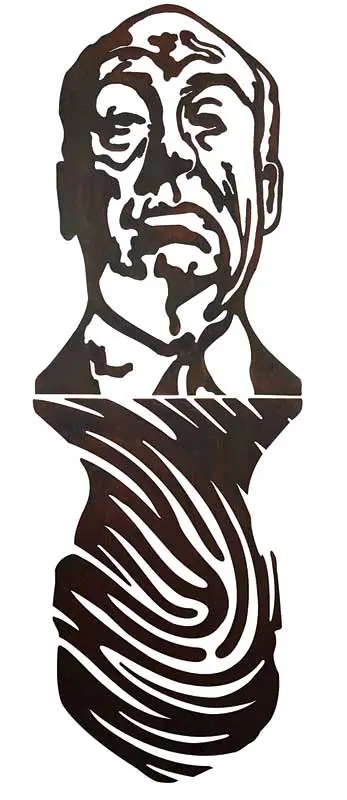
Martínez essential material is metal: iron, aluminum, and steel. Tras la huella is worked on patinaed steel which, attached to the wall, functions as reliefs in two dimensions, one real (the image-shape-iron) and the other virtual, be it painted or literally affixed to the wall. This is a series of portraits using the fingerprint patterns as their template, resolved in linear articulations. In a differentiated order of formal components of the material used, the linear, solid, flat, filled, and empty result in an interplay of structures that in the end behave as violent expressionism. These structures can be seen as subverting their physical dimensions, and it is from here that there emerges, precisely, what the artist calls an “infinite and unstoppable constant,” cited previously. The fingerprint-portraits: Ponte el sombrero (Magritte’s bowler-hatted gentleman); Soy inocente (Hitchcock); Muchacha con grilletes (Vermeer’s Girl with a Pearl Earring); Culpable soy yo (self-portrait) are easily identifiable naturalistic silhouettes. Devoid of rhetorical charge, these structures in some instances are repeated according to the ambivalence of their being monochromatically flat silhouettes, as well as reliefs in cut iron that simulate the geography of fingerprints. In that sense, they reflect the artist’s skill in subtracting the figure’s abstract essence and combining it with his own schematics, presenting it to the viewer as the direct expression of a dual work: one and the other.
The work displayed in this new solo show situates Martínez, within the Venezuelan visual arts context, as an investigator of form and content. His connections with Venezuelan sculpture hinge on the interests in kinetics as a formal and conceptual element, be it through real movement as in his pre-2007 sculptures, or virtual movement, as in the fingerprint-portraits of 2008. In both cases, he refers to the notion of the open work, which unfolds in space as a structure of intelligible intent and meaning; even in the more abstract sculptures, we recognize their organic nature (a flower, a bird, a portrait). The relationship with the visible is immediate so that Martínez works his proposals outside of traditional concepts of three-dimensionality. By using multiple formal systems, the artist proposes similarly multiple perceptions, with the participation of several systems of reference in the artistic practice, such as design, drawing, the two-dimensional, abstract connotations alongside figurative ones, and, of course, the three-dimensional.
BÉLGICA RODRÍGUEZ