
From March 7 to April 30, Brazilian artist Geórgia Kyriakakis (Ilhéus, Bahia, 1961) presented, at the ample exhibition space of Gabinete de Arte Raquel Arnaud, a solo exhibit consisting of a mural installation titled Outros Continentes (Other Continents).
In this group of works, never before exhibited, the pieces displayed included nine drawings of various sizes that were created with color pencils and then altered a posteriori by reproduction through digital media. Juxtaposed as random systems to each of the iconographic groups, there is a constellation of black and white photographic reproductions that depict several seascape vistas through the employment of the aesthetical tautology of the horizon line found in the ocean. In Outros Continentes, the thematic operative matrices by Kyriakakis are, undoubtedly, cartography and the world map. The no-color approach, namely, the various gradations of values, produced in this thematic exhibit a nearly ritual magical effect, while simultaneously creating a premeditated aesthetical proposal that has a “distancing” effect with regard to the time of the image and the time of the work. These are typical indicators of certain paradigmatic Land Artworks, as it is possible to detect the citational spiral to which the artist resorts, which adopt certain precise guidelines by Dennis Oppenheim, Robert Smithson, Richard Long, Michael Heizer, and Anna Bella Geiser, among others.
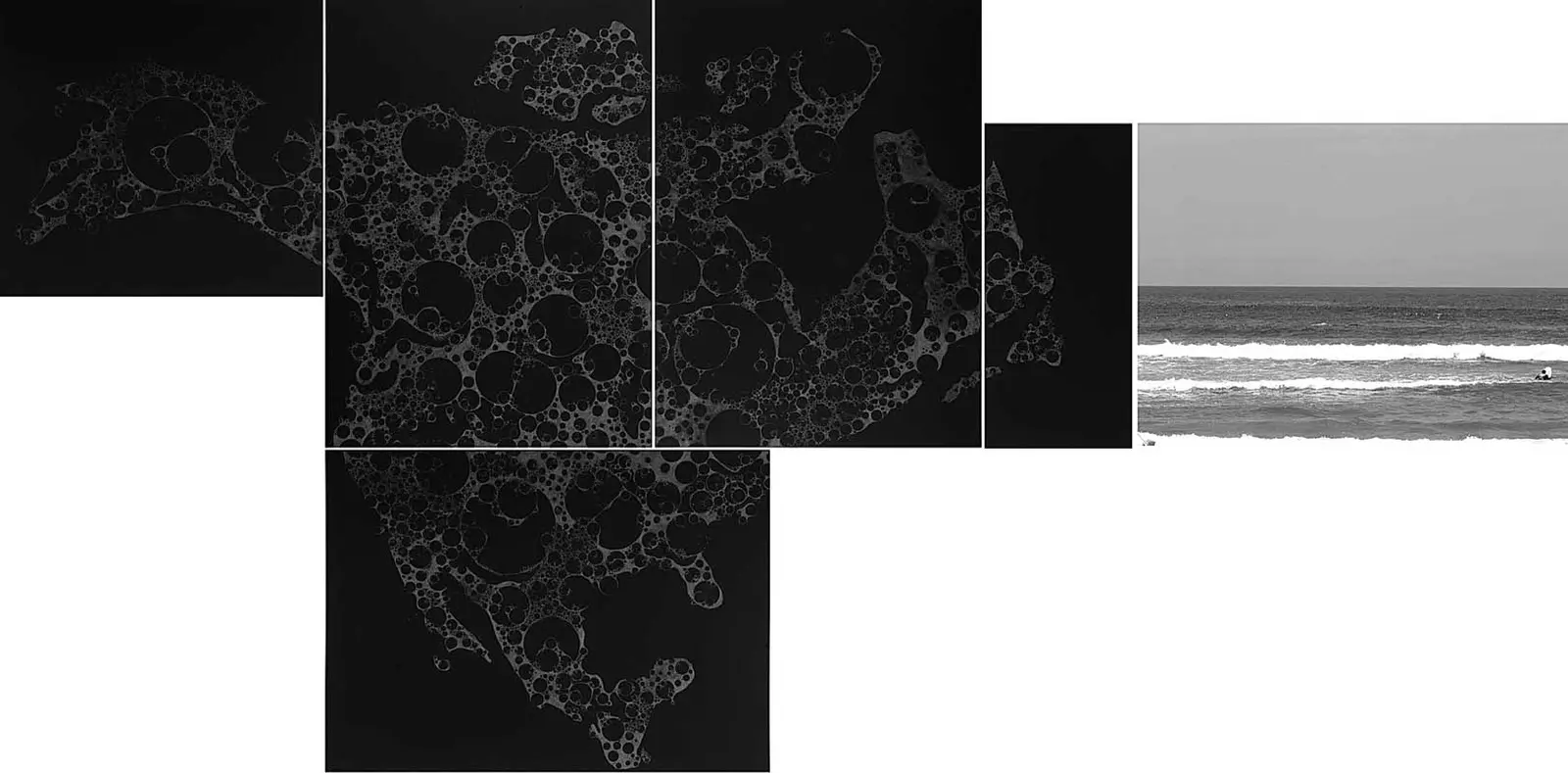
The exhibit by Kyriakakis proposes a mise en scène of mobile cartography, a group of simulated earthworks in which several natural elements are placed in the foreground. The artist relies on the historiography of modern art and late-modern art, which consists of re-appropriating functional devices from Land or Environmental Art. Thus, the exhibited works function as “documents” of actions – that may be fictional – while at the same time these function as authentic “installation art objects.” Kyriakakis’s need is clear: to take over the entire exhibition space as a whole, to insert a flow of environmental energy; namely, to convey the urgency caused by the state of several oceanic ecosystems along the coastline. At this juncture, we must ask: Why not work conceptually on the construction of the small natural world itself? Because here there is no longer concern with re-elaborating proposals on notions of the epiphanic space that belongs to the universe of figurative representation, nor of the heuristic space present in many Programmed Artworks, nor is it about an interest or search that peruses pitagorical ends – a characteristic of Minimal Art or of the Primary Structures. It is symptomatic to observe the manner in which the artist pays homage to the U.S. as the birthplace of Land Art in these world maps.
In Outros Continentes, Kyriakakis operates from a true “eco-catastrophe.” Here, one can perceive a deep activation of the senses on a quest to reclaim the natural world that searches beyond what we assume to be technological alienation. We return to the idea of a “magical technique,” a counter-culture or an alternative culture: a thinking very much in vogue about slow life, slow cities, a non-violent and tranquil way of life; about “another” aesthetical theorization on contemporary human beings’ good nature and focusing on their non-destructive creative qualities. The image “coincides” with the photographed and drawn object. The author’s “mark” or “autobiographical signature” may seem to disappear as she leaves her space to the landscape and forgets a little of herself. Because of its nature and its iconic and spatial fashion of graphic explanation, this is a new type of modus amoris. It unveils throughout this rex extensa, which serves to share with the spectator an accumulation of noetics, emotional, and aesthetic contents. On the other hand, the modifications constitute a hypothetical world of fantasies, a sort of “superspace” conceived to achieve an artificial paradise. On this locus that gradually becomes abstract, the author performs a foundational anchoring of specific values of signs. Play, rite, magic, fiction, invasive expansion, a desire to reject the formulations of a narcotic society, the fallacies of extremely noisy and apprehensive everyday life. Outros Continentes, a vision by Kyriakakis conceived of in Brazil, presents a multiple images in which Latin America itself relinquishes the real and transforms itself into “otherness.” Empathic fusion is essential in this type of opus. Nevertheless, Kyriakakis “controls the landscape,” determines it, “reproduces it,” from heterodox languages. In Outros Continentes, we discover a modality of conscience that is also a building of awareness associated with what are and have been the interventions on nature, but with a more current focus, less harsh and cold, in which we can also individualize specific hedonistic and ornamental elements.
Geórgia Kyriakakis affirms that this thematic exhibit is part of a nucleus of works created from 2006: These are Archipielagos, Fuerzas and Flujos, born from the idea of reorganizing the world and, as in all post-conceptual art, the artist relies on images that in the end are much more mental than documental. In playing with the notion of permanence, instability and transiency, equilibrium, inertia, resistance, and fragility act as indices of human actions and as a “mapping” of social, political, and geographical relations.
CLAUDIA LAUDANNO