
Under the title Otherworld, Carol Jazzar Gallery, located in Miami’s Design District, presents us with the most recent production by the controversial duo Guerra de la Paz.
Guerra de la Paz is a working group comprised of Alain Guerra (Havana, 1968) and Neraldo de la Paz (Matanzas, 1955). These artists, who live and work in Miami, have been collaborating since 1998, enchanting us with a more than a unique proposal.
The source of inspiration and raw material for Guerra de la Paz’s work is the stuff of recycling. Both artists situate themselves in the huge warehouses that process second-hand garments for charitable donations and undergo a long process of selection. This process of assessment of materials functions as a kind of creative workshop, the neurons spinning on the basis of the very nature of every material that crosses their hands. The effort is a true challenge yet it also has an important element of play, given by chance.
Once the working material for each project has been selected and classified, the production stage begins, also with a significant degree of physical effort. Like oracles that weave complex tapestries while deciding our fate, Guerra y de la Paz devote themselves to long working hours in their workshop. Knot after knot, fabrics that twist capriciously until they cease to be mere pieces of cloth and become loaded with life. Long is the creative process; the results are magnificent.
From the conceptual point of view, the work of this creative duet connects with one of the contemporary world’s greatest priorities: the necessary reformulation of our use and abuse of natural resources, and a raised awareness of our active role in the process of recycling and in the inventiveness required to re-appropriate materials and objects available around us. Art shares this sensibility, and the work of Guerra de la Paz is a clear demonstration of it.
But while, in general, this concern for nature and the environment underlies the duet’s entire production, each new series undertaken by Guerra de la Paz is identified with a specific theme. In the case of the Otherworld, the interest focuses on mythology as a mechanism to explore our fears and desires, our past, and our future. The show is comprised of seven imposing and morbid large-format sculptures that take the viewer through a world of reveries and chimeras that is not devoid of menace and terror. Thus, beings from a different realm seem to scrutinize each one of our movements, while investigating us with inquisitive gazes and intimidating us with supernatural powers.
Within the universe of mythology, the female image occupies a prominent place. Her supposed serpent-like nature and her power of seduction have been explored recursively in myth and superstition. Perhaps because of this Guerra de la Paz focuses on the female figure, often as part of whimsical symbioses where it coexists with other—no less obscure—species of the animal kingdom, such as spiders or sharks.
Two works stand out in the show, as we follow this constant of the female figure as an incarnation of myth. I am referring to Tip-Toe and Daphne, both from 2008.
In Tip-Toe, we are confronted with a mythological female being, half-human, half-animal. This being is all the more unsettling for possessing no face. It has no eyes, and yet, cautious, we keep our distance as we intuit it to contain a different meaning, a powerful one we ignore. That feeling of caution that overcomes the viewer is reinforced by the title. A single, defiant horn—like a spur—crowns the sculpture. This sort of unicorn whose female nature is emphasized by its four sensuous limbs invites touch and caress as much as it does guardedness, despite its intimation of venomousness.
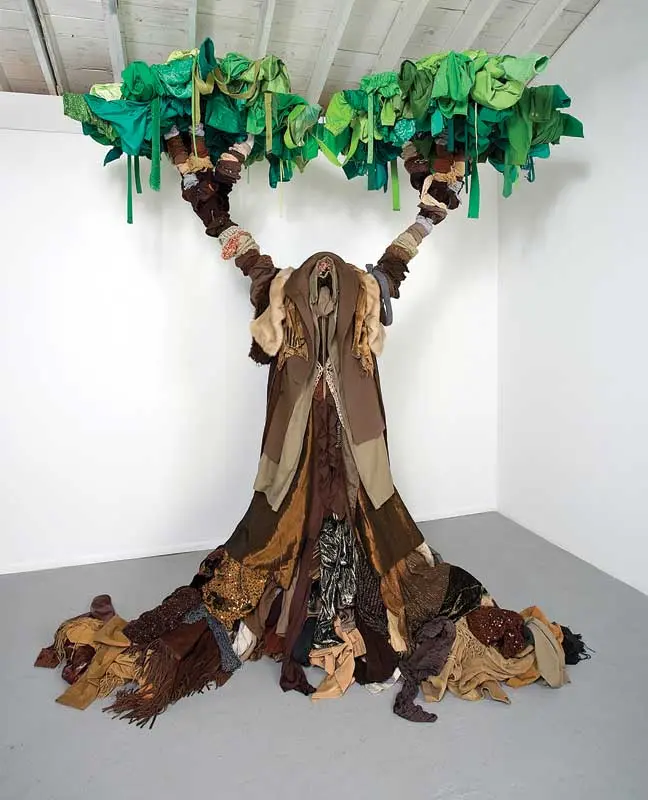
Daphne is the work that closes the show. It takes as its starting point a passage of Greek mythology that has been often visited in the History of Art, which narrates how the nymph, desperately running from Apollo, asks for help and is transformed into a laurel. But unlike most artists who have used the episode, Guerra de la Paz does not focus on the moment of metamorphosis but rather in the final result, when Daphne has ceased to be human to become incarnated in the noble laurel.
Inserting itself into the logic of the group’s entire production, Daphne violates the limit of myth and becomes a demand for the protection of the world we inhabit, which is the protection of our very own selves.
JANET BATET