
TEOR/éTica was planning an exhibition of works by Gustavo Araujo since late 2007. It would present his recent painting and would include some of his emblematic photographs, which had given him his recognition, in order to show the coherent relationship of the paintings with his previous practice. Indeed, Araujo’s paintings prolong his photographic work, continuing in a more intimate medium, at a slower pace. Araujo’s recent endeavors began with a desire to enter the space of painting, accompanied by a determination to master his craft, following workshops with experienced painters, combining this with readings and reflections in the privacy of his studio. These works evidence his knowledge of the advertising language and techniques, which is just as present in this period as it was in his photography, though filtered through a personal sensibility. Araujo’s sudden death interrupted the project as it was conceived, and the show at TEOR/éTica is comprised of works dated between 2000 and 2008, gathered posthumously, that show the intensity with which he was working.
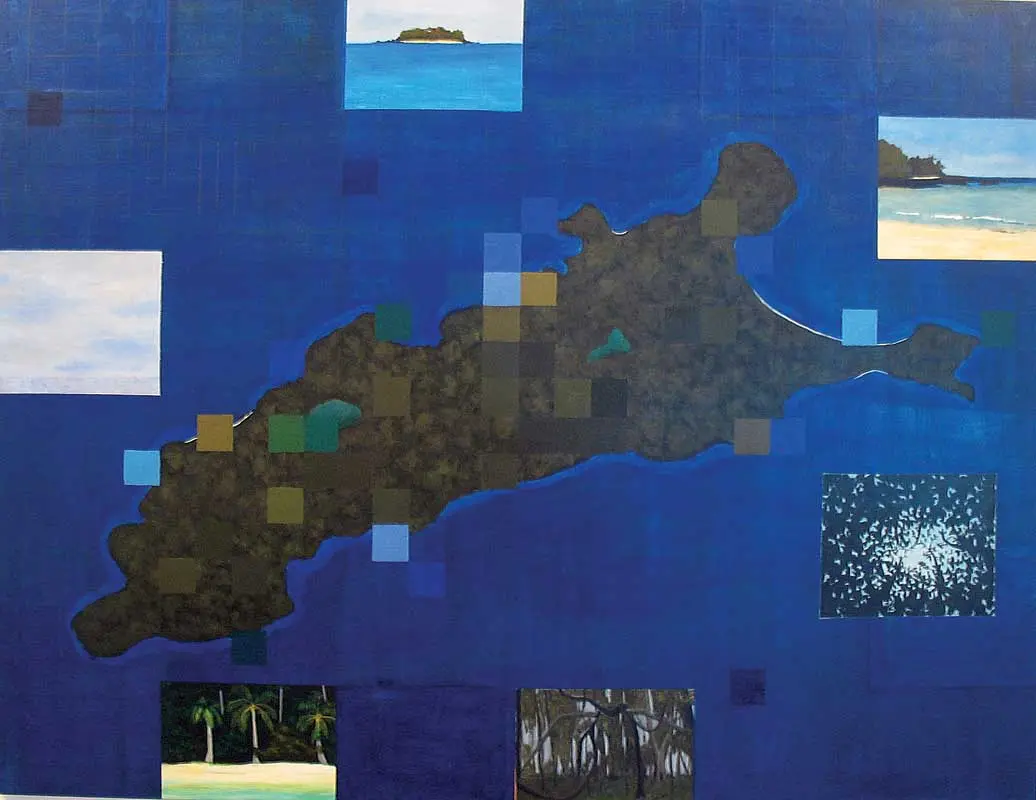
Araujo’s pictorial experience initiated when he already enjoyed great recognition as a photographer. He took the risk of assuming painting in full, without fear of error, and worked tenaciously for several years, achieving a surprising level in a short period of time. In his learning process, he went through traditional genres that he had already worked with as a photographer -portrait, and landscape-, seeking to define what he desired to achieve in his art, and specifically what he was seeking in the pictorial field. The modular untitled painting he was working on at the time of his death is particularly significant, as it is a strong indication of a profound shift and an opening to new horizons.
Works like Isla (Panamá) and Isla (Paris), 2005, are his first attempts to conceptualize the idea of an isolated territory in an imagined ocean: Panamá, isolated, floats in the Caribbean, and Paris, transformed into a forest traversed by the Seine, floats on an unknown sea. Coiba, 2007, represents the old Panamanian island-prison, now a nature reserve. The modular structure, resembling the billboards that are omnipresent in Panama, is a constant element of Araujo, in which he constructs abstract vegetation made of irregular circles, circumscribed by sand and surrounded by an intense, uniform deep blue. He is also obsessed with zenithal visions. Coronado, 2007, originates from an aerial view taken from Google Earth, where all buildings are deleted: from the sky, between clouds, he allows us to see the coastline where he spent much of his life, and where his father had lived. Two works focus on the mainland, without a reference to the sea: Río Azul, 2005, of a strong evocative character, and Mapa #1, 2007, where we already perceive an attempt to deconstruct color into pixels.
Various levels of reality and landscape are superimposed in a small work with the sub-title This is so Magritte!, 2007. During the workshop to which he was invited in 2008, organized by the Carolina Foundation and the Félix Llopis Foundation on the island of Contadora, he picks up this idea again and produces a series of sketches, essays, objects, and studies. Esto es un paisaje, is one of these works that, continuing with the idea of the island, develops an intention to superimpose realities, thoughts, memories, and experiences. This workshop marked Araujo deeply and prepared him for the research he was engaged in at the time of his death.
A major achievement is found among the more openly figurative works in the unsettling Hyhits, 2006, where a female figure clad in a black bikini hides her head in the sand, like an ostrich. Equally powerful are the four self-portraits, oils produced between 2006 and 2008. In his photographic work, self-portraits were presented in a film-like sequence, where the passage of time underlies the image (Olas & Molinos —winner of the Central American Biennial in 2002). His painting, however, captures a single instant of that time that flows irrepressibly and seems to reflect diverse moments of his life and his personality, united by a penetrating, direct gaze.
The work of Gustavo Araujo is traversed by a poetic spirit, since his beginnings with themes of nostalgia, dreams, and memory. In some ways, Araujo grants coherence to the incoherence that surrounds him. The sea is always present in his work, in different ways: as a welcoming space, as a space that is at once isolating and protective, as a liberating and purifying space. Regarding Exit, Donna Conlon wrote to him: “I love having an image of the sea with the label Exit. I always see the sea horizon as the strongest symbol for eternity, so that my first thought was in that context, the possibility (or inevitability) of abandoning life.”
VIRGINIA PÉREZ-RATTON