
In a little more than a decade, Heriberto Nieves (Vega Alta, Puerto Rico, 1957) has become one of the most sought-after Puerto Rican sculptors, not only in his country but worldwide. His numerous and extremely provocative public sculptures in Puerto Rico, his monumental sculptures in France, Venezuela, Finland, China, South Korea, Dominican Republic, and the United States; the important prizes he received at the 2nd Florence Biennale (Silver Medal) and recently at the 2008 Olympic Games Fine Arts competition in China (Gold Medal); having been named Resident Artist at the University of Puerto Rico at Carolina (UPR-Carolina, its Spanish acronym) – the other artists that have received the same honor are Francisco Rodón and Antonio Martorell, at UPR-Río Piedras and UPR-Cayey, respectively; and his more intimate creations, prompt us to revaluate his artistic trajectory and to make a deeper analysis of the body of work by this tireless artist.
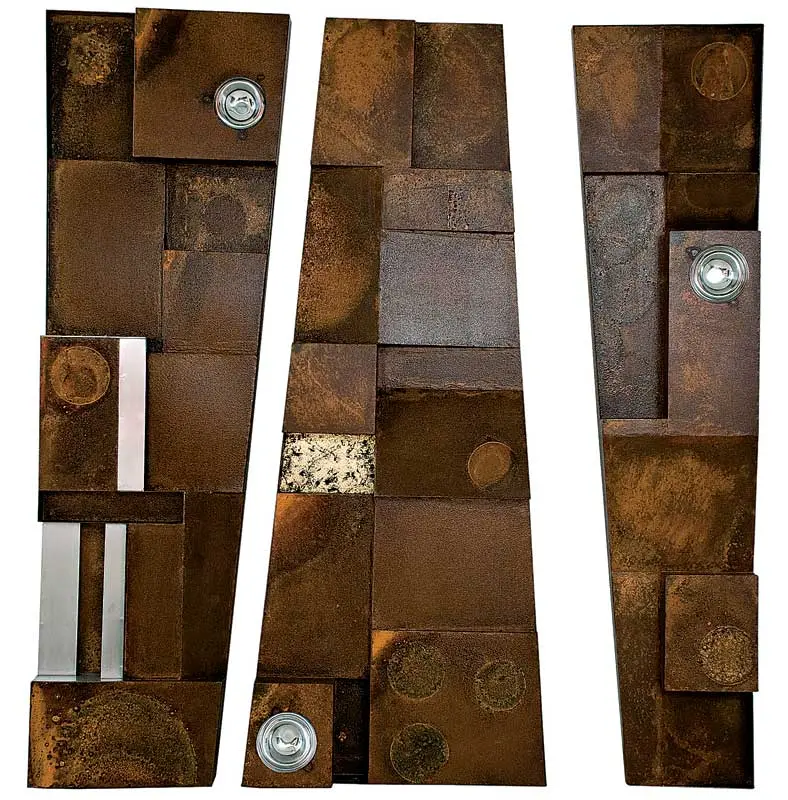
I have known Heriberto Nieves since the beginning of his artist career. I have seen him evolve and become a true three-dimensional poet. One who can merge cosmic (the beauty, mystery, and incomprehensible vastness found in our enigmatic universe) and everyday elements (our daily existential struggles transformed into metaphors) with great lyricism and dramatic gestures. I can attest that we are before an amazingly energetic and uncannily creative person.
On one occasion, Nieves said to me in an interview: “I have always been an artist. At one time I did not know it, but once I accepted this gift I have done nothing else but art. I draw inspiration from my surroundings: the countryside, the ocean, the Universe, and mainly, what I see when I look into a mirror; a being full of creative possibilities whose mission is to interpret, transform into metaphor, the things he is exposed to, that he has a passion for, and that define him.”
At the beginning of his career, Heriberto Nieves concentrated on painting – specifically in the male nude figure – but he was immediately seduced by the three-dimensionality of sculpture. He then created constructions and/or installations existential in nature (he would intervene x-rays and invite the public to enter dimensions that Shakespeare defined perfectly with his famous “To be or not to be.”
Having fully committed to the art world during the 1990s, Heriberto Nieves understood he had to “make up for lost time,” so he completely immersed himself in his work and in a short time was able to build an original and easily recognizable aesthetic discourse. Sure of the direction his work was taking, his compositions – fashioned by welding several metals, some oxidized, others painted – are based on humans and their physical essence (the human being’s relationship with “everything,” specifically with the sculpture and architecture inherited from Marco Vitubrio and the Greek world), as he cleverly closes in on humans and their relationship with spirituality and the Universe.
Understanding our relationship with life, time, and the Universe to which we belong has made Heriberto Nieves’ artistic endeavor remain in a constantly evolving state. Each of his basic periods is an approach to the human condition as it is presented in the different stages of his life – birth, childhood, adolescence, youth, maturity, old age, death, immortality – and the relationship we have with the firmament. The artist has stated this clearly when he noted: “My work is always evolving. It is based on my aesthetic and ethical inquiries, and on existential experiences during my childhood, adolescence, and youth – all those discoveries that took place that make me who I am today – and, most importantly, my work draws from the contemporary moment in time in which I exist, within a society that continues to question and judge me, a generous yet still very unfair society. I find refuge in figuration, in my homo-erotic photographs, and in exquisitely abstract works. I find refuge in transforming into three-dimensional metaphors my relationship with Eternity: an unknown space where we may have the right to fly, the right to all liberties, even those unimaginable ones.”
The work by Heriberto Nieves in Puerto Rico and in other countries (a production as prolific as only that of Puerto Rican Master Pablo Rubio) is celebratory in nature. This artist lives each part of the creative process intensely – conception, creation, and installation – for his artistic expression is always a celebration of life (even with all of its injustices and contradictions), of miracles, epiphanies, surprises, and orgasms.
The same artist who created red waves near Puerto Rican beaches, amazing celestial bodies full of lyricism and mystery in France, South Korea, and China; yellow waterfalls stemming from rock mountains; secret maps filled with “coins”/”urns” to lose ourselves in sweet adventures; “angels” dancing beautiful rites of seduction; this time wants us to know the work he has created during his 52 years of age. In his previous exhibition at the Biaggi-Faure Gallery in San Juan titled Mapa Cósmico (Cosmic Map), this multifaceted artist presented an impressive and seductive show of the “adventures/cosmogonies that entice him as an artist, and as a man whose sexuality is still questioned. This time, Heriberto Nieves has decided to share with the public pieces ranging from mobile sculptures, defined by their poetic balances, to “paintings” framed in metal “boxes” that attempt to capture – from an organic/symbolic/spiritual point of view – both the Caribbean nature and the Cosmos; from a hallucinating triptych that may be appreciated as the landscape observed in a cosmic voyage, to a pendulum with which Foucault would have been happy (or the other way around…).
MANUEL ÁLVAREZ LEZAMA