
Julio Galán’s trajectory in the art world can be described as a fulfilled dream. One could even make it, following the testimony of those closest to him, into the plot for a movie: Julio Galán in New York City. Was it a fugue, an escape, or a call to be heeded? There were opportunities for the projection of his work; the leaps and triumphs that took him from Monterrey to New York, and from there to France (and the world) are easy to enumerate but were hard to accomplish. The tragedy of his death of a stroke came to pass away from all cosmopolitism, in Zacatecas. Galán was so given to legends that, in terms of fatality and fate, and following his own trajectory, this was probably inevitable.
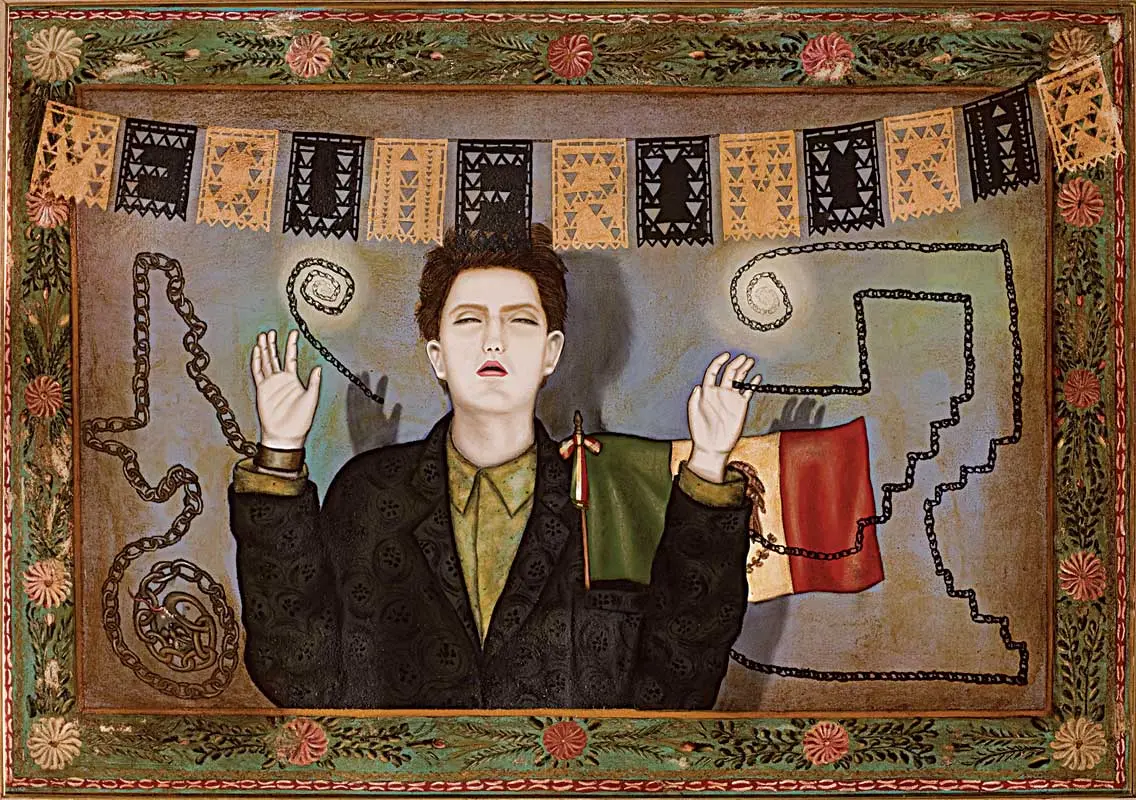
Julio Galán is a product prone to petty-bourgeois mannerisms, given with supernatural passion to his own role. Julio Galán knew himself to be Julio Galán: there wasn’t a quest, but a lack of satiety. He knew his own spectacle, and he knew more than that. It is not an invention, he invented himself time and again between irrational bursts and the order demanded by compulsion, his work and career are comparable to Basquiat’s or Clemente’s: the last residue of Romanticism (a rococó disorder, as natural as it was gaudy.) He was an apparition. An exemplary paradox that portraits a costumbrismo trivialized in its exacerbation, negated as a possible world, even on the canvas, violated to the point of its tearing apart in its quest for a euphuism that was tragic and ridiculous in equal measure. An uncomfortable prodigal son, sold as “Mexican painting’s enfant terrible,” he ended up described and explained —with uneven success— among labels and declarations (the latter is attributable to Argentine critic Ana María Battistozzi.)
Yet beyond all that Julio Galán possesses an ungraspable quality. Something that defines him, period. Hanging from a wall he is revealed as a mystery, between the narcissistic fixations of an imaginary created as an alternate reality, a never-never land, a wonderland, stained—the adjective is indeed auspicious—with violence as real as the deceit that exists between possible worlds: disappointment, resentment, frustration. The enchantment-like appeal of Galán’s work for the general public, beyond collectors and specialists, is that he doesn’t need to be explained, at least not in the way required by other contemporary artists. He lives like a per se, I insist; something that lets itself be hung on a wall and displays its value. He has a history, emerged from his fascination with the Baroque and the paradoxical needs (a symbolism that says and un-says) of his own neurasthenia. You might want to have someone to explain, in a sympathetic way, the place and time of each painting, as though in that way it were possible to unveil the lot of a perhaps excessively romantic artist, by roll-calling, with medical candor, the symptoms of his pathology.
To his chagrin, Galán has become an official artist. Exploitative reduced to being almost a pop reference, he survives as an extravagance. It is not as much about his work as it is about the character created on the basis of his work. The retrospective selection exhibited at San Ildefonso shines for its anecdotal character. The videos, photographs, and testimonials that frame the 120 works on exhibit (between oils, pastels, collages, and ceramic) insist on the character, as a starlet rather than as an artist. Our tour of the work is supposed to be chronological (it gets lost at times between themes and dates,) in a prêt-à-porter exhibition put together by Guillermo Sepúlveda, his discoverer (he presented Galán into society in 1980, with an individual show at his Monterrey gallery) for MARCO. In its itinerancy, the show was previously at the Amparo Museum in Puebla. The museography, attentive more to unloading than a reformulation of places, is inadequate to the brightness of the star. The show is supposed to be biographical, yet it falters in its chronology. Excessively trusting what has been put on display, it fails to understand it beyond the rudiments of the play-by-numbers.
For Sepúlveda, Galán’s world was “utterly Proustian.” This not in terms of a lost time but a complexity that demands, “for its just appraisal, great attention and patience in order to decipher a vast number of unimaginable codes.” It is not a question of a past to be recovered as it is one of “the secrets of the thousand voices of the past that inspired him.” The narrative vocation of Galán’s work tempts with a literary explanation that, I am afraid, is closer to Kafka. It is a mysticism of the possible enumeration of the pathways of the chosen. Julio Galán lies time and again, and in each one of his representations live the unsettling traces of something that wants to be true in order to explain its horror.
In Galán’s own words: “I like to use makeup to provoke others and myself. With it I am not hiding from myself; it is all the others who are rattled and hide from me.”
RICARDO POHLENZ