
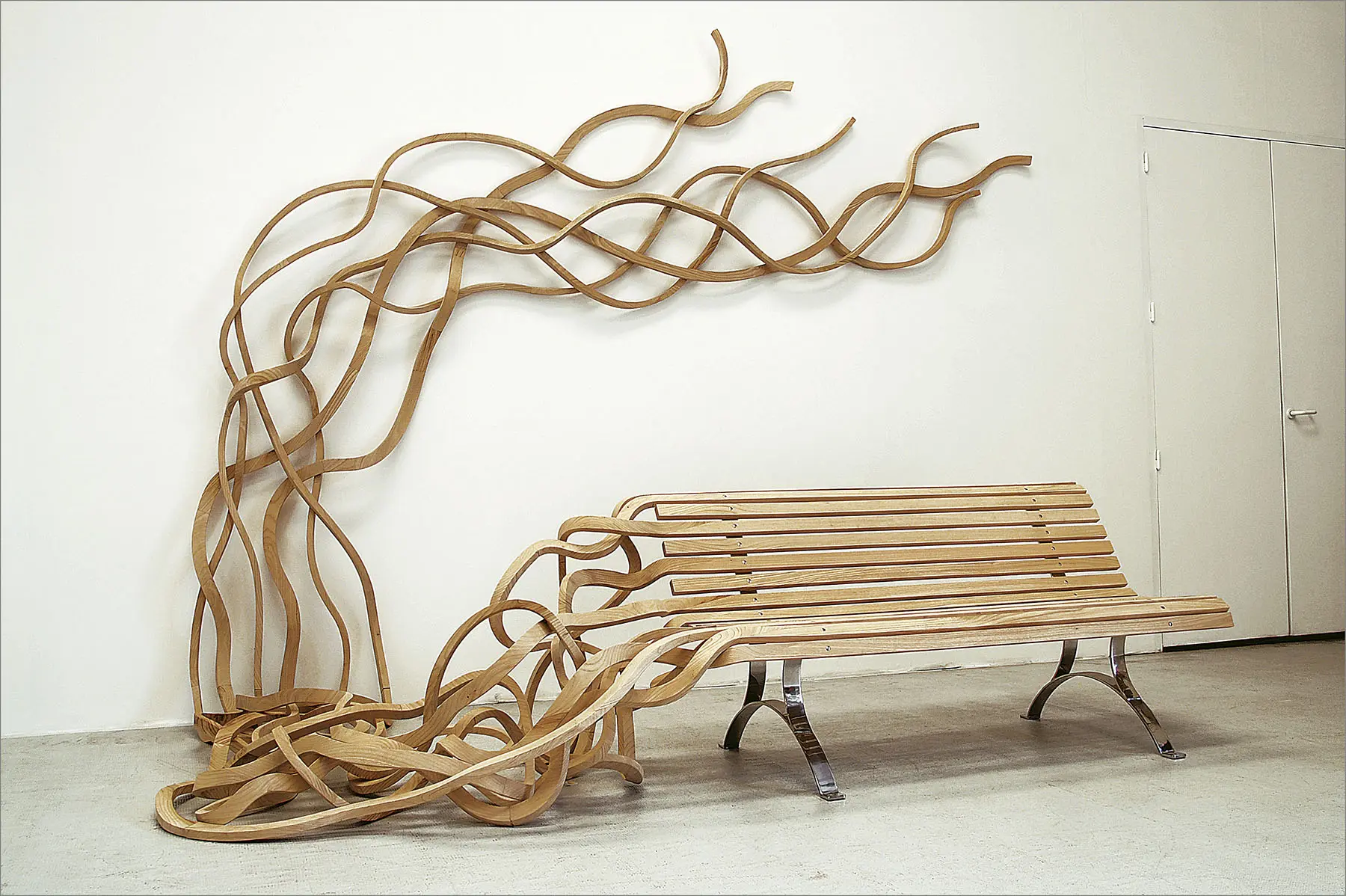
In the work of Pablo Reinoso (Buenos Aires, 1955), uncertainty has a happy ending. A mixture of architect, sculptor and designer, space and time for him never cease to be ontological coordinates, which in their material expression are able to push us from concern to crisis and return us safe and sound —also a little more aware, but in good spirits— to the (almost) everyday world.
And it is by virtue of that ability that Reinoso’s workflows in two directions, depending on whether one approaches it as art or as design. While he knows to respond to the requirements of the latter with bonus tracks that hit emotional or spiritual zones, articulated in a natural way with the orthodox couplet of form and function, Reinoso is also able to question design and render it more honest, proposing transparency that salvages it from its Faustian bargain (yes, with marketing) and rejoins it with the necessary history of things made for living. In both fields, his work retains two tones: strong and discreet. But, does Reinoso belong more in one field or in the other? In a holistic way, he seems to inhabit both at the same time.
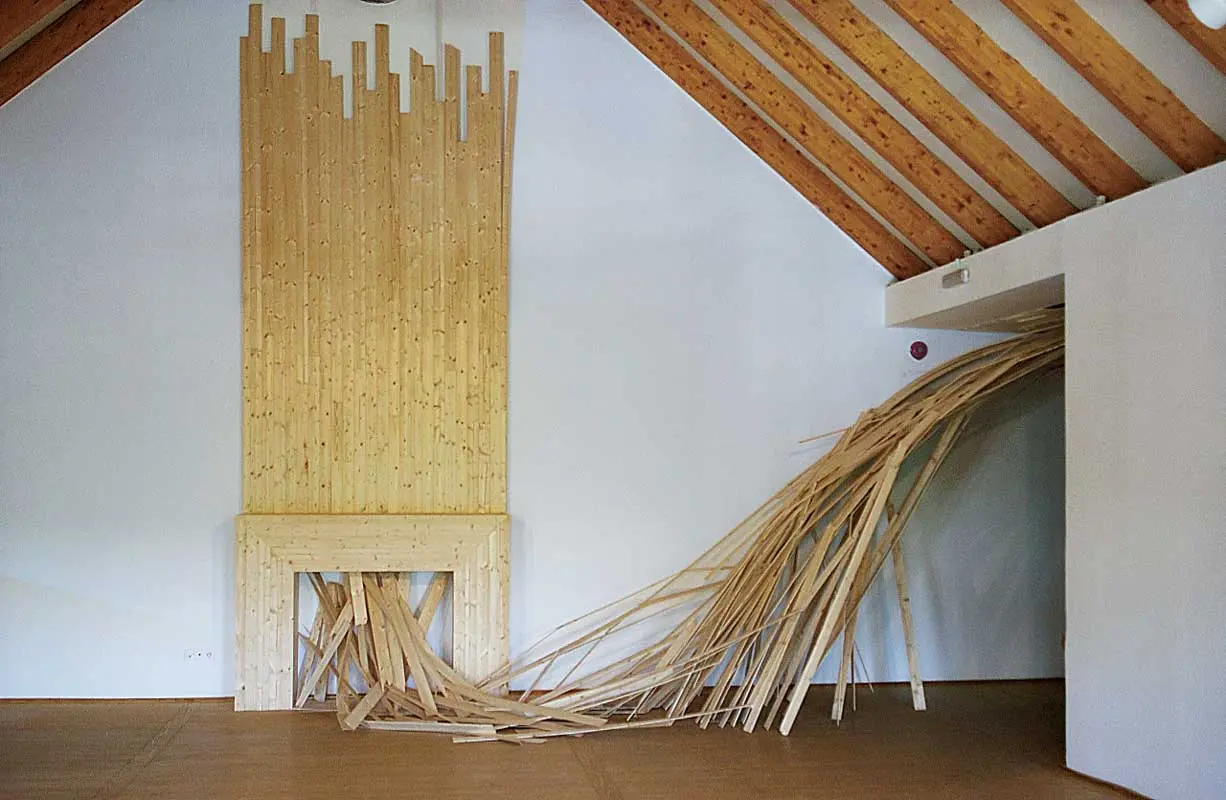
And, in that sense, it is possible that Enredamaderas (2009), the installation he recently hung (and the verb acquires in this context a superlative dimension) at the Museo de Arte Latinoamericano de Buenos Aires, is the monolog that best represents that irreversible path. This work, which required 600 linear meters of ash wood, was delicately sculpted by sections in a Colonia del Sacramento, Uruguay, workshop. It is a park bench, of the classic type and iconic all over the world, but with a rebellious bent. Already in the sitting part, a light crossing of wooden pieces announces the vivid awakening of the plant matter that was its wood, which a meter later will concentrate the organic force of all matter to launch into the conquest of space in search of light, in its own way.
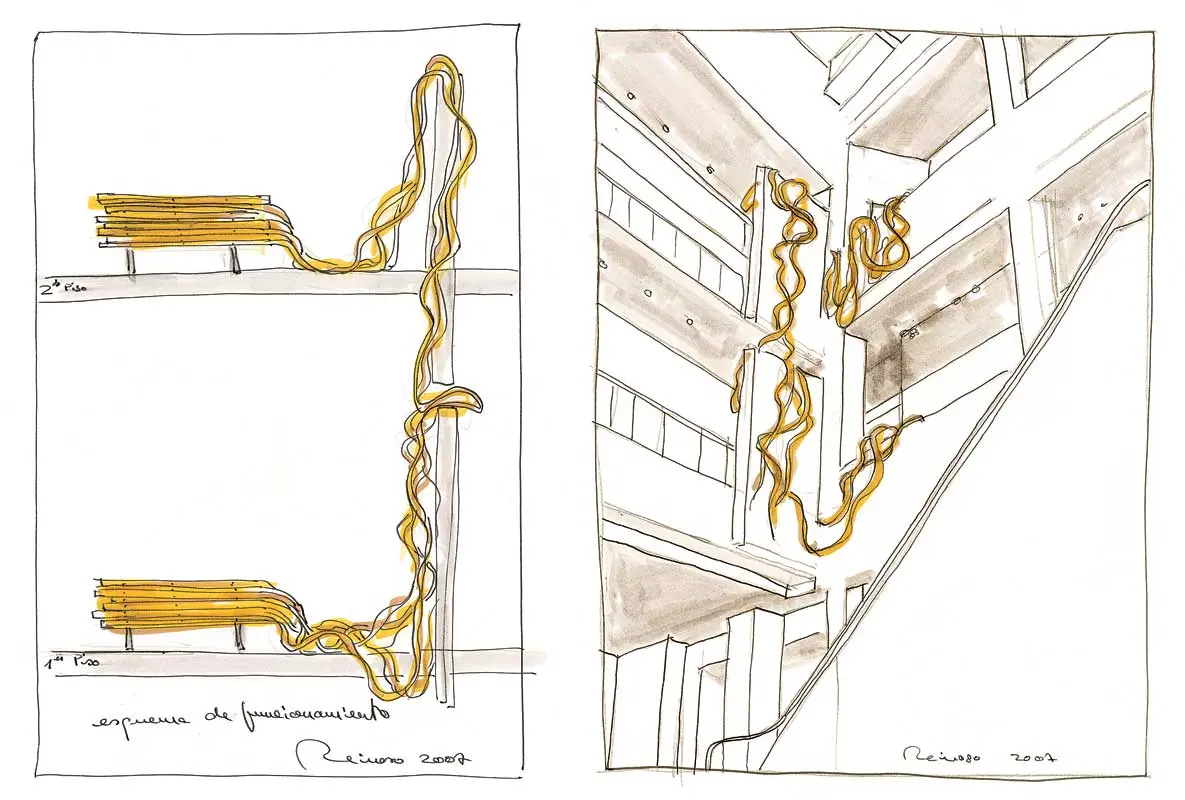
Situated in the museum’s second-floor gallery, the bench frees the green impetus of its wooden strips, which twist forward, upward, downward, entering a crack, climbing a wall. For those who see it from the ground floor, the volume outlines against the wall an overflowing spaghetti pot on a Lewis Carroll scale. Meanwhile, the work, which now hangs morbidly in the vacuum, grasps the first-floor rail, enters the gallery, and returns to its state as design thirteen meters below, originating another bench, which unloads such epic effort with slight rasps in the wooden strips of its seat.
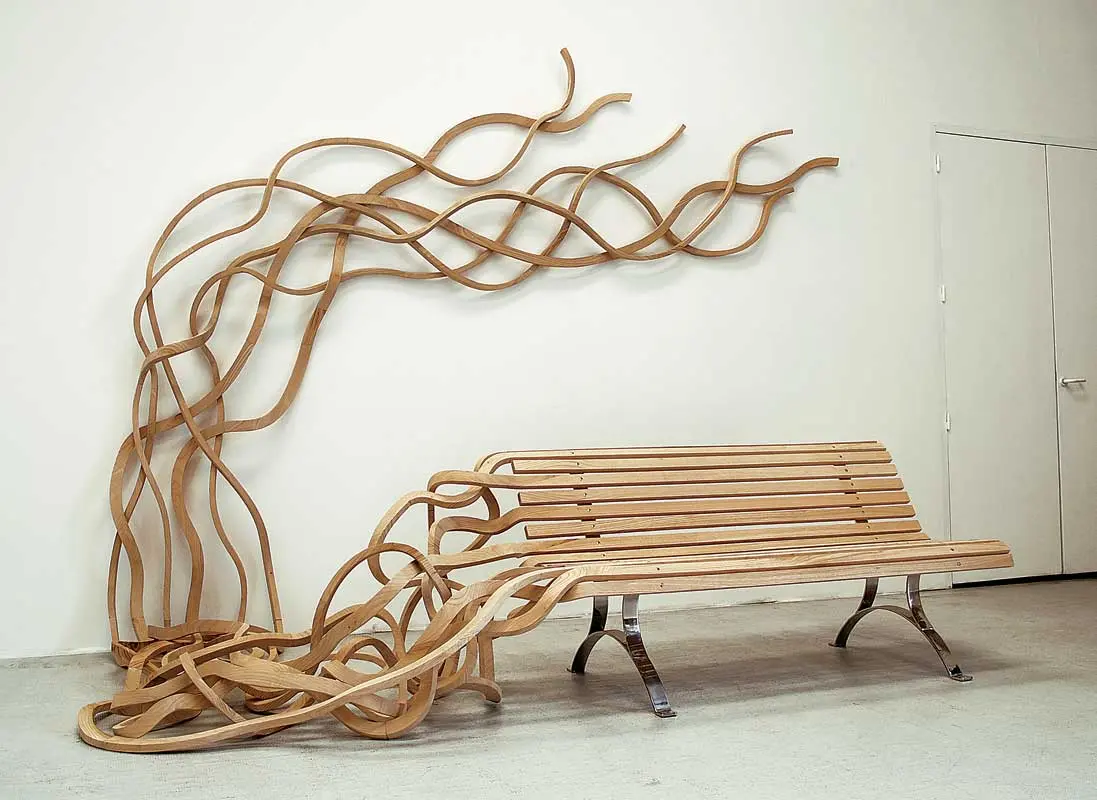
Specially conceived for MALBA’s Interventions in Architectural Space program, Enredamaderas integrates the series of spaghetti benches that takes as its point of departure the traditional park seats, the one that every city claims as its own and whose origins are lost in anonymity. “At the start, they all respect their initial design, but each one invents a new story. This is the boldest because of its size, the one most involved with its own fate: the architecture that will hold it,” the artist explains. Confronted with the challenges of scale and location chosen by Reinoso —a triple-height corner, perhaps MALBA’s most difficult, right at the angle above the access escalators—Marcelo Pacheco, the museum’s general curator, notes: “What is striking about Enredamaderas is its dual nature: it encapsulates the paradox between what is controlled and what grows wildly, highly marked by its dimensions. It is lightweight and dense at the same time, mysterious and comfortable, skillful and wily; it possesses the menacing peculiarity of things that change. I am astounded by the way in which it dialogs with the works around it: Bony, Seguí, Kuitca, Berni; it can slide by calmly, it can compete, at times it falls silent.” It is true, following the choreography of Oscar Bony’s El triunfo de la muerte is not an easy task. Yet, the image of an oversized spaghetti connotes the precise Mafia-like sign required by Bony’s black and white series of bullet-ridden self-portraits. “Pablo’s work is mutable, it has the meaning of visual utility and the sliding of the senses,” Pacheco adds, after pointing out that this is the first intervention since the program’s inception in 2002 that explores directly the porous border between art and design. And Reinoso is a long-term explorer of these shifting scenarios. Regarding the notion of vines and creeping plants, all he says by way of a precedent is his viewing of Tarzan as a kid (laughter). Meanwhile, what drove him to incorporate benches and seats as raw materials was his perception of the “sitting beings” he understands us to be and the flaws in the design of chairs.
A disciple of Jorge Michel, Reinoso began as a sculptor at the age of 13, although he remembers that already then there were things that moved into the domain of design: chairs, loungers, bookcases. And his sculpture revealed a significant concern with function: this is how his articulated works originated. “Many years later I realized I was mixing both things and made a division, letting the visual work drift away from functionality and consciously driving my designs to assume it frontally. But since one cannot escape the path followed, my spaghetti benches came to put that border in question,” the artist-designer —who already at the age of three had been given by his mother his first carpenter’s bench, to be like his grandfather— says now.
Looking back now through the rearview mirror and identifying the landmarks of his dual path, Reinoso notes that Ashes to Ashes (2002, Casa de América) is a breakthrough moment. That installation manifesto, titled after a beautiful and raw David Bowie song, created an apartment where the architecture turned 360 degrees and disappeared through a chimney. An interior tornado, in slow motion, that holds within itself, in an altered state, Reinoso’s generative obsession: space, where everything takes place, what is and what seems to be. The recreation of his sequence paintings inside spatial environments is outstanding. In this way, with resources that seem telepathic, in this work, he shifted planes and added, to the omnipresence of air, the threatening notion of the element of fire. A step well beyond the warmth of the home hearth.
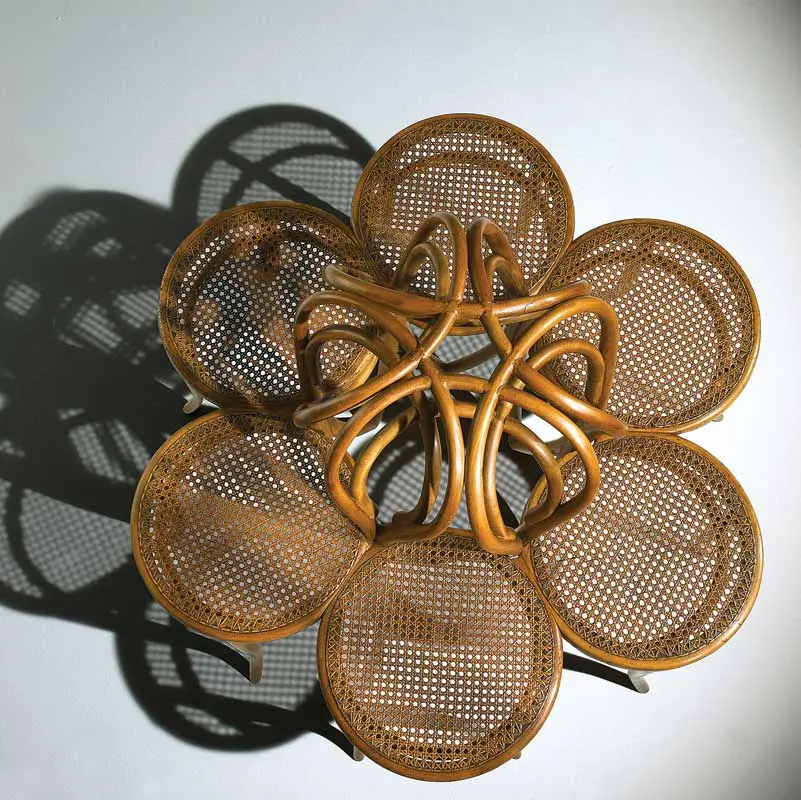
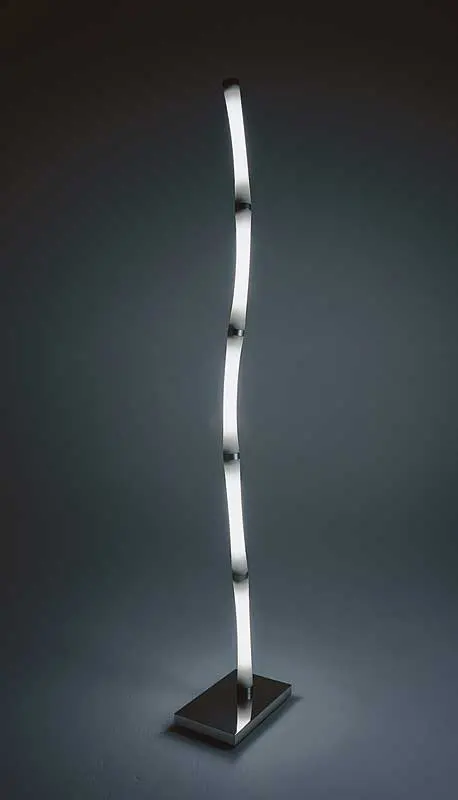
Whereas design works like the Bamboo Light System for Yamagiwa (and one has to be bold to work in bamboo in Japan,) the cosmetic and perfume containers for Givenchy (at last, rouge that comes with the little mirror necessary to use it,) or the feathers for Dupont are the result of maturity, the marks of such growth in the painting are given by the Respirantes and Thonet series as well as by the spaghetti benches. Don’t the Respirantes sculpture contain inflatable objects that could be serially manufactured, supports, and refuges that appeal to the insuperable comfort of captured air? On that point, Reinoso reveals that for him, comfort is synonymous with space, with having a place.
The pieces that comprise this series, which uses high technology to rhythmically inflate and deflate the parts as if they were living objects, evoke pillows, stretchers, or beds that invite us to reflect on issues like sleep and dream, breathing, and illness. About the precarious and mystifying balance that governs biological functions.
“The explosive spread of design makes my ideas look better than before. And now that my two worlds are known, it is fun and interesting to look back into my previous works, when you can clearly see which part of each is present in the current ones: this is a recent discovery for me, and I want to observe it,” the artist acknowledges.
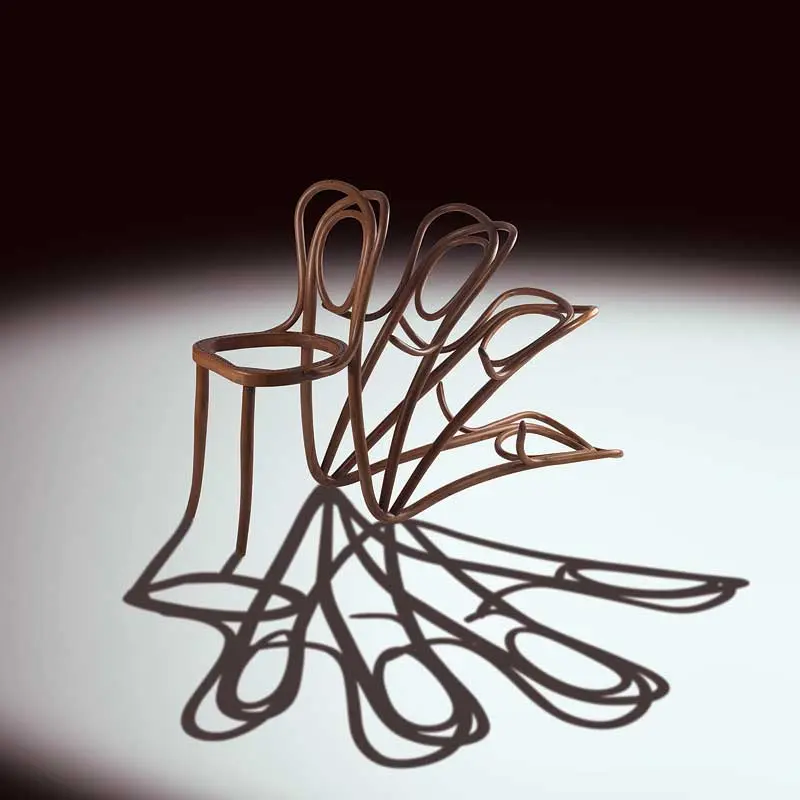
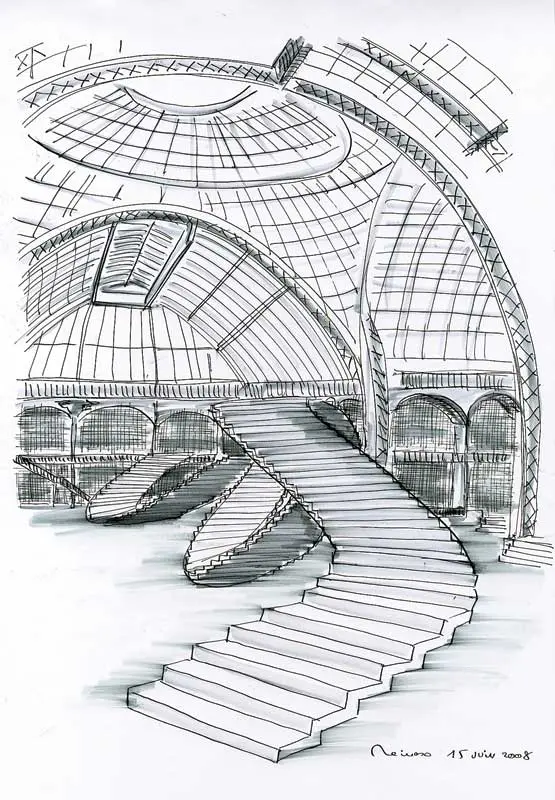
In that chain of inputs and outputs, it is important to note other concerns such as fragility, order, and passages-habitations, traversed by time’s inevitable arrow of beginning-development-end and alternatingly interrogated in the public space (Grand Palais, 2008) and the private one (Mon 9m2 place Saint Sulpice, 2003). The themes that bind a being to its material and objectual world in Reinoso’s are so deeply existential that the thoroughness of his work makes them less worrisome, more superficial in appearance, at times decorative. This generates a double spatial and emotional paradox. Charge and release. Charge and release. For instance, the weight of his dialog with Thonet has yet to be properly appreciated: Reinoso took the first industrial furniture design, a historical landmark, and 150 years later made the world’s best-selling chair (number 14) to once again explore the relationship between body and support (and neurosis!), in a choreography deliciously unwound by Spain’s Blanca Li. The fine jesting tone of his work, which possesses the histrionic and candid tempo of silent films, began to assert itself already there. “Divertimentos, allegro vivace,” he would say, perhaps influenced by his friends Les Luthiers, the Buenos Aires group of comic musicians, for whom he created a series of instruments based on the Thonets: Lethoneterias. “But it was time to dialog with design itself rather than with a designer, I didn’t want to be Pablo Thonet any longer, I was beginning to look like a traveling salesman for the company,” he says, amused. Poltrona Freud (2004) was also an interesting, over signified game based on an iconic chair from Made in Italy, the Vanity Fair of Poltrona Frau, from 1930, the archetype of modern chairs. The ultralight Jyn & Jon chair revisits another historical piece: Frank Lloyd Wright’s Taliesin Chair (1946). Reinoso being a resident of Paris since the age of 23, but very Argentinean at the same time, the unconscious associated with the couch and to wood (also the parquet flooring, in a possible allusion to a Peronist political metaphor) appear again in an essential series of photographs that reinterpret psychoanalysis on the basis of furniture. But note that this is done without orthodoxy: “The world seen from the standpoint of laughter is a marvelous world, there is no way to avoid the end, but in the meantime… who can take away anything from you,” he quips.
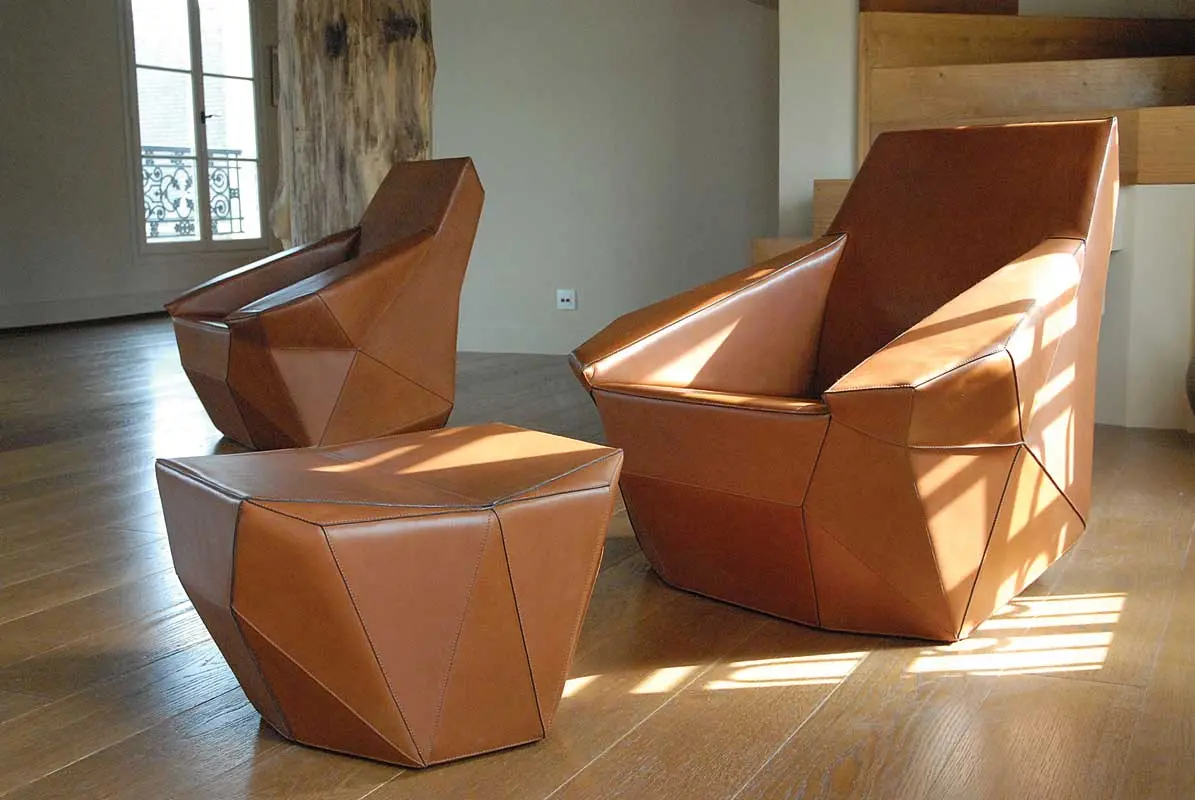
Among his closest echoes with other artists, he acknowledges Picasso. “It seemed a stretch. I like Picasso very much, all of it, but what moves me the most is the line: for me, he is a draftsman who courses through the entire work structured on the basis of his drawings’ line. Picasso’s line is s-e-n-s-a-t-i-o-n-a-l, such handling of rhythm, of sensuality… the lines of this vine as they come down, taken in sequence, have something, even if it is a translation into solid materials. While I was doing it I liked to think of it as a dialog with Picasso’s line,” he says. He also cites his recent memory of folds in El Greco, achieved through the use of shadows: “It is something that always touched me deeply, but I never thought I would be able to include it in one of my works: like thinking about him as I am working, to augment the line of force. That came as a surprise. Had I been a painter, it would perhaps have happened through the palette, but I am a sculptor and approaching El Greco from sculpture… one is parked far and needs to walk for a while to get there,” he says with a smile.
Other artists he has felt connected to in recent times were graphic humorists, such as Steimberg and Quino. “For example, one day I remembered a drawing of a man who bends a tube with his knee while looking at a musical score, and as the image zooms out he sees what the brass instrument will look like once it is completely bent,” he laughs. About the touch of humor in his work, he says that the comedy component appeared in recent years and that it is fragile but also fun. “Respirante is a strong work, highly abstract, very forceful, but you don’t laugh, it confronts you with your life. Starting with the Thonets, people started to laugh. There I realized I have the capacity to make people laugh. When I was younger it never crossed my mind, I was too impressed with art to have fun or move to a joking tone,” he says.

As in a delicately balanced movie, humor and fragility—which is part of an apocalyptic vision—coexist in his entire visual work: “Something that moves me is the balance of the Earth,” he says, as he works on his new series of hand tools for working on soil, all of them with unsettling handles that come alive, fueled by the same vegetal drive that put Enredamaderas in motion. Reinoso accepts that this work, originating on a commission, functions like design, in this case with MALBA’s architectural space as his client. And in this way, he arrives at another key point in his concern with borders: the way in which he uses design to question the genre. He prefers the idea of “shaking” it. “Having been schooled in art as I was, when I am in a design mode I know that I must offer a solution to whoever is paying. In this case, the work can be questioned like any work of art would, and perhaps as a design object. It seems to me that there is something positive there. I am not pretentious, I don’t go around saying ‘look at what I discovered.’ I note whether it shakes things or not.”
There is an almost surrealistic episode in the prehistory of the spaghettis that Reinoso lived in 1992, caused by a transportation strike that paralyzed France. The legs of a table he was supposed to deliver were stranded in Marseille and he was unable to go get them. He subjected himself to two or three hours-long traffic gridlocks until the time when the strike has ended, he was able to get to them. Something made him take the least-crowded ramp into the expressway. After a while of driving without seeing a single car, he started to see how grass and trees grew from the asphalt and how the animal population around also became denser. That post-civilization world he seemed to have entered was nothing but plants and beasts reclaiming their domains during a “break” granted them by human society. “I knew then that even if humanity destroys everything, there will undoubtedly be a living body to start a new cycle,” Reinoso says. “Between euphoria and sadness, I discovered the strong strategy behind vegetal growth.”
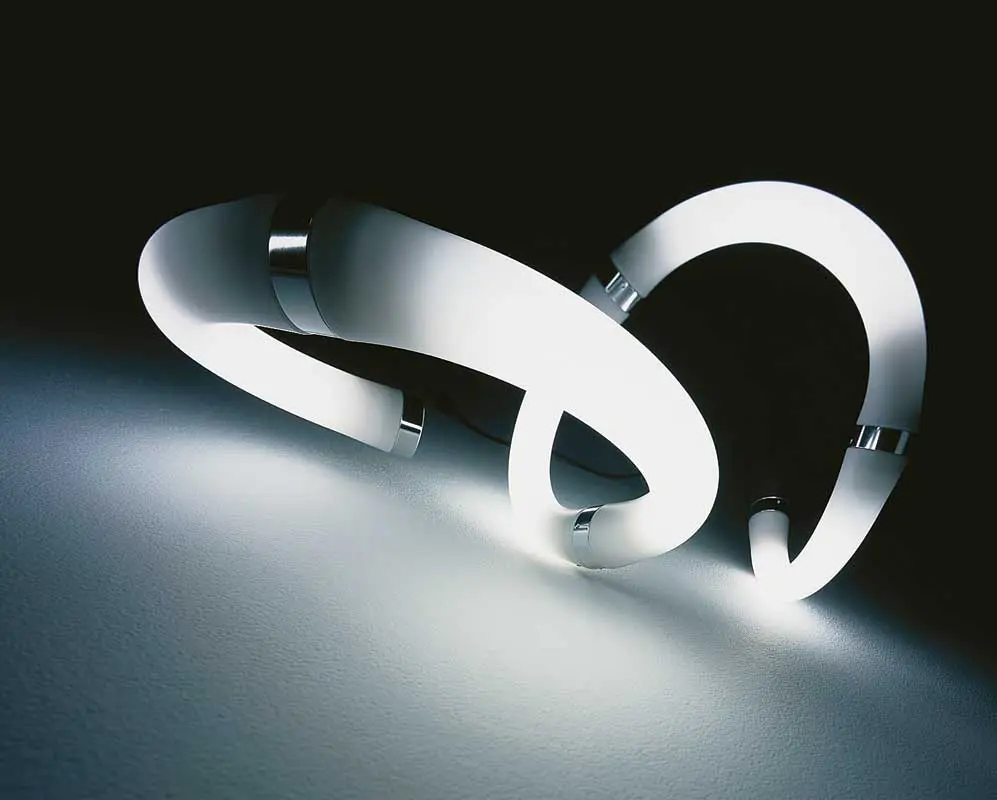
This is why this most recent work and the tools that will follow it, rather than launching a dry ecological message, use an organic break: we cannot produce without concern for the consequences. But, then: so much wood? First, he answers, this is wood that it is permissible to use, a controlled harvest. Second, the message behind everything that is senselessly spent, due to the abuse of marketing, is to think about returning it. For Reinoso, it is extremely interesting to work based on a pattern of growth as finely elaborated as the vegetal one. “Nature always has a good argument. It will create horror, but not a stupid thing. That’s why I question design, which behind the full pressure of marketing tends to repeat the same nonsense without asking questions. The intellectual demand for art is much higher,” he asserts.
Although Reinoso claims to know little about Latin American design, he assumes that the region’s designers, having fewer resources, already adopt a more critical posture. “I have contacts with many of them and they seek me out from many parts of the world in order to work in my study in Paris. I must have a point of sincerity that is identifiable, precisely in a field that is all covered by marketing,” he ventures. For Reinoso, the lie begins when excess production must be sold. “Every once in a while there appears in the art field a successful idiot, but there are so many critical eyes and so much reformulation that interrogates what happened before, that there are defense mechanisms. In design, that observation workshop is less common. Whoever is selling something well, will not question it…,” he says.
From a reading of his own trajectory, Reinoso highlights the gaze of the great conceptual artist Víctor Grippo (Junín-Buenos Aires 1936-2002). “He liked my work from the beginning. I met him when I was very young. I left for Paris in 1978, at 23. I had exhibited here (I started at 18), and at that time he was working on his toolset in reinforced concrete. Many years later, in Paris, I took him to my workshop just as I had finished designing some rouge with a mirror (for Givenchy) and I gave him a cosmetics line. And he told me that it was great for someone to approach the term design from the standpoint of art, which is what he had done all his life. ‘Design is the foundational word,’ is what Grippo said.”
This kind of operation gives the design the ability to generate a critical discourse: a vaccine against its autoimmune disease. “Curators spend their time electrocuting artistic creation in order to see what is left. Who or what opened up a semantic field, and who or what did not. This is one of the most serious areas in terms of classification of values, with plenty of research activity. However, in design… everyone who has an ass can sit on a chair. And there are industries that manufacture them, and that’s it, nothing is questioned. There are no strong intellectual demands as in the case of art,” he says. Why is it that a design object developed from the artistic field can open a long chain of signifiers that interrogate other products? For Reinoso, what is important in that operation is to question the paradigms in order to prevent a victory of marketing and a defeat of design in its essence of solving problems with less cost and for a larger number of people, rather than inventing a need.
—How do you see the fact that design is entering the world of collections, something greatly emphasized after Design Miami Basel?
—It is always interesting for certain areas of creation to be valued. The design will have to establish its collecting hierarchies, it is a matter of time. But I am certain that it will have a significant place. As far as I am concerned, I am stirred always by prototypes: the moment of searching.
And while he thinks about what is next for his new tools, he shares his interests: “I want to move into construction tools, but I haven’t found the way yet because I want to think up works that resonate precisely with Grippo’s, designer first and then artist. I was influenced by the way he looked at my work, even though at the time I didn’t understand his reading, and time didn’t allow us to explore it…,” he says. But Grippo’s interest is for Reinoso a good sign: “I don’t know if I am decoding it right, but frankly I do the best I can to remain loyal to that gaze.”
CAROLINA MUZI
Design Journalist and Editor.