
In 2005, the first San Juan Poly/Graphic Triennial revived the legacy of this city which, despite its geographic isolation, was decades ago a veritable epicenter for a view of the continent’s strong graphic tradition. Under the theme of Trans/Migrations: Printmaking as Contemporary art, the proposal, organized on the basis of vectors like technological displacements, geographic transits, and conceptual trajectories, fulfilled its intent with an expansive view dispersed throughout different locations, which in good measure allowed us to revisit the historical contributions of Puerto Rico’s powerful graphic arts, focalized on cultural resistance through print media, and also revealed its potential use as a source for the production of meaning in the work of Latin artists in the Americas and Europe.
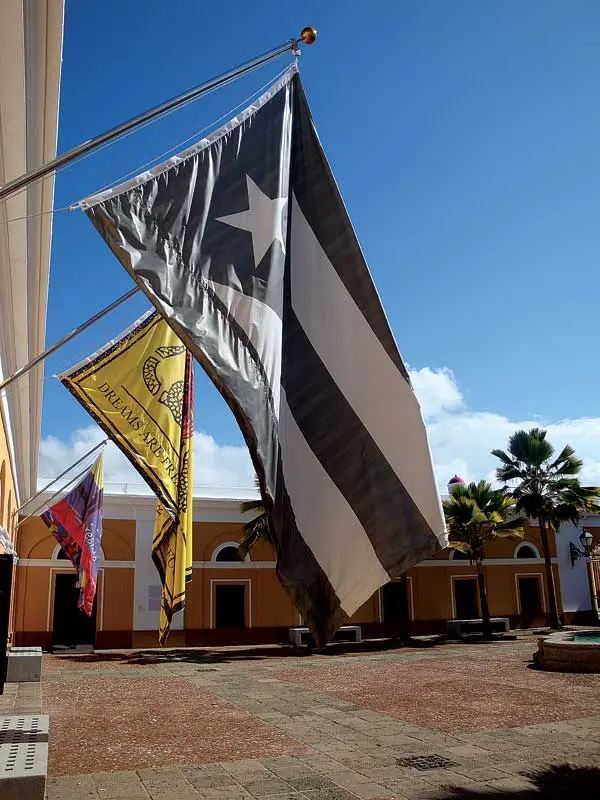
With the second Triennial, headed by Adriano Pedrosa, co-curated by Julieta González and Jens Hoffmann, and concentrated on the galleries of the old Spanish Navy armory, La Puntilla, the force of this epicenter acquires a new dimension and is reaffirmed from a more focused perspective, decidedly turned abroad—without excluding, of course, key boricua artists—that approached the modes of artistic production of the present by means of two strategies. First, a “constellation of solo exhibitions and artist’s projects” was selected, which, given its character, restricts the number of inclusions following criteria that can be considered exclusionary but give greater and better visibility to the nature of their creative proposals. The collective exhibitions included works related to four axes both in terms of working means and conceptual projection: marginal money, literary forms, diaries, the archive (comprised of personal records and public histories), the flags especially designed for the Triennial by Federico Herrero, Alexandre da Cunha, Carolina Caycedo, Hew Locke, Julio César Morales, Juan Capistrán, Wilfredo Prieto, y Adriana Lara. The Triennial evoked the kind of rare emotion one experiences when the coherence of a curatorial vision gives us access to perspectives that open up channels into contemporary artistic production. Not a reflection of trends, of course—because they are many, dissimilar, irreducible—but ways of revealing the implications of certain closely related artistic practices, which precisely emerge from the spaces of intersection between the works. For example, new ways of using the graphic arts to amplify collective memory; the relationship between artistic and literary procedures and alternative forms of political contestation, such as the unveiling of fictions that, through the printing press, become confused with reality; or the kind of meta-artistic practices that parody the mercantilization of the work of art or money itself as an art object, and the transgression of the modes of circulation of the work of art.
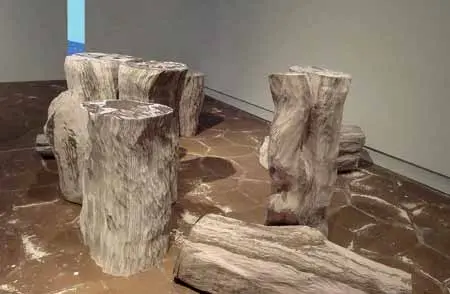
In the constellation of solo exhibitions, Miler Lagos’ show has the quality of a meta-artistic work that contradicts the properties of the material it apparently uses (so as to relaunch the old philosophical debate between appearance and reality, or to destroy our perceptual habits), and also connects with the history of art and society in each context. In this case, his fictitious wooden tree trunks were built with piled-up copies of prints by Rafael Tufiño, one of the greatest practitioners in the tradition of social art that emerged from the Taller de Artes Gráficas of the Education Division to the Puerto Rican community. Each misleading trunk accumulates—with a gesture that is playful but not alien to the relationship between the work itself and its context—the infinite reproduction of history-laden images like that of sugarcane cutters.
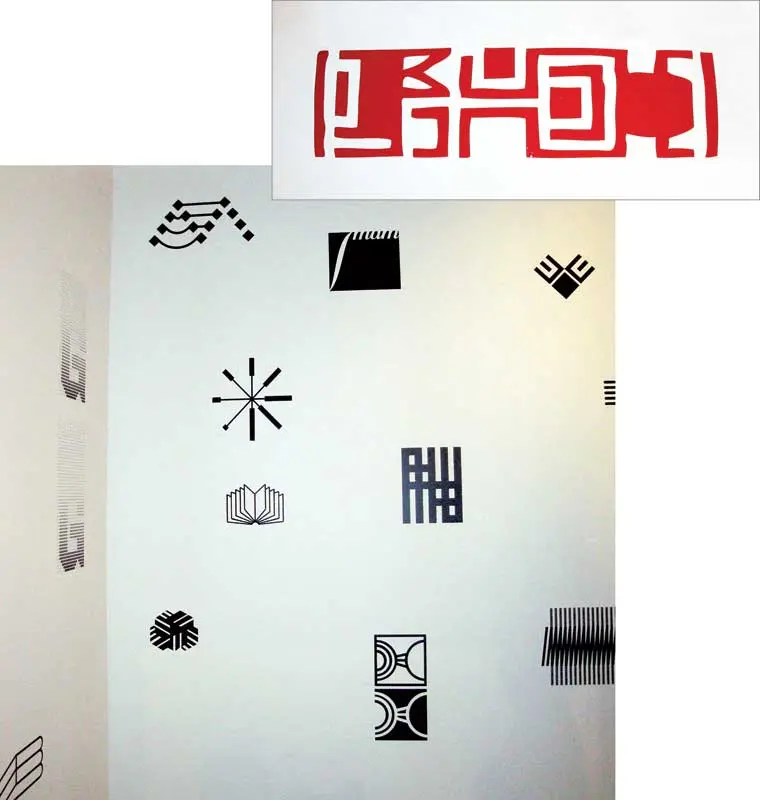
Both the potential of the graphic arts in the politico-social arena in a much more playful or subtle way than in previous decades, but without losing sight of the historical tradition and of artistic procedures, and the exploration of fiction in art, are contemporary keys present in other solo exhibitions. In a small room/passage, illuminated by an intentionally weak light, Alessandro Balteo Yazbeck exhibited works from the series Enredos modernos, with 19 institutional emblems created by various artists and designers—such as Carlos Cruz-Diez, Víctor Hugo Irazábal, Gerd Leufert, or Waleska Belisario—between 1960 and 2003, compiled by Aixa Díaz and Álvaro Sotillo. The long graphic tradition that produced hybrid emblems of pre-Hispanic iconography and modern designs was negated with the homogenization of all logos into a single emblem created by former Culture minister Farruco Sesto, who in 2006 imposed a drawing he had made, inspired by the iconography of the Panare ethnic group, as the sole and omnipresent image for all institutions. The totalitarian undertone of that gesture, equivalent to that of Chinese emperor Shih Huang-Ti, who attempted to erase all traces of culture previous to his dynasty, is exposed with this installation. A refined conceptual protest that recovers valuable images condemned by power.
The exhibition of the Taller Popular de Serigrafía is perhaps the show that is more connected to the graphic tradition in terms of political struggle, in this case in Argentina. As Magdalena Jitrik puts it, “Political graphic arts happen in explosions, accompanying insurrectional moments.” The works function as a trace of historical moments. For example, the members of this workshop accompanied the foundation of a political movement led by subway workers seeking a six-hour workday in 2006. When the group was deactivated in order to find the Movimiento Intersindical Clasista, the Taller created a flag. The graphic arts, beyond the story of those groups, synthesizes in this case the intense concentration of human masses around objectives. It functions as traces that are not altered by a historical defeat. Residues of a memory that is, in the end, collective.
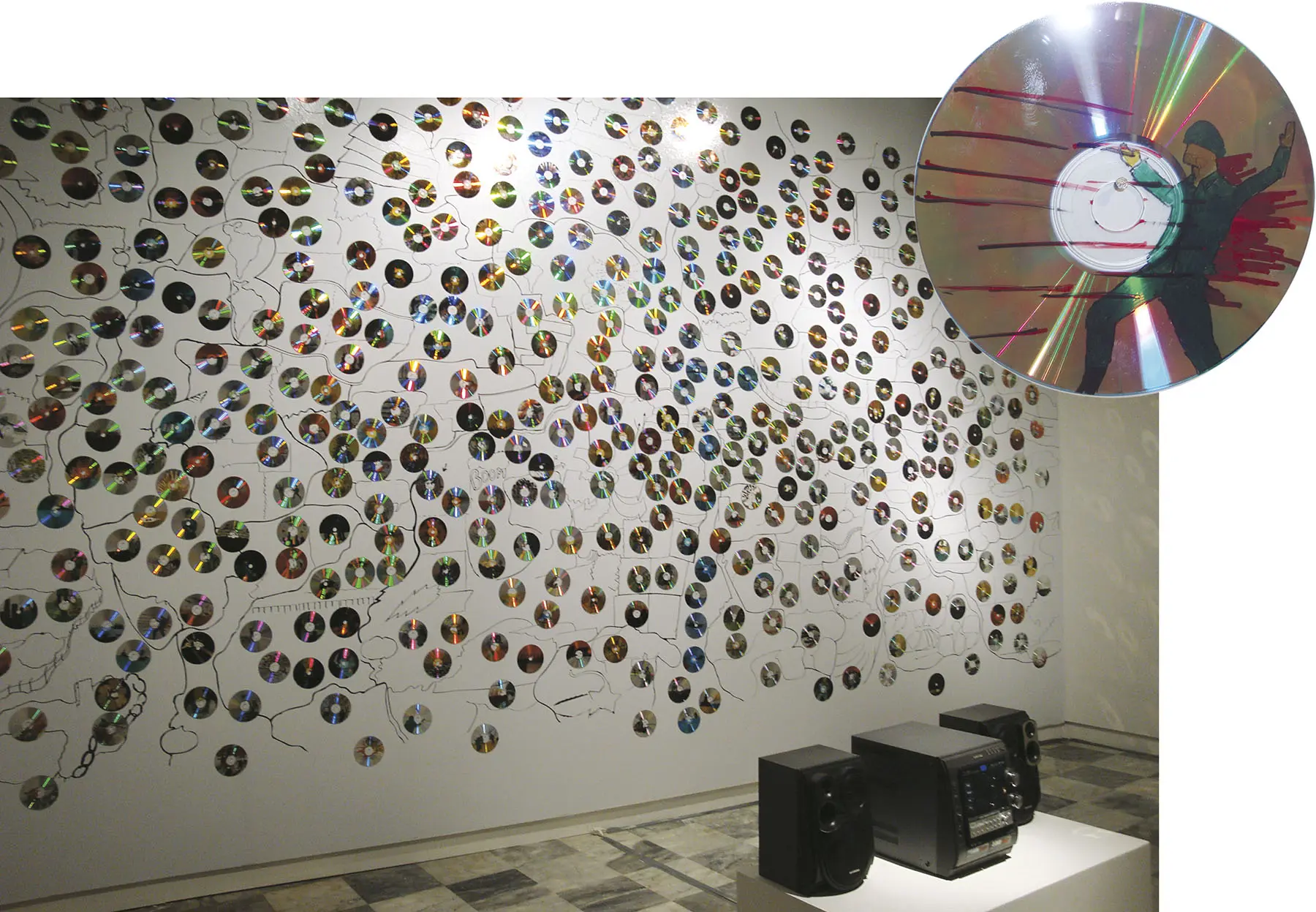
The triennial explored the ways in which those residues of memory expand into other graphic media. A complete wall is taken by Sonidos Piratas (después del mapa de Oyvind Fahlstrom), a collection of CDs from the Nuevos Ricos label, one of Carlos Amorales’ collective inventions that ended up working in real life. This key creator of artistic fiction that is transferred into reality—as he did with the masked wrestler Amorales, whose disguise became an object of desire for professional wrestlers—uses fantasy in order to explore social and mental networks in contemporary cities. The CDs were intervened with his drawings, which in turn hark back to the archive of liquid images he has been appropriating via the internet. This time they were war images. He has also “raided” the cracks in the walls of abandoned houses or empty lots in Mexico City, like graphic signs that can suggest images or horror stories in a contaminated city plagued by signs.
Mario Ybarra Jr. documents graffiti, the initials that soldiers carved on the doors or bricks of an old bunker in Wilmington, during the Civil War. His installation transforms the gallery into a reproduction of that now-abandoned memory site, where, like in a palimpsest, new anonymous graffiti has been layered on the traces of the old one. In her installation Tool for Infinite Monkeys, Julieta Aranda explores “the limits of the word beyond the text” with a room that stages the idea that in a limitless time, monkeys hitting a keyboard will create coherent texts by chance. As in Time Will Tell: An unreadable script takes shape and then destroys itself, she confronts writing with time as a framework that renders the production of meaning relative. She tests its limits—its end or loss—for human collectives. Erik Beltrán’s solo installation uses the mass media printed to isolate the process of collective perception of events, in order for his viewers to break with the inadvertent identification of those events with their mediated reconstruction and, at the very least, to wonder about the relationship between “history, evidence, narration, and conclusions.” In this way, in his artistic practice, the graphic arts are an instrument for the disarticulation of the same long-settled perceptions of reality that it tends to foster when deployed to manipulate opinion and imagination at the behest of media power or of media interests. The diagram is reasserted in his work as an artistic language for the political subversion promoted by a distancing from our passive assimilation of the image of the world transmitted by print media. Christopher Cozier’s installation with cardboard boxes and the word “fear” singly printed on them refers also to the alliance between mass media and power, or the mass manipulation of our consciousness.
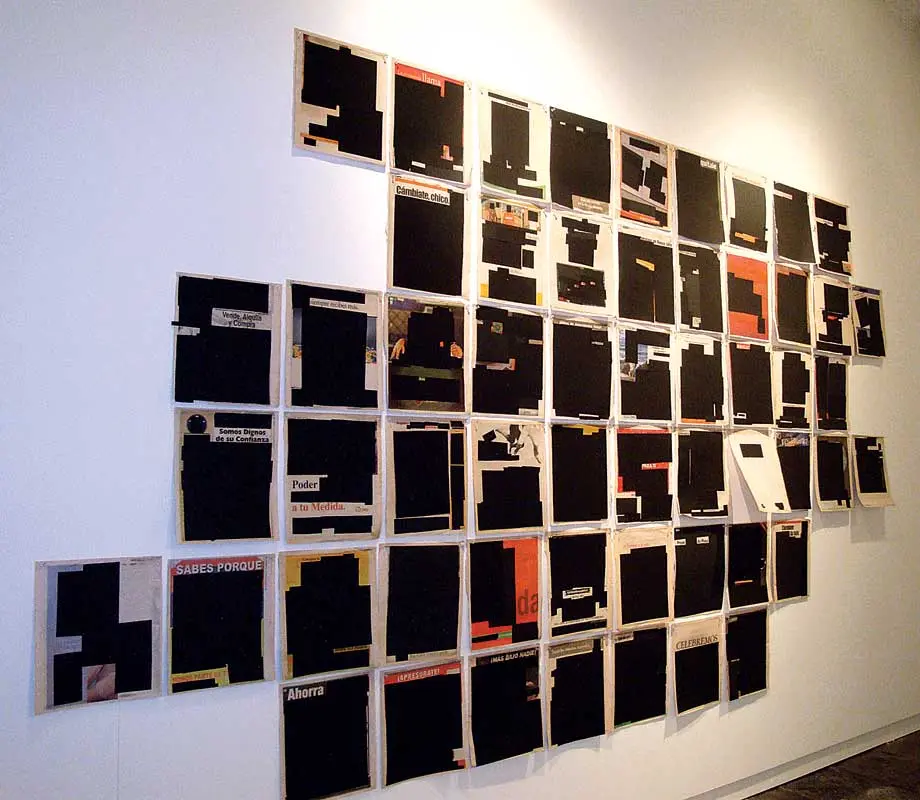
A good part of José Martinat’s work also refers to this topic in connection with that new form of collective memory that is the internet. As in other exhibitions of the previous series where he used an algorithm to generate news with words taken from local sites, with the idea of showing the distortions of information that amass images of the world, at the Triennial, he presented an installation with the sculpture of a palm tree that expels texts incessantly and not only refers to the oversaturation of an age filled with information that the speed of life can make us equate with forms of truth but to a transfer of the Surrealist concept of the exquisite corpse to the cybernetic era. What there is of chance and absurdity in the procedure works as a liberating window or a buffer zone against pre-set configurations of reality. Many works in the Journals collective-exhibition section connected with this perspective of questioning the identification of fact with news or reality with information. Chemi Rosado created abstract works through the juxtaposition of wide black tracings with the vigor of action painting on entire newspaper sheets, leaving intact words like “knowledge” to oscillate over the canceled images. Jorge Macchi presented geometric networks that could have brought Gego to mind if they weren’t newspapers where only the margins were untouched, and Johanna Calle once again dissolved the readability of the text in formal works that seemed greatly minimalistic and aseptic yet made with corrosive contents.
Back on the solo exhibits, Mauricio Lupini derives modes of representation into other paradoxes. He has deconstructed, for instance, the appropriation of species classified in museums, like the extension of a mediated way of observing nature that we accept without questioning its artificiality, while real creatures become extinct. At the Triennial he presented six alternating videos that effect a parallel deconstruction of modernity, but on the basis of the music that identifies different nations, like the music produced in the 1960s and 70s by Venezuela’s Onda Nueva, “whose songs were contemporary to the country’s intense period of modernization.” His intervention in the songs’ lyrics doesn’t alter the melody but implies a curious “remix” as it extracts onomatopoeic words that, in contrast to the period, refer to the notion of a pre-language in violent contrast with the modernity expressed by the songs.
In Full Spectrum Dominance (2008), Runo Lagomarsino alludes to slogans used by the anti-Iraq War movement in the US and quotes deployed by their opponents. His drawings, made through the prolonged exposure of letter-sized paper to the sun and hand-cropped letters, irradiate formal subtlety, but are loaded with the violence of a burn: they refer to the way in which the socio-political environment produces readings of the world and discursive metaphors on the basis of which we read history.
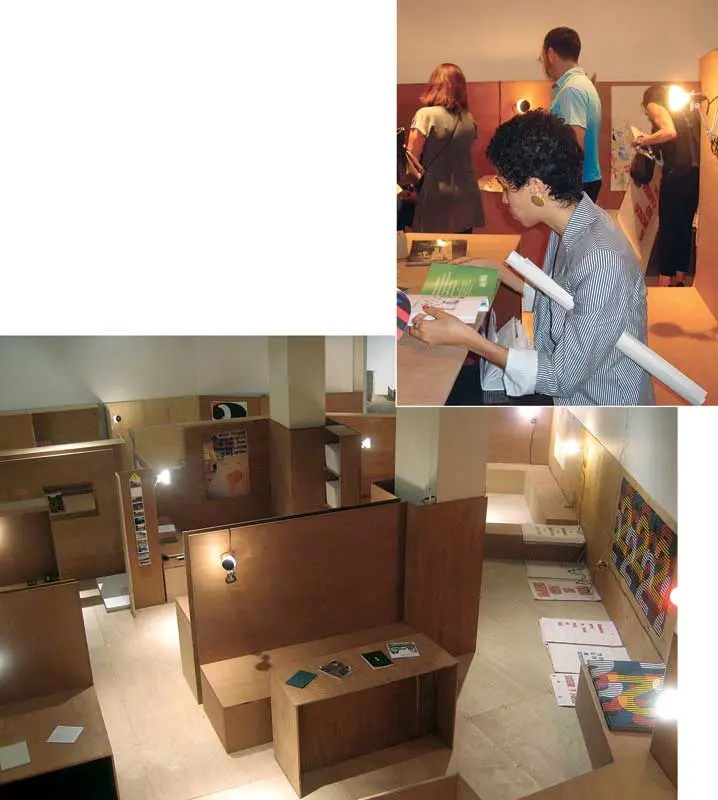
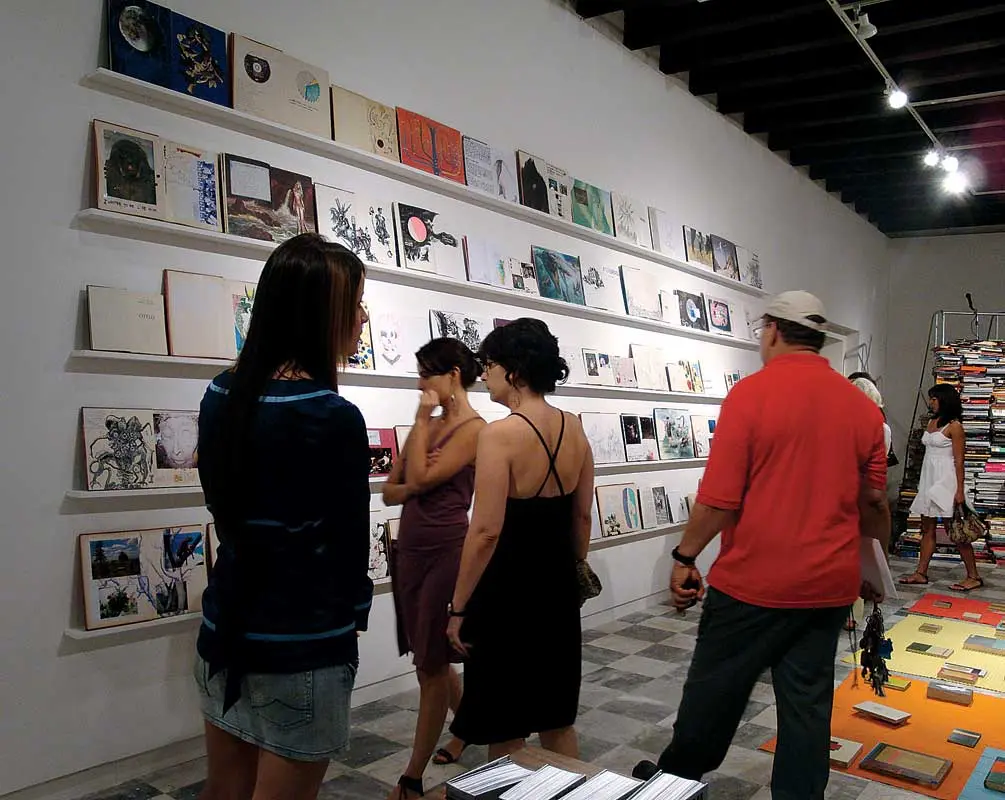
Gabriel Sierra’s site-specific installation, a perfect fusion of architectural design and sculpture projected as a reading room with wooden panels that were in a way a labyrinth, and wooden benches to sit on, which bring into play the viewer’s own body, generated a wave of interactions with its unexpected pathways and its character as a container for other works: it led us to twenty artist’s books dispersed around the room, solo projects by artists like Pablo Helguera (La suite panamericana, among others), Abraham Cruz Villegas (one of the best writers among contemporary artists), Alexander Apóstol, Carolina Caycedo, Cao Guimarães, Chemi Rosado, Jesús “Bubú” Negrón, Mario García Torres, Mateo López, Nicolás Robbio, or Tony Cruz, specially published for the Triennial and fulfilling in a way the notion of the book as object explored in the collective gallery Literary Forms. Also situated in this section was the Monte de Piedad by Juan Mejía and Giovanni Vargas, with wooden books on a “canvas” of blankets (a domestic element) installed not on the wall, but on the floor, so that the rarefied “library” becomes a geometric composition, not only abstract but capable of breaking the verticality of the normal position. Also, there was Intimate Diary 3D, a library of pictorially intervened books by Adrián Villar Rojas, who denaturalizes them, transforming them into hybrid artistic forms rather than into paintings; among other works by artists like Hisae Ikenaga, José Dávila, Marco Rountree, Valeska Soares, and William Córdova.
At any rate, Sierra’s work, developed in close collaboration with the curators, synthesized the spirit of the Triennial as it contained a central axis of vision on explorations referred to memory and collective imagination, as well as for its fusion of design and art in a project that was anti-architectural from the perspective of habitual aesthetics, but which arouses a new kind of attention, another mobility for the body, and expands both the viewer’s physical relationship with the work of art and the possibilities for enjoyment and appropriation. Because that reading room not only allowed us to leaf through the books as chance determined how each viewer found them, but it also worked as a shelf for other freely moving graphic artworks. Six editions of Número cero magazine and copies of banners by artists like Carlos González or Alex Quinto and Ena Andrade were offered to the public for free, in a procedure that is inevitably connected to the way in which Félix González Torres revolutionized the relationship between the viewer and work with his photocopied, piled up, free images. In fact, photocopies, as an operation that transforms the relationship between viewer and work, that triggers the concept of reproduction or infinite replacement and thus challenges its mercantilization, has become a means for participatory, free-access playfulness, as in the proposal presented by Gaston Pérsico and Cecilia Salkowitz. Their incitement to photocopy art images (several donated as gifts to anonymous viewers by artist friends) takes importance away from the notion of authorship and substitutes an emotional universe for the concept of a monetary value for the work of art.
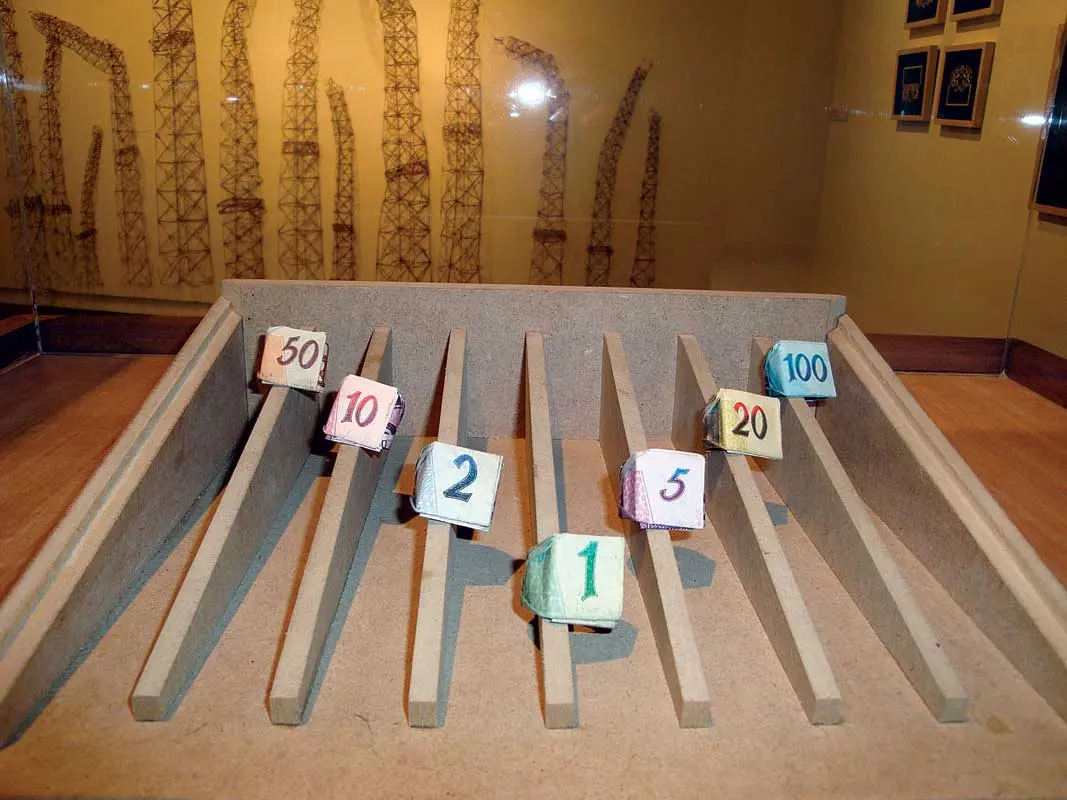
The growing reflection about the iconic value of money and the way in which it has penetrated the work of art is crucial in the Dinero marginal collective show, where we found works that are already historic, such as Zero Dollar, the first edition of which was launched by Cildo Meireles more than 30 years ago, altering the charge of the found iconic object—a one-dollar bill—with a sense of humor that voids its monetary value while demystifying its historical weight, and politicizes it by replacing the face of George Washington with that of Uncle Sam. Also in this section was Gabriel Sierra’s Apple (of temptation) with an attached dollar, and works by Nicolás Robbio, Mateo López, Jac Leirner, and Máximo González, among others. In a formally impeccable installation charged with socio-political impact, Miguel Ángel Rojas’ synthesized two elements—money and coca—the debacle of his country, Colombia. Marcelo Cidade’s rings made of bills exposed the fetishistic value of money, which begins to erode art itself. Perhaps one of the greatest enthusiasms afforded by this Triennial was to verify the new ways in which participating artists counteract a somnolescent perception of the world and shake their own collective memory and their perception of the moment.
ADRIANA HERRERA
Art Writer.