
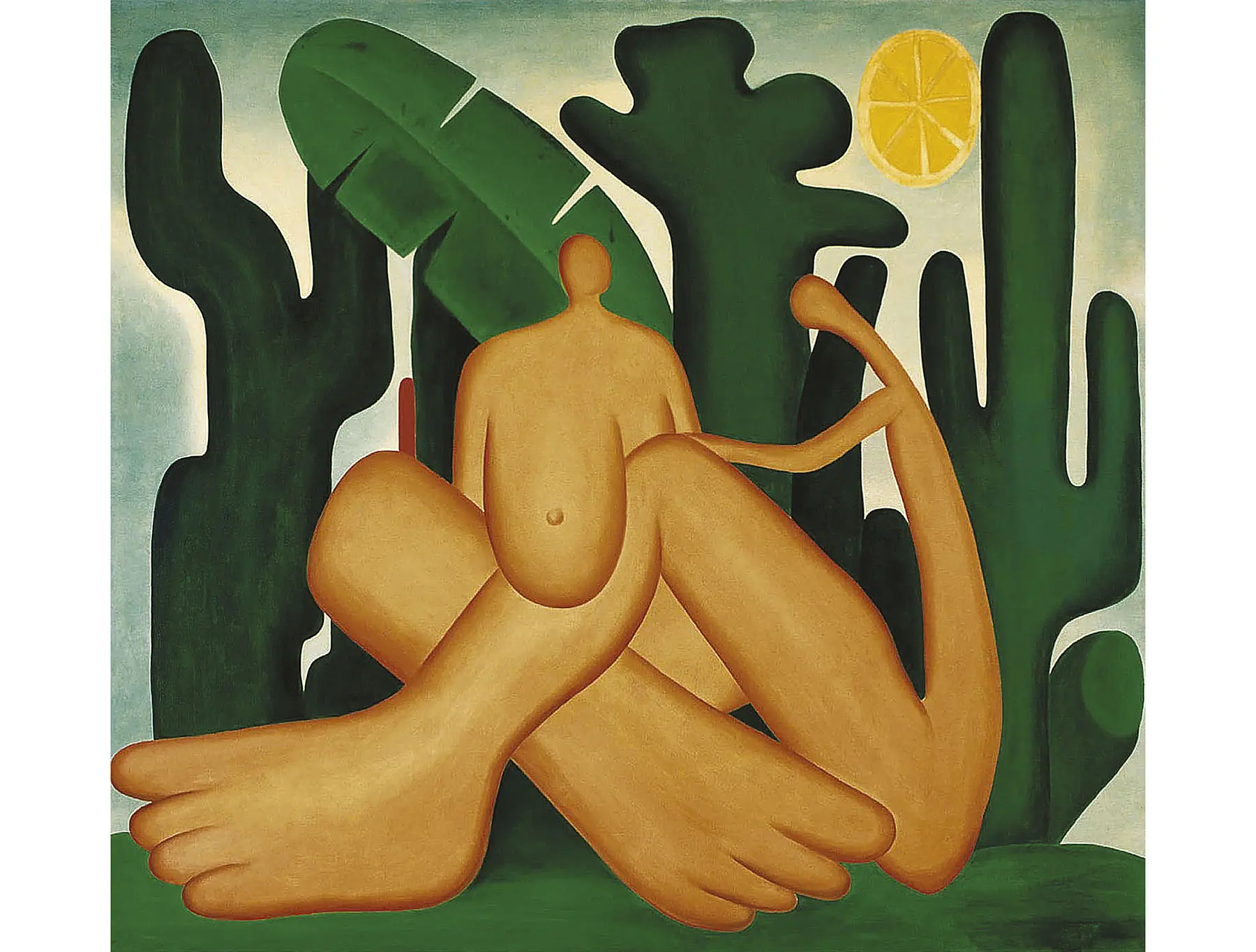
This is a significant show, important for an understanding of the Brazilian artist’s production during her “Pau Brasil” and “Antropofagia” periods in her career up to 1933, when a different phase, the social one, began to define itself. The exhibition gathers 182 works between oils, drawings, and watercolors, documents from the period, and representative objects of Brazilian culture.
The show’s concept and organization are by Juan Manuel Bonet and the Juan March Foundation. The intent is to bring to the public a number of keys for an understanding of Tarsila do Amaral’s proposal. The curator points out the “commingling in her painting of the early-Twentieth Century European Avant-Garde movements, especially Cubism, and Brazil’s environmental and human landscape during the period.” The show seeks to delineate “the story and show the context of the virgin forest of Tarsila’s Brazil.”
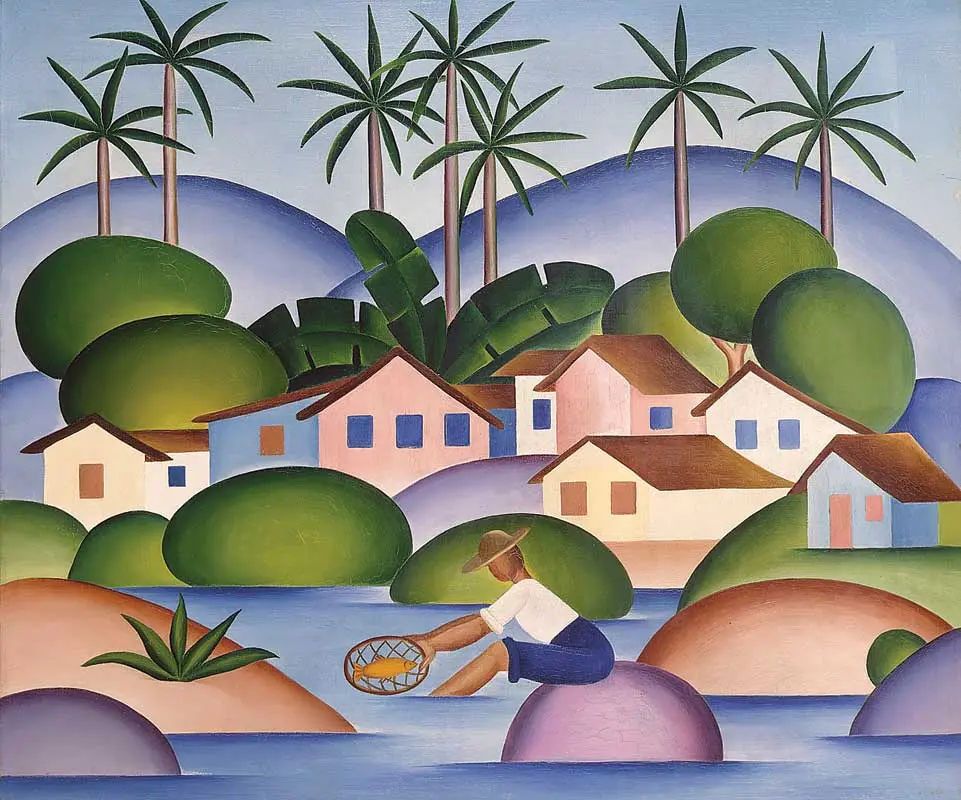
Supported on this premise, the exhibition presents significant works by Tarsila. These works come not only from museums and private collections in Brazil, but also from European institutions like the L’Hermitage museum in Saint Petersburg (Fisherman, 1925); the Grenoble museum (Head, 1924, with the original frame by Pierre Legrain); the Museo Nacional Centro de Arte Reina Sofía, in Madrid (The Family, 1925, and the drawing Abaporu VI, 1928). In this way, the show becomes a unique opportunity for visitors to encounter a set of works from collections from many parts of the world.
The curatorship proposes a dynamic relationship between Tarsila’s works and the Pau-Brasil and Antropófago manifestoes, written by Oswald de Andrade, her husband at the time. Thanks to the daily coexistence between the writer and the visual artist, there was a continuous intellectual exchange that influenced the creative work of both.
Besides the manifestoes cited above, a series of works by other artists, as well as objects and documents, underlie the contextualization that the curatorship seeks. The direction determined by the proposed reading is supported on a European view of modernity in Western art and a view of Brazil that underscores topics such as “being a tropical country” and its “exoticism,” as a contribution from a foreign viewpoint. The country’s cultural reality is interpreted in that way.
Thus, an essential role in the show is reserved for a number of works on loan from Madrid’s Museo Nacional de Antropología (Máscara, Amazonia - Tocantins/Xingú; Brazaletes, Amazonía - Tapajos-Madeira); the Nationalmuseet, Copenhaguen, (Eckout’s Tapuia Woman, c. 1641 and Still Life with Tropical Fruit, c. 1641-44); the Museo Thyssen Bornemiza, Madrid, (Frans Post’s The Church of St. Cosmas and St. Damian and The Franciscan Monastery at Igaraçu, Brazil, c.1660-1680); the Museo de América (Map of Brazil, dated 1658, and an image of La Inmaculada Concepción, 1701/1800); the Biblioteca Nacional de España (Map of Brazil, lithograph, 1750); a series of drawings by Rafael Castro Ordóñez about typical dress, landscapes, and portraits in Bahía in the Nineteenth Century and Río de Janeiro landscapes. Also, lithographs of Río de Janeiro by Marc Ferrez, dated 1885 and 1890.
The search for a contextual dimension brings the curatorship to suggest a comparison between Tarsila’s work and that of other Brazilian modernists, her contemporaries, all of them key names in the historical scene of Brazilian modern art in the 1920s, the decade that saw the dawn of the modern movement in the country, with the Semana de Arte Moderna. 1 Present in the show are works by Anita Malfatti, Vicente do Rego Monteiro, Di Cavalcanti, Lasar Segall, Cícero Dias, and Victor Brecheret.
The design of the show establishes a correct relationship with the curator’s intent. Documents and objects, inside display cases, dialog with the works arranged in the ample exhibition gallery. An important catalog was published, with texts from the period and essays by Aracy Amaral, Jorge Schwartz, Haroldo de Campos, and curator Juan Manuel Bonet.
This is Tarsila’s first posthumous exhibition in Europe curated by a Spanish specialist. Previously, the artist’s work was included in various shows, but the curatorship was always by Latin American experts who valued other fundamental issues in the understanding of her work, issues related to artistic modernity in this area of the Americas.
About Tarsila
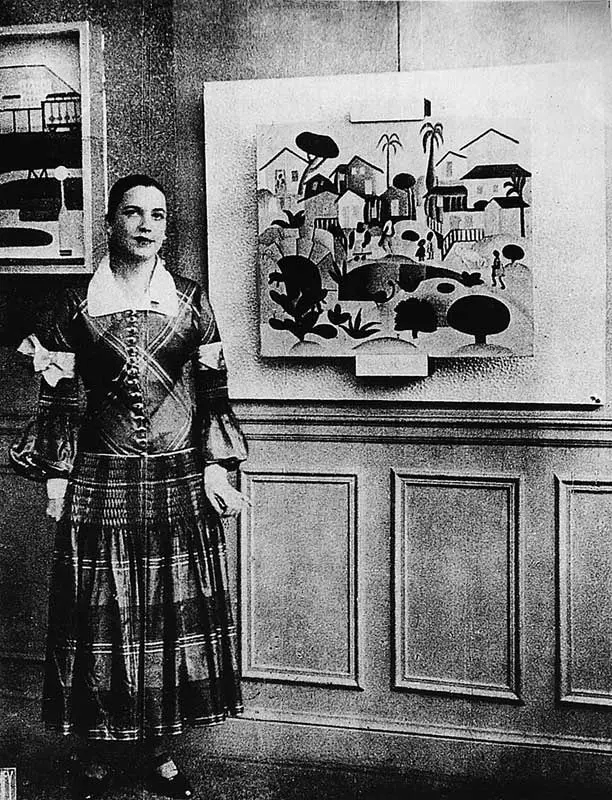
Tarsila do Amaral was born in São Paulo State in 1886, in the San Bernardo Hacienda, located in the small city of Capivari, at the time dominated by the Coffee economy. She belonged to a traditional São Paulo family, and French culture was an essential point of reference in her education and the development of her tastes. Tarsila learned French and was able, from very early on, to spend time in Europe, mostly in Paris, on several occasions. She first encountered the French capital in 1904.
She made her first drawings in the family property, as a child. These were copies of sacred images from the church —santinhos— or drawings of animals she saw in the hacienda. Her earliest art studies took place in Brazil with academic artists, prestigious teachers in São Paulo society. She took lessons with Swedish sculptor Zadig and with Brazilian painter Pedro Alexandrino in 1917, and a little later she studied with German impressionist painter Elpons, all of them established in São Paulo. In 1920 Tarsila traveled to Paris to study at the Académie Julien.
In Paris, although devoted to academic studies with live models, she had an opportunity to observe the emergence of new pathways in art, especially Cubism and Futurism. She also became acquainted with Dadaism, as proven by her correspondence with her friend Anita Malfatti, another important Brazilian painter.
Tarsila did not participate in the Semana de Arte Moderna, an event that defined the first break with traditional art, but returned to her country on that same year of 1922 —a year of intense cultural effervescence in Brazil. Once there, she joined the Modernists.
With the Modernist group, alongside writers and poets Oswald de Andrade, Mário de Andrade and Menotti Del Picchia, musician Heitor Villa Lobos, and painters Anita Malfatti and Di Cavalcanti, Tarsila became one of the main promoters of the expansion of modernism in the country. It can be said that in the visual arts, in the 1920s, Tarsila was the artist who most successfully gave structure in pictorial expression to the foundations of that aesthetic project.
She returned to Europe in 1923, her gaze already turned towards the new Avant-Garde proposals. She married Oswald de Andrade that same year; de Andrade was the most iconoclastic among the Modernists, the author, as we have seen of the Pau-Brasil and Antropófago manifestoes. Together they traveled in Spain and Portugal, and in Paris, they rented an atelier at Rue Hégésipe Moreau, 9, close to Place de Clichy. She studied with Lothe and was in contact with Gleizes and Léger. There she created some of the canvases that were to become famous among her output.
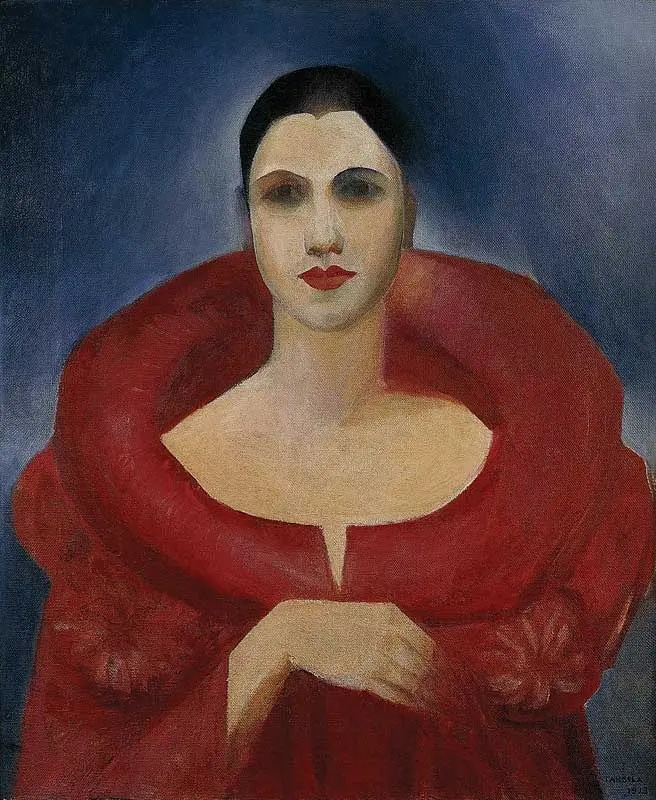
She painted her Autoportrait au Manteau Rouge, with the same coat she used for a dinner in honor of aviation pioneer Santos Dumont. She painted the Blue Portrait of Sérgio Millet, one of the Brazilian critics who observed her work most accurately. It was Sérgio who commented that:
“With Lothe, Tarsila learns the need of a reaction against Impressionist bolshevism and crosses the bridge from academicism to modern life, new themes, synthesis, rhythm, movement. With Gleizes, the importance of geometry: ‘geometry, abstraction of the object, creation.’” 2
Her French sojourn with Oswald de Andrade was marked by intense cultural life. She met Blaise Cendrars, the Swiss poet who was to visit Brazil the following year and to connect with the Modernista group. She met Jules Romains, Jules Supervielle, Valéry Larbaud. “Paris became for me a world of wonders,” she said later. 3
Tarsila and Oswald de Andrade took part in the city’s main cultural events of the time: the attended the Diaghilev ballet with Picasso’s stage design; the saw the Swedish ballet with a stage by Léger; they frequented bookstores and cafés whose patrons included intellectuals like Max Jacob. They hosted Brazilian artists and intellectuals then in Paris. Their workshop was visited by Brancusi and Ambroise Vollard; they established contacts with the critics Léonce Rosemberg and Maurice Raynal.
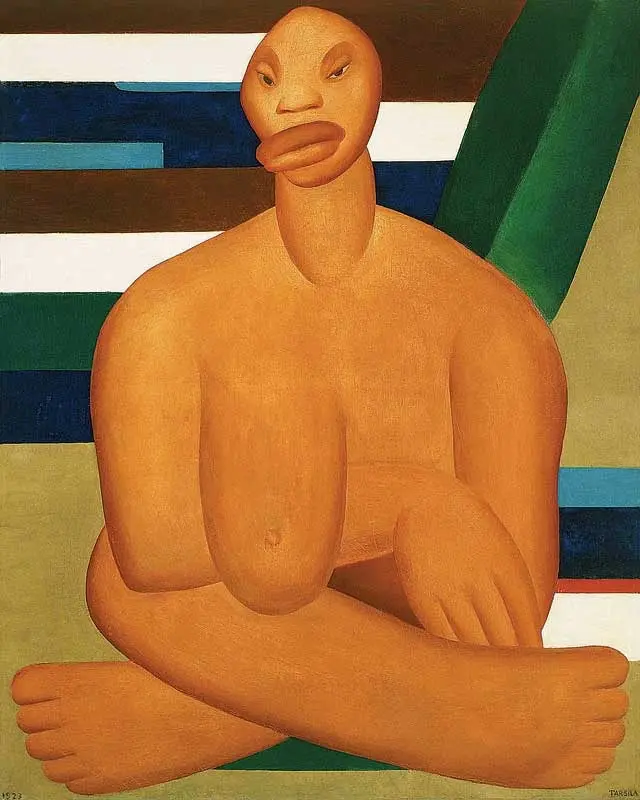
In 1923, Tarsila painted Black Woman,4 a key work in the history of Brazilian and Latin American Modernist art, an emblematic canvas for the understanding of the paradigms that governed the new Brazilian vision at the time, which brings to the fore the issue of the nation’s cultural identity.
In Brazil, as in all of Latin America during the era of the first approach to the artistic Avant-Garde, the search for an expression of identity played the role of reconstituting the historical sense of reality, of its essential foundations. The deployment of current artistic languages, the attempt to catch up with the contemporary in the period between 1920 and 1950, made evident the need to also measure what we are, how we are, what is particular to us in relation to hegemonic cultural models with which we have coexisted since colonization.
NOTES
1. In Brazil, the Semana del Arte Moderna was the event that broke with academicism. It was a collective gesture of rejection to the status quo in the arts, in order to create a new spirit. It exhibited the most forward-looking artistic production. The Semana included visual arts and architecture exhibitions, conferences on literature and music, concerts, recitals, poetry and prose readings, dance, all of it as an expression of the ardent desire for a new, modern mentality. Brazil was idealized as integrated to the most developed and most active European artistic capitals.
2. Apud GOTLIB, Nádia Batella, TARSILA . São Paulo. Ed. Brasiliense. 1983. P. 34
3. Idem, ibidem. P. 32
4. This works belongs to the collection of the University of São Paulo Museu de Arte Contemporánea.
LISBETH REBOLLO GONÇALVES