
Sharjah, the cultural capital of the United Arab Emirates, is located on the Persian Gulf and has a population of some 800,000 people making it, the UAE’s third-largest city after Dubai and Abu Dhabi. An initiative of its Sultan, HH Dr. Sheik Sultan bin Mohammed Al Qaimi, Ruler of Sharjah, the Sharjah Biennial has been organized since 1993. The event was founded with the intent of fostering relationships between Arab-world institutions and artists, as well as with the international art scene. This year the Biennial held its 9th edition between March 19th and May 16th, inaugurating for the first, in parallel with Art Dubai and the alternative fair Al Bastakiya, in order to strengthen art in the Gulf region and take advantage of the audience of collectors, critics, curators, and artists. Directed by Hoor Al Qasimi and with Jack Persekian as its artistic director, the event’s team also included curators Isabel Carlos and Tarek Abou El Fetouh. The Biennial brought together 60 artists, 34 of them women and 24 selected from its production program, through which the chosen artists receive official support for the production of their work, emphasizing the importance of the process. The main exhibition was complemented with a film and performance program, Past of the Coming Days, conceived by Tarek Abu El Fetouh, and a series of workshops and conferences that, under the title of March Meetings, brings together cultural institutions working in the Arab world.
Several artists from Latin American countries participated for the first time in this 9th edition of the Sharjah Biennial. In part, thanks to Portuguese independent curator Isabel Carlos, who in 2004 was artistic director of the Sydney Biennial and in 2005 was in charge of Portugal’s delegation to the 52nd Venice Biennale. Under the title of Provisions for the Future, the curator posited a topic to integrate artists and issues from different places, inspired in Sharjah itself, a city that, as she puts it in the catalog, “…is a cultural and geographic meeting point where the notion of “future” is permanently evoked.”
The Biennial integrated artists from many areas, main artists from the region, whose works deal with issues like memory, journeys, immigration, integration, and exile. Several of the works on exhibit were created on-site and inspired by the city. The main exhibition was held at the Sharjah Museum of Art and was accompanied by a catalog where each artist responded to seven basic questions, which allowed readers to explore the specific work the artists were presenting at the Biennial as well as the challenges they faced to create it.
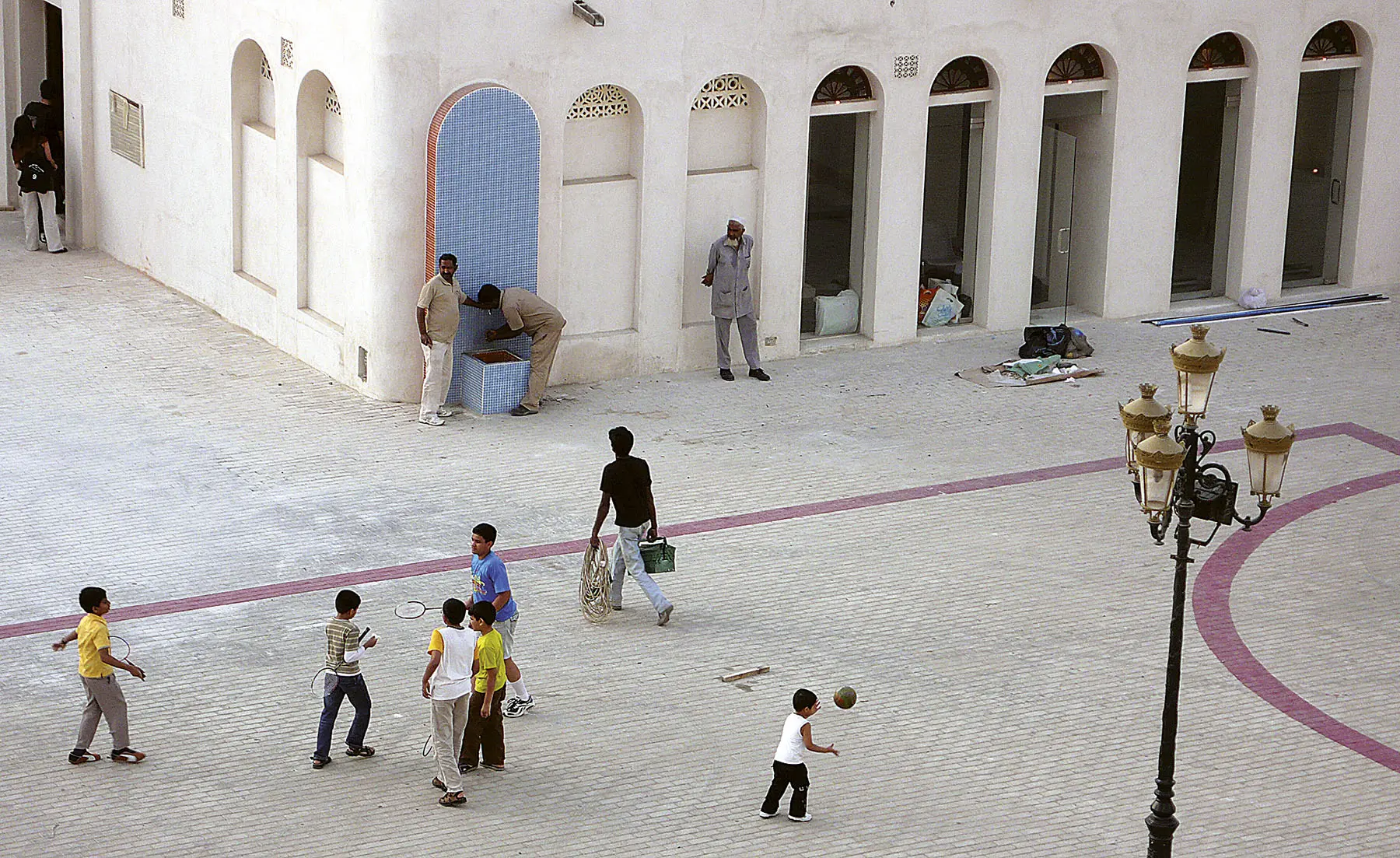
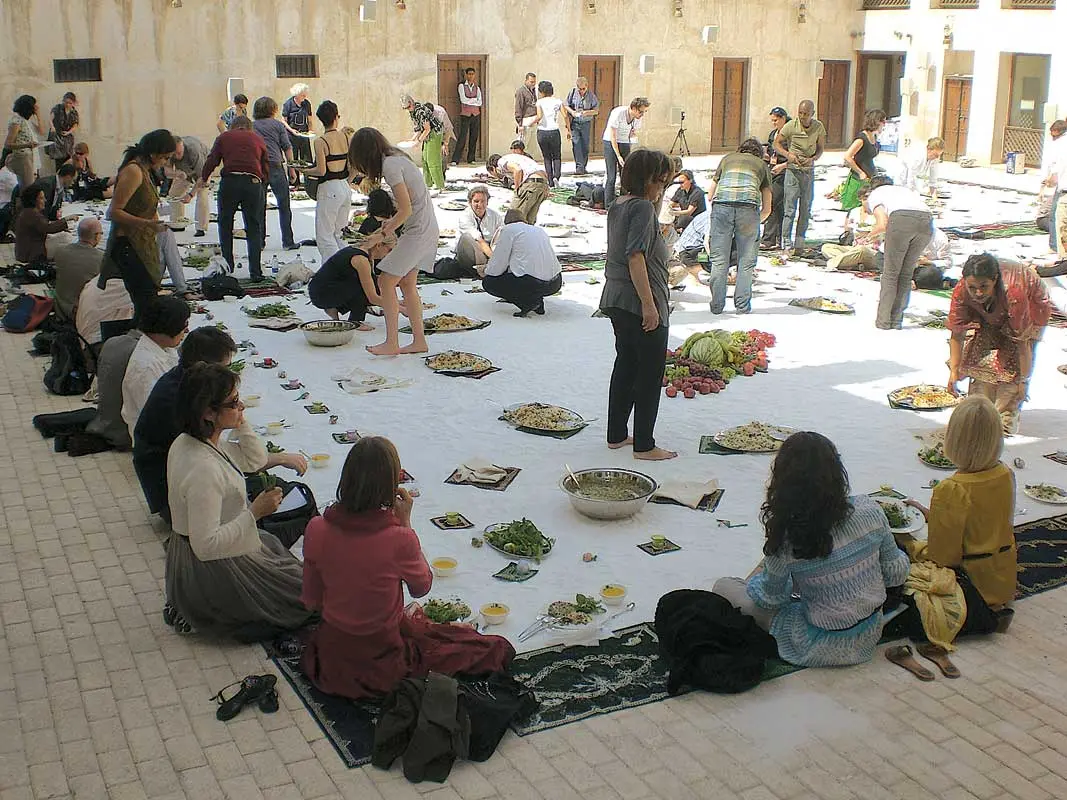
One of the most interesting works, well interconnected with the context of the city and its environment, was the fountain -created by Maider López, from Spain- located in the square that lies across from the Sharjah Museum of Art, offering the only public drinking fountain in the city. López, who has distinguished herself by intervening spaces, created during a residence in 2007 the work Football Field, where she painted the lines of a soccer field on this square; now locals have placed goalposts and use it to play on a daily basis, giving the space a new function. Another interactive work was the one developed by Gita Meh, an Iranian artist based in Dubai. Soffreh (tablecloth in Persian) depended entirely on its viewers for its culmination as a work of art. The artist laid down a white tablecloth made of sugar to serve as a canvas on which she placed mats, utensils, and a large banquet. Around it, visitors could sit and leave their mark as they enjoyed a variety of dishes prepared by Meh herself, such as lentils with raisins and saffron rice, expressing the artist’s desire to arrive at new meanings on the basis of interrelatedness, understanding, and the integration of different cultures.
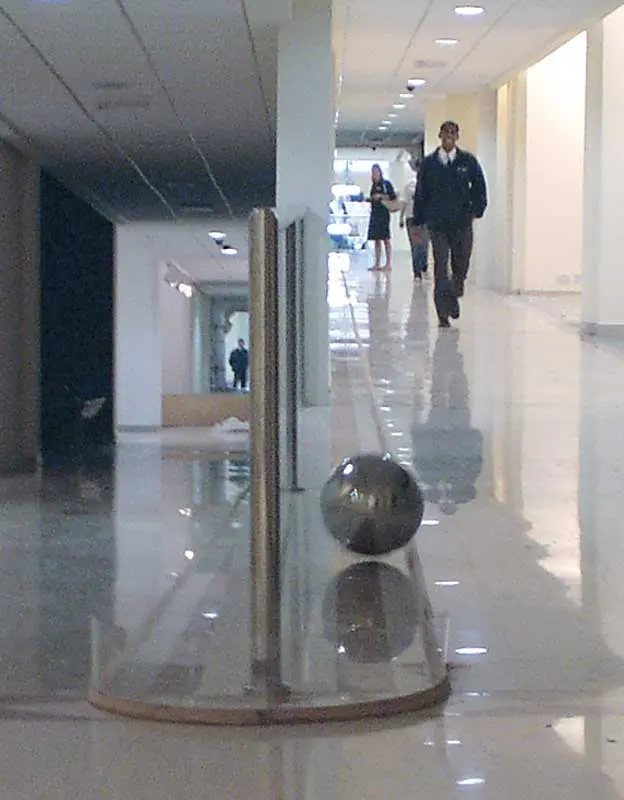
With the intention to create her work directly in the museum where the Biennial was held, German artist Karin Sander developed an installation that ran along the rail in the upper floors and down to the lower ones on a subtle track on which a metallic sphere rolled; every so often the ball was picked up by a security guard, who placed the ball on an upper floor to have it begin its descent again. Sander is interested in the relationship between space, art, and the public.
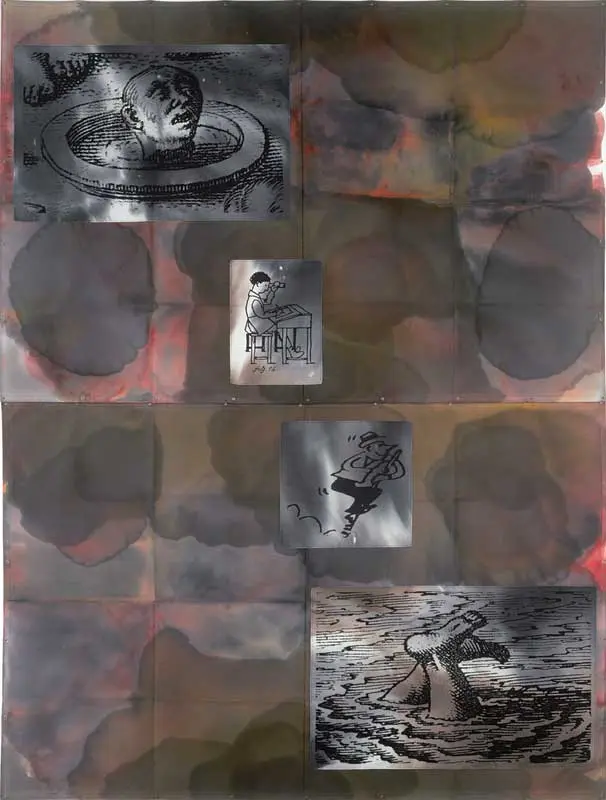
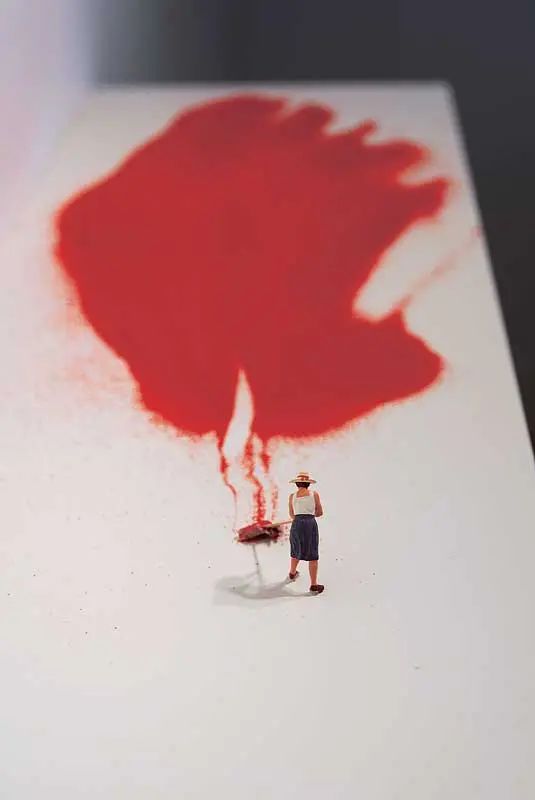
The presence of Latin American artists included well-known names like Liliana Porter, Eugenio Dittborn, and Valeska Soares in collaboration with O Grivo, as well as younger figures like Juan Araújo and José Luis Martinat. Dittborn, from Chile, and Porter, from Argentina, were placed across each other in order to show the portability of their works, which do not require a great effort to be transferred and installed. Dittborn presented a three-way dialog with his famous aeropostal paintings, a concept he develops by means of paintings and photographs inspired on themes of travelers, such as the Robinson Crusoe story, which he folds and sends via regular mail to different places to be exhibited, and where the traces and marks left by the process become part of the work. In turn, Porter presented a group of works that explore the concept of representation and spatial location, among them Fox in the Mirror, 2007, a digital video that deals with the meaning of reality and our awareness of the role we play as responsible creators of that meaning. Porter’s work speaks of dislocated simultaneous situations and plays with scales of time and space, destruction and reconstruction, joy, and sadness. Trabajos forzados (arena roja), 2008 evokes, in this context, the sand of the vast deserts that cover the region.

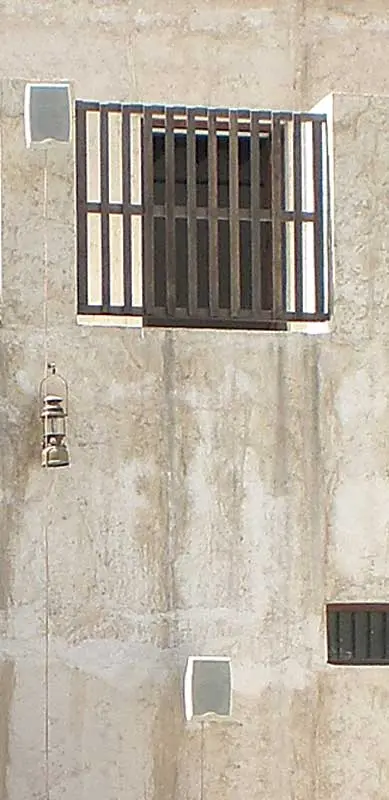
Valeska Soares, from Brazil, presented several works, among them a set of three perfectly sculpted marble objects, two pillows, and a mattress, the plasticity of which allowed viewers to evoke their own intimate stories. Soares’ most notable work was a sound installation created for the Biennial in collaboration with O Grivo (Marcos Moreira and Nelson Soares), a collective that works and researches “new music” in the field of acoustics. (Shushhhhh…) Prelude was inspired by the moment before a concert or recital when the audience starts to request silence and the shushing sound expands throughout the space. This work tells of absence more than of presence and includes 48 speakers discretely installed on the walls of an open patio. Each speaker transmitted the sound of a person silencing somebody. The sounds were configured so as to create a musical pattern. This work also acquired an unexpected layer of meaning due to the context. During the course of the day the silence includes sounds from the city and from nature, and at certain hours allows us to hear the Koranic prayers that are broadcast, also via speakers, to the entire city. These sounds that come through the silence of the audience are integrated as part of the work’s musical score.
Peru’s José Luis Martinat, a young artist currently based in Sweden, appropriates existing materials and transforms them to achieve a new interpretation. Martinat presented the latest of seven videos he has created based on cartoons from the 1970s, where all human presence has been erased in order to leave only environments. The question thus becomes, “What is a city without its inhabitants?” In this video, the image of a flagpole without a flag is repeated constantly, in reference to the identity or the lack thereof. Martinat also presented a selection from a series of commissioned drawings. This project began in Lima in 2006: he asks street portrait artists to draw him as he appears, and then to draw him as if he were dead; in the second case, the street artists are free to represent the way in which they imagine Martinat’s death.
Venezuelan artist Juan Araújo presented a group of works related to architecture. Araújo has developed his career working with references from the history of art and dealing with the reproduction and appropriation of works of art, about which he poses different reflections.
The Sharjah Biennial was able to respond to different identities and to create a commitment to a growing city, fostering the emergence of a space for exchange on the basis of a rapprochement between different cultures. I was surprised to see a cultural encounter of this caliber allow the promotion of political propaganda during the March Meetings, which fomented the conflict as with the case of Dr. Rafiq Al Husseini with his exhibition, Jerusalem, Capital of the Arab World 2009, instead of using the cultural exchange as a tool for mutual understanding towards peaceful coexistence.
SUSANNE BIRBRAGHER