
Alicia Viteri has been telling stories ever since I’ve known her. First, she told the story of some insects that spread all around the world. I witnessed how a small fly, observed with the passion of a scientist and painstakingly drawn on a cinc sheet, came slowly to life. This took place in the Printmaking Workshop at Universidad de Los Andes, under the supervision of Umberto Giangrandi and the knowing gaze of Juan Antonio Roda. Drawn in great detail, some of those little animals later conquered a Coca-Cola bottle, and others emerged from a giant tube. Little by little, these beetles, ants, and flies became humanized, got rid of their wings and insect-like limbs, and joined carnivals and funerals as men and women of extravagant features and expressions walked through canvases to finally congregate in a large mural. Then came the story of Prince Próspero, a symbol of the power and ambition that rule the world; this tyrant, his family, and his court, treated in a caricature-like, deforming style of drawing, could very well, as someone noted, have come alive in cartoon production. This story was dispersed in engravings, drawings, and paintings adorned with gilded colors, brocades, and sequins; the promise of gathering it into a book never took off as a project, but I always thought it was interesting. Alicia’s own image peeked here and there between these stories: alongside her face, the mountains of her native city, Pasto, also appeared on the canvases.
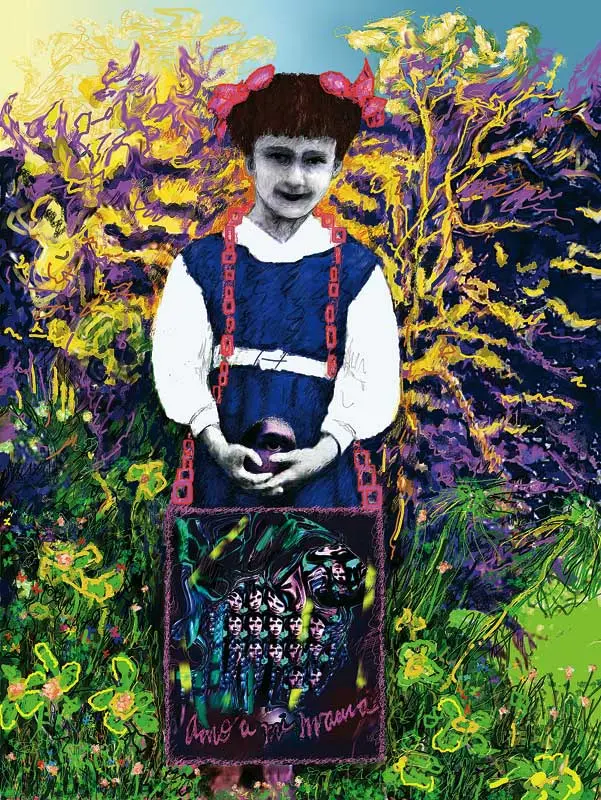
In recent years, Alicia Viteri has remained intent on telling stories; this time around, it is her own personal history that she tells. Her efforts were directed towards the creation of a book that would recount her life through images and brief legends. The landscapes she has been working on since some time ago became a parallel production that allows her to approach color and to leave behind the black-and-white world of her insects, carnivals, and funerals while deepening her mastery of the craft of painting. Since the previous period, Viteri has focused on collecting images from her family album and taking new pictures of her friends. In the midst of this project, her life was threatened by illness; overcoming all obstacles with great tenacity, and with the support of Benjamín Villegas, the book project moved forward and came to fruition. It was launched in March in Panama City and in mid-April in Bogotá, at the Gabriel García Márquez Cultural Center. On both occasions, an exhibition of the images printed on the cloth was presented in parallel to the book launch. For this project, Alicia Viteri put her pictorial and graphic expertise to the service of new technologies, using computer software to replaces brushes, burins, and the sharp point of a pencil. She intervenes the photographic images that are the starting point of her portraits with these new media. The scale of her prints on fabric makes it possible for her to capture with greater precision the many details that comprise each portrait or event, superimposed on which are other images that enrich the subject’s features.
The book, which includes an introduction by historian Ángella Picardi, was nominated for two Latino Book Awards in New York City and won second place both for Best Cover and for Best Art Book in Spanish. The book’s format and its violet-silk cover present, intaglio-like, the image of Alicia as a child, which turns it into a delicate object. The translucent-paper sheets that precede each portrait and the corner guards support the intimate nature of the story and reinforce in the reader the experience of having in their hands a photographic album. The images in this project, Memoria Digital, deal with affective connections with the father, with a mother who died young — orphaning that child wearing a giant pink bow on her head — a mother who is still longed for; they deal with relationships with her siblings and with us, her friends, each one treated in a unique way. And of course, there is a protagonist at the center of this story: Stephan Proaño, whom he calls “my partner, my friend, my son, my father, my lover.”
Those of us who know her work in detail can see certain features of her insects filtering through to the images that comprise this project, especially in some images that allude to moments of anxiety; in the same way, we find here the large-hated woman who was part of her series of self-portraits with the mountain in the background, and also some of Prince Próspero’s relatives.
I don’t know how much this review will mean to an audience unconnected to a personal story, and I don’t know how this family album, speaking with the voice of affection, with a large dose of humor, and with great graphic quality, will reach readers and viewers unrelated to the tale. Such are the challenges confronted by whoever sets out to make public her personal life, an effort that I see as of vital importance. This project has overcome all obstacles to make, in the end, life triumphs over art.
MARTA RODRÍGUEZ