
Some years ago, I penned several essays for the first catalogs of young Puerto Rican ceramist/sculptor Cristina Córdova. At that time, she had just begun her fortunate artistic career. She had already become an accomplished ceramist, among many other great Puerto Rican ceramists, such as REDO and Cecile Molina. Ceramics on the island had reached a degree of popularity and sophistication thanks to the foundation of the project Casa Candina by Susana Espinosa, Jaime Suárez, Bernardo Hogan, Aileen Castañeda, and Toni Hambleton, the works created by the ceramists at the Liga de Arte de San Juan (founded by Sylvia Blanco), and John Balossi’s teachings at Recinto de Río Piedras of the Universidad de Puerto Rico. Córdova then transitioned into a well-known artist in the U.S. (where she has resided since 1999), and her works are in high demand in her homeland.
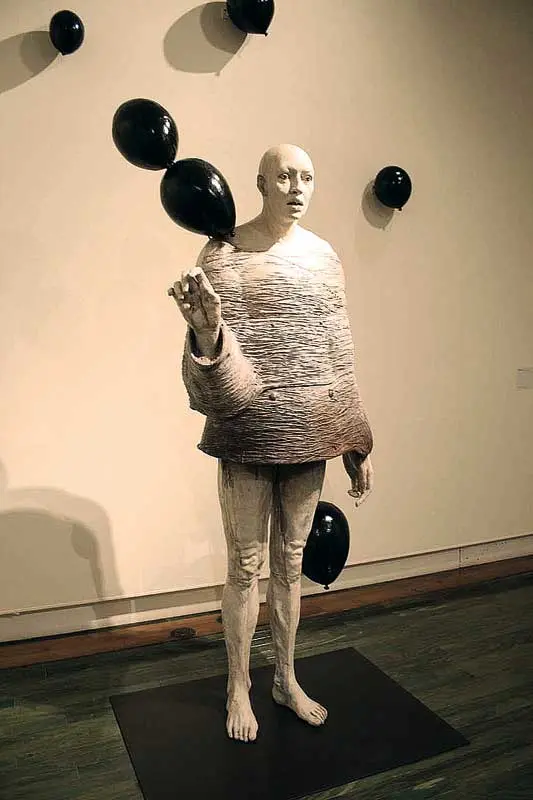
At the beginning of her artistic career, Córdova demonstrated her originality and excellence in the field of small-to-medium format ceramic sculpture. She focused on capturing the essence of women (and men) from a surrealist approach, as she sometimes leaned toward exaggeration, playfulness, and the grotesque. These tendencies in the case of her renderings of women were prompted by what she perceived to be a lack of understanding about their nature and their notions of love, happiness, dreams, and aspirations. For the local Puerto Rican public, the artist’s works were always regarded as an interesting combination of existential challenges and conversation pieces that nevertheless possessed a certain aesthetical appeal (such as Goya’s engravings). With an enormous desire to further her development as an artist, Córdova attended several workshops in the U.S. and completed a Master's degree in Fine Arts at the New York State College of Ceramics at Alfred University in 2002 as her work began to achieve new and interesting depths.
Since 2001, each exhibit that Córdova has presented at the Pamil Gallery, which represents her in Puerto Rico – in the U.S. she is represented today by the Ann Nathan Gallery in Chicago and by the Hodges Taylor Gallery in Charlotte – she has become more provocative, as well as a commercial success. Cristina Córdova was increasingly coming closer to understanding, on the one hand, the lack of understanding toward men and women by a classist, sexist, and essentially unfair society, and, on the other, the nature of women and their perspectives on love and happiness and the importance they place on their dreams and aspirations. The more she saw herself reflected in the mirror, the more complex her work became. She dealt with journeys such as those in the Odyssey, wars like those described in the Iliad, and hellish environments and temporal purgatories akin to those narrated by Dante in The Divine Comedy. But Córdova was also able to offer paradises.
The exhibit ENTRE][TIERRA is a journey in which Cristina Córdova presents us with enormous remnants of the human condition. Marked by an original Catholicism and now by all her new artistic freedoms – aesthetic and ethical – the artist accepts her creations as distorted mirrors that reflect our struggles for survival and our desires for something better. According to Córdova, “The realization of our true potential to understand and exist to the fullest is undermined by the human need to structure and define. I attempt to create metaphors through the forces of the socialization of these figures.” I am not sure whether the artist is well acquainted with the works by the postmodern philosophers, but there are in her thinking echoes of their daring yet interesting postulates. What I know for certain is that the majority of her sculptures force us to attempt to understand our existence/destiny, whether we observe it from a Marxist or a capitalist perspective, from our spiritual or our animal side, or as kings or as slaves (Heraclitus).
In ENTRE][TIERRA, Cristina Córdova has no trouble borrowing from elements such as The (prehistoric) Venus of Willendorf, Chinese terracotta sculptures from the Ming Dynasty, pre-Columbian sculptures, Twelfth Century African terracotta art from Ife, or more contemporary works by Henry Moore, Antonio López, and Fernando Botero. Once again, the artist’s works can be generally described as histrionic, and we can see the artists presenting small but consequential works of a surrealist/existential/feminist nature that are involved in a conscious dialogue with what is taking place in today’s globalized discourses. ENTRE][TIERRA is undoubtedly an impressive exhibit that was well thought out and professionally executed and mounted. However, many personalities of the art world, including several internationally recognized award-winning, Puerto Rican ceramists, wonder whether the monumental size of her series/installation Salvavidas (Lifesavers) – unlike her small-format sculpture series titled Las Negras (Black Women) and Lid – was necessary, or simply a device to attract attention: some of the sculptures even move. The response given by Córdova is a resounding no. The large- scale series included the works El Aire Huele a Humo (The Air Smells of Smoke), Tiempo sin Memoria (Time Without Memory), Canto Errante (Errant Chant), as well as Duelo I (Mourning I) and Duelo II (Mourning II) – both of these latter two works represented interesting visual and intellectual challenges for this art critic. Cristina Córdova is able to capture an extraordinary array of emotions in the faces/heads and in the bodies of her medium-format sculptures. I interpret her efforts as simply an attempt to demonstrate her technical virtuosity (the same slab-building techniques employed by pre-Columbian potters) and to capture the human condition. Córdova has the ability to render three-dimensional portraits. She also has the power of a chronicler who narrates the past and present history of women, from those enslaved to others who endured the perils of an exodus –as shown in her work La Huida (The Flight). While she may depict some women condemned to obscurity, she also sheds light on strong and brilliant women. Cristina Córdova captures the intensities that mark our lives and afford hope to those who believe in balloons, wings, laughter, and in true communions, for she is always transiting back and forth from the earthly to the sublime.
MANUEL ÁLVAREZ LEZAMA