
Centre Pompidou
Paris, France
After Big Bang (2005), Mouvement des Images (2006), and, more recently, Traces du sacré (2008), which included an accompanying website, the Musée national d'Art Moderne continues, with elles@centrepompidou, its policy of renewal in the presentation of collections. Instead of the traditional chronological course, the thematic a priori traces a path that seeks to posit the issue of the connection between women, art, and society in the Twentieth Century. An exhibition in progress, the curatorship here will change in upcoming months thanks to contributions from other collections, ending only in late 2010.
Published in 1950, E. Gombrich's celebrated History of Art did not mention a single woman artist. Forgetfulness? Carelessness? No. Rather, a willed dismissal, since at the time art by women was seen as minor or marginal. However, women artists did not wait until the second half of the Twentieth Century to become noted. They participated in every visual revolution from Dada to Surrealism, including abstraction; they were present in the avant-garde and achieved a respectable position in it. From Sonia Delaunay to Natalia Goncharova, from Anita Malfatti to Tarsila do Amaral and Maria Martins, from María Izquierdo to Frida Kahlo, from Meret Oppenheim to Joan Mitchell, to mention but a few, women –among them a number of Latin Americans1– contributed vastly since the 1920s to the development of every new artistic movement. The ignorance of their work harks back to a long history whose motivations, both cultural and political, began to dissolve in the second half of the Twentieth Century. In those societies that did not acknowledge them as artists, their progress was slow, hampered by obstacles, resisted by art historians – who, in a large majority, were and continue to be men.
It has only been in recent decades that women finally gained the right to a true status as artists and their production was recognized in full. While women were present in artistic creation, from time immemorial (as attested by the Venus of Millender –ancient Austria, upper Paleolithic) they materialized solely as theme and object in art produced by men. Courbet's famous 1866 painting L'origine du monde, hidden for many years, is the most provocative culmination of this fact. This canvas breaks with the reigning hypocrisy in the representation of female nudity, showing in a very realistic fashion a woman's sex, de-mystified, and at the same time revealing the creative, earth-bound dimension that the shape of the pre-historic Venus had already displayed. As Michelle Perrot has written2, women are theme and in that sense are "created," but they are not yet creators. Creation belongs to men. Women do not have the time or space needed, nor do they have the education or economic means to devote themselves to art. The place of women in art is corroborated by Simone de Beauvoir's dictum: "one is not born a woman but becomes one." For somebody who is female and an artist, the construction of a career, the promotion of her work, their social and artistic acceptance depend on a daily struggle in an environment where decision-makers, be it art merchants, gallery owners, or critics, often hesitate to gamble with women's careers. A salient example is the career of French-American artist Louise Bourgeois, recognized only when she approached her 80s.
In this exhibition, created from an initial selection of female artists from its Modern and Contemporary Art collection (200 out of 900), the intention of Centre Pompidou has not been to ghettoize these artists, much less to outline "female painting." By presenting more than 500 works on two floors and in 7,500 square meters, the show's five curators, four of them women, offer a vision of the world of female artists –feminist or not– that allows us to place theme within the history of art and reveals a different imagination and a different gaze. The public is also presented with a different approach to the show through the website, an ambitious project designed initially as an essential outgrowth (40 filmed portraits of artists included, texts from the galleries, a search engine for women's themes and activities). The show is presented on two floors and arranged around two chronological periods approached thematically: on the 5th floor, the works presented under the generic title of Pioneers are grouped into eight sets, with titles that at first sight could be surprising (Amazons, Industrials, Reflective ones, etc.) The works, dated between 1930 and 1970, are by photographers like Diane Arbus, Dora Maar, and Gisèle Freund; painters like Joan Mitchell and Helen Frankenthaler; or sculptors like Argentina's Alicia Penalba, whose beautiful Hommage à César Vallejo (1955-1960) we can see at the entrance. Frida Kahlo's small autobiographical painting The Frame (oil on aluminum, 28.5 x 20.7 cm, 1938), acquired in 1939, only highlights the slimness of the Latin American presence. At the same time, the dispersion of these sets within the Musée National d'Art Moderne forces visitors to follow a fragmented path that makes wandering about difficult and renders the cohesiveness and impact of the discourse relative. We were left wanting in this first presentation, which has large lacunae in terms of the representation of female artists and their works in the international scene. A single collage by Hannah Höch (Mutter, 25.6 x 20 cm, 1930) illustrates the somewhat frustrating character of this first part that, nevertheless, wants to be a foundation.
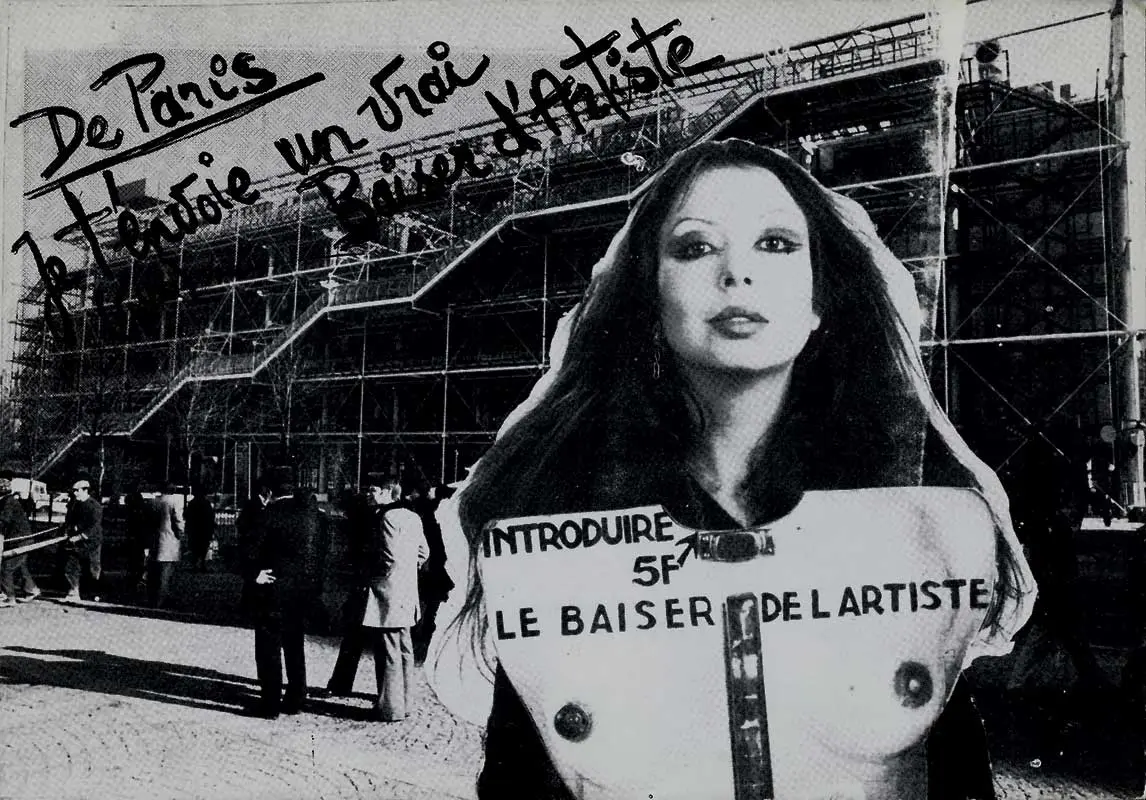
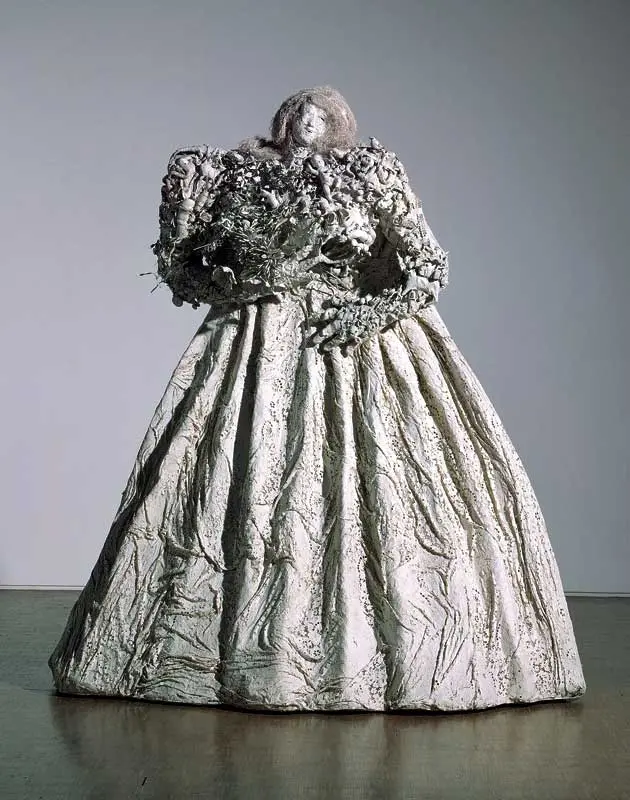
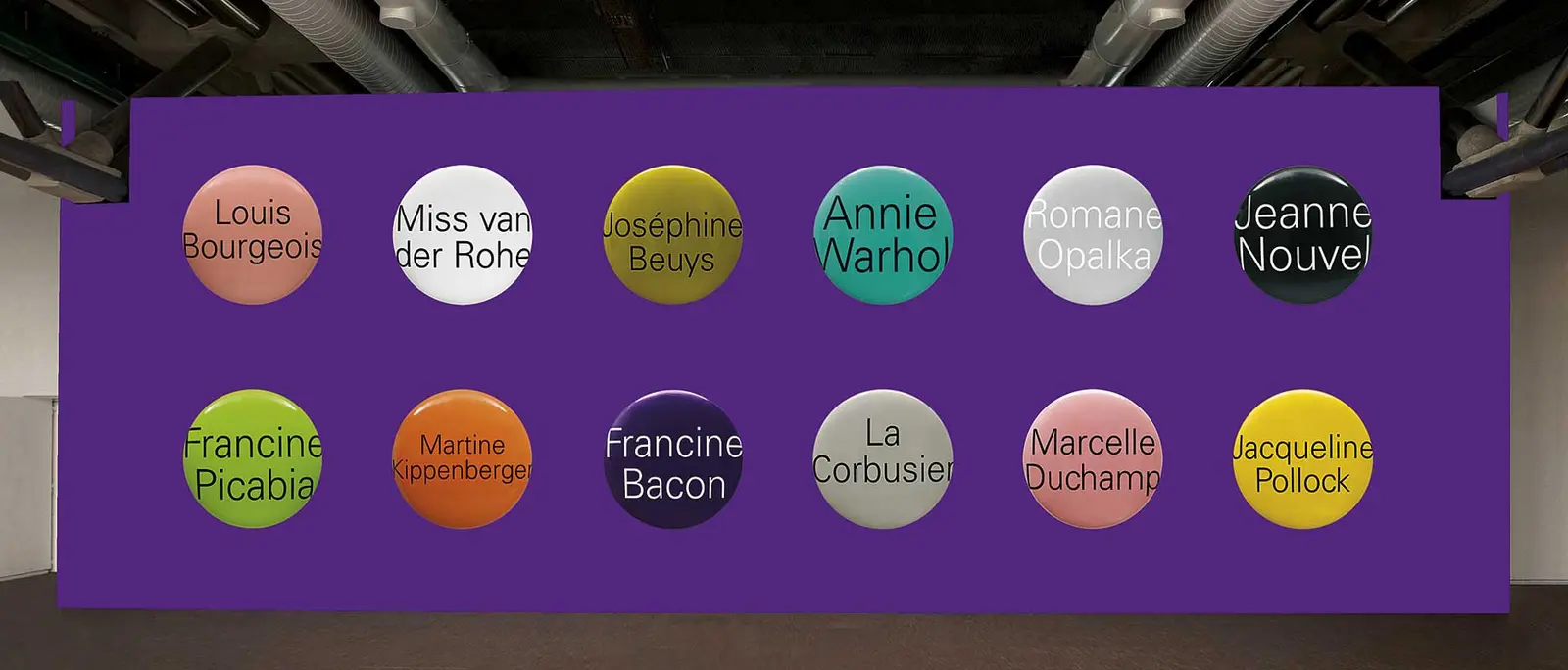
The contemporary section, on the 4th floor, is organized around the same thematic scheme. Six large sections, each divided into chapters, put on display a series of works that include paintings, drawings, installations, videos, and photographs. While the Centre Pompidou collection is international, the historical references and landmark dates presented as chronological points of reference for women's conquest of the art scene are essentially French and North American, European at most. Two generations share space at the entrance to the show: Agnès Thurnauer large installation (Portraits grandeur nature, 2007-2008, resin-and-epoxy-paint pill, 120 cm in diameter), which feminize the "big names" of Twentieth-Century art (Marcelle Duchamp, Francine Bacon, Jacqueline Pollock) mostly lacks visual interest and conceptually is just anecdotal. It soon gives way to Niki de St. Phalle's two oversize sculpture-collages: Crucifixion, 236 x 147x 61,5cm, circa 1965, and La Mariée (1963), which immediately posit the issue of the "second sex," its alienation, social conventions, and violence against women, opening up the exhibition to an inescapable dimension, that of feminist positions from the 1960s and 1970s on the basis of which women asserted their existence and reaffirmed their identity. In this section, dominated by feminist views and titled Fire At Will, we can see photographs of performances by Orlan (like Le Baiser de l'artiste, from 1977); Valie Export provocative video-performances from 1969, or Hannah Wilke's (1940-1933) scarification photographs of 1974-75. This physical violence exerted by women on their own bodies is seen further in the section titled Slogan Bodies, with videos by Tania Bruguera –País mío, tan joven, no sabes definir (2001)– and Ana Mendieta's Chicken Piece Shot (1972), where she covers her skin in blood; the coupling of a woman and a goat (Kiki Smith, bronze, Tied to Her Nature, 2002); Marina Abramovic's video-performance (Freeing the Body, 1976); or Jana Sterbak's beef dress Vanitas: robe de chair pour albinos anorexique (1987), to cite only a few works from a period dominated by the drive to exorcize femininity. An exacerbated vision of the body on stage, of its own violated nudity; the body as object, the body altered, alienated, humiliated, which reject being treated as an object. The next section, Eccentric Abstraction (Lucy Lippard's expression, from 1966) is intended to show that women do not confine themselves to the organic or to sensuality, but are able to use new materials, invent new strategies, participate in the Twentieth Century's new visual and theoretical categories (paintings by Shirley Jaffe and Aurélie Nemours; Lygia Clark's Bicho; Yayoi Kusama's installation My flower bed (1972, made with bedsprings and gloves painted red); Alina Szapocenikow's (1926-1973) organic and humorous series of photographs of chewing gum; and 11 recent drawings by Louise Bourgeois (Extreme tension, 2007, graphite and print with watercolor) representing organs of the human body.
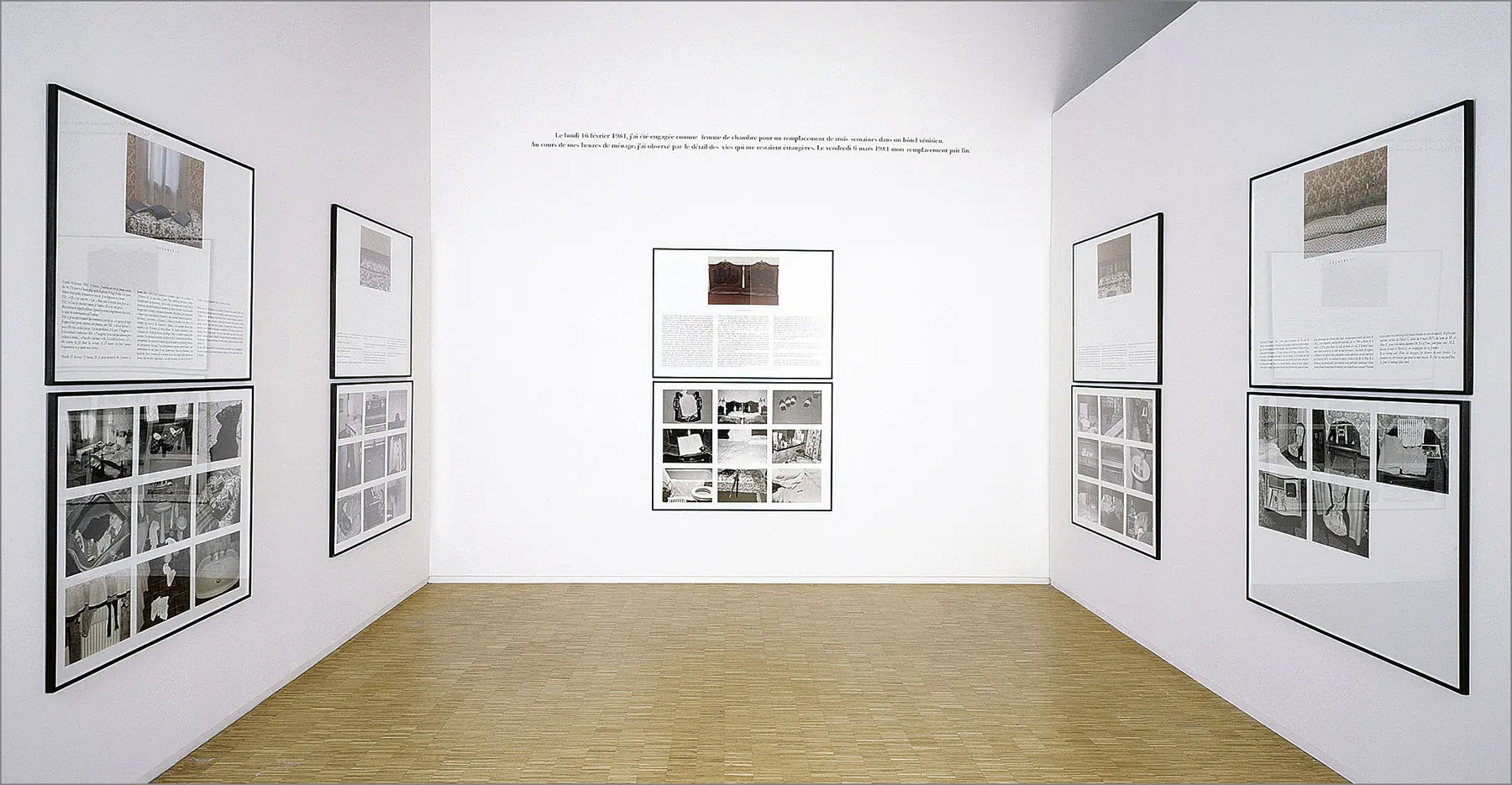
The section titled A Room of One's Own (after Virginia Woolf's 1929 novel) includes several three-dimensional installations that claim the principle of the cell for living: Louise Nevelson, with Reflections of a Waterfall I (1982, painted wood and mirrors, 280 x 447x 42cm); but especially Dorothea Tanning, Chambre 202, Hôtel du Pavot (1970), an installation made using fabric where furniture is transformed into body parts; Mona Hatoum's impressive, oppressive video Corps étranger, 1994, where, on the floor, the camera penetrates every body cavity in close up; Sophie Calle, with her series L'Hôtel (1981-83); and Pipilotti Rist, with a captivating and poetic audio-visual installation on a star-covered floor with projections and sound (À la belle étoile, 2007).
After the arrival of conceptualism, the flesh becomes rarified, the body loses its physical substance, with works by Lea Lublin (L'ange de Piero della Francesca, a 1980 painting) or drawings by Rosemarie Trockel (1989). Cristina Iglesias' beautiful installation Untitled (2002), accompanied by sounds of animal and human voices, creates a cupola of interconnected words on superimposed planes traversed by the light that projects from that arabesque of writing on the floor and walls. The exhibition ends with the section Immaterials, dominated by an ascetic quest and the dematerialization of the work of art, where movement, which translates the ephemeral and fleeting nature of time, is triumphant in works by Jenny Holzer, Geneviève Asse, and Judith Reigl, among others.
This minimalistic ending of the contemporary section of elles@centrepompidou closes a museographic and conceptual development characterized by the presence of high-quality works representative of its voluntaristic demonstration. The thematic a priori prompts a reflection about aesthetic points of view that marked the evolution of mentalities and the artistic representation of women and sex. While the feminist proposal is very much present, the absence of artists like Judy Chicago or Canada's Francine Larrivée, whose feminist works marked an era (1979), is equally salient, as is the fact that, in general, the Centre Georges Pompidou's policy of acquisitions and exhibitions gave priority to less militant artists. It is possible that the second show will surprise us... However, the exhibition's strength, which seems to attract a diverse public in terms of gender and generation, resides in the way it justly highlights a different artistic sensibility, a different understanding of the world and the ego, confirming the notion that women have finally regained something men had "robbed" them of for centuries: their representation of themselves, ultimately fostering a more balanced dialog between the sexes.
NOTES
1. In Latin America, in the front of social and political emancipation Ecuador was the first to recognize, in 1929, women's right to vote, after the Soviet Union (1918) and the United States (1919), but before Brazil (1932), Argentina (1947), Mexico (1953), and Colombia (1954), and also before France (1944).
2. A major French feminist historian (born in 1928).
CHRISTINE FRÈROT