Enrique Jezik excavates instead of gathering. An unusual process if we consider the predisposition these days toward superimposition. Chipping away at the surface, we encounter something that we had intuitively known from the beginning: a vaguely defined distance that was kept hidden. Jezik is not after a specific or mediating image, but rather he privileges finding the result in the erosion that is caused by producing such an image, like a sculptural metalanguage. This aggressive carving of the raw material represents ceremonial destruction capable of transmitting contained violence; the resistance of the material is proportionate to the intensity and directionality of the blows as if each of the mediators perfectly understood the rules of this painful process.
In the exhibit by Enrique Jezik titled Mapa y Mira Telescópica (Map and Telescopic Sight), excavation becomes a paradoxical process. Six plaster panels have been carved to outline a firearm’s telescopic sight, on a scale larger than real life. Upon sharpening the gaze through the amplified lens, the target is revealed at the correct distance for an effective shot. Serving as canvas and wall at the same time, the surface fashioned in plaster renders the gaze of the attacker or victim difficult, as it conceals any possible horizon. It is, in fact, a sight for a blind eye.
My madness and my fear
have large dead eyes
the fixity of fever
What is looked at in these eyes
is the nothingness of the universe
my eyes are blind skies
Georges Bataille
I wonder, then, what these blind looks are aimed at, other than toward nothingness. Drawn on a two-dimensional panel, they can only signify a dictionary of terms. Mildot, Rangefinder, Alemana, and Crosshair are the nicknames given to these silhouettes that are sophisticated tools for specific targets. Weapons that require perfect sights in a framework of illegality for their undercover and illicit use. Blindly, these sights cannot aim at a concrete character, but rather target an amorphous subject that conceals the purpose of the action.
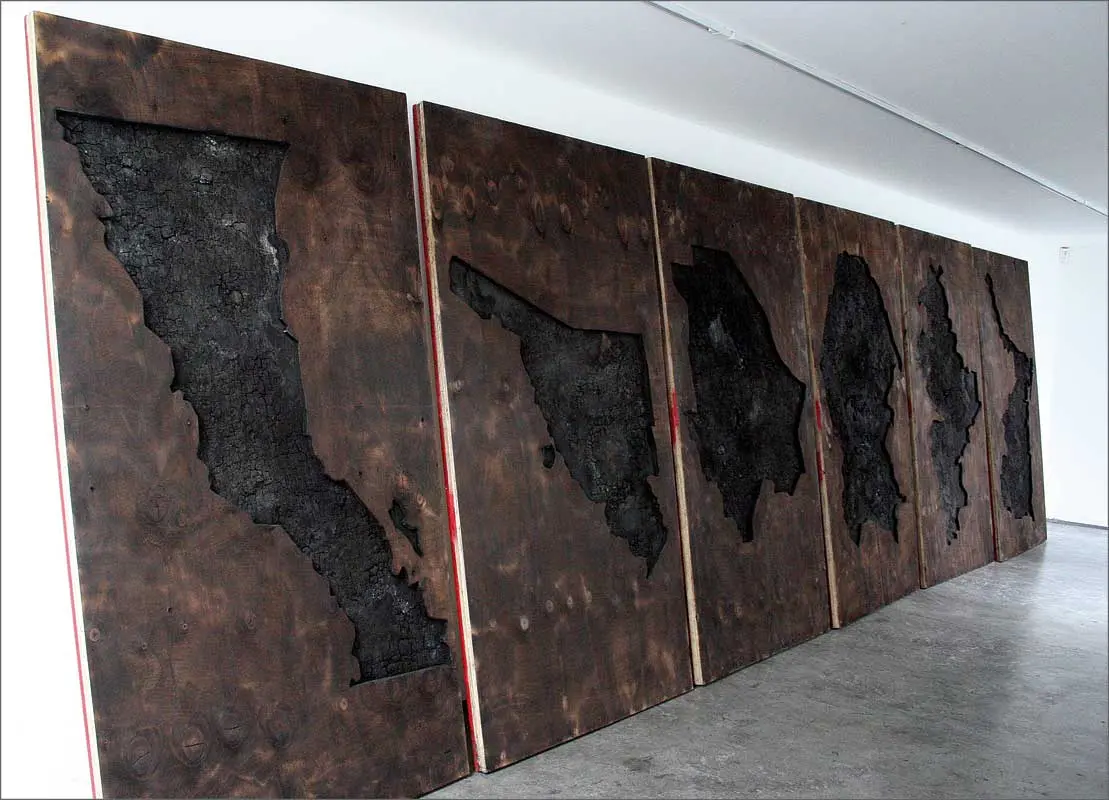
Standing next to this first series of telescopic sights, there are six bas-relief wooden panels. On their processually burned surfaces, the seven northern states of the Mexican Republic can be observed. Drawn without size distinctions, they reveal to us an imaginary geographical situation on a decomposed map; a telescopic sight through which nothing can be seen, and a disintegrated geographical map.
The relationship between both works underscores a country, overwhelmed by the uncertainty that has been transformed into a strategic camp for sights that fire at different targets. The original raw materials used in both works, it is no longer a metaphor for resistance, but rather one for a mirage. Nevertheless, for me, the idea of discovery appears to be especially important in this small-scale excavatory act. The dead must be buried for them not to feel that they are participants of a murder, for the desire to kill, according to Bataille, is interdicted. Nevertheless, to forget the fallen becomes an analgesic for the memory; the greater the number of layers standing between us, the more remote reality appears to be. Thus, excavating is an act of necessary violence despite the possibility of a fortuitous accident. To the degree that cosmetic layers are excavated and interfered with, Jezik’s extractions reveal a stratification of contents: to activate forgotten spaces more as a reminder than as a consideration.
RUTH ESTÉVEZ