
Política de Ensayo (The Politics of Rehearsal) is the first exhibition in Colombia by Francis Alÿs. The exhibit was curated by Rusell Ferguson, and gathered some of the most recognizable works by the Belgian artist. Política de Ensayo is the grouping of many essays, attempts, and repetitions of events, some of which, according to the artist, had a point and others that did not.
The Belgian-born Mexican artist surveys cities and stops to detail the flows, the palpitations, and the relationships of these with their inhabitants. Through the creation of actions and video installations, Alÿs generates several meaningful symbolic readings on the social systems of the places where he carries out his actions.
In the video titled Caracoles (Snails), he shows a character in a slum located in the mountainous outskirts of a city –that very well could be Mexico City or any other Latin American marginal urban space– were given the inclination of the terrain, there is a certain tension in the activity. The character in the video kicks a coke bottle that is easily identifiable, and this prompts the generation of referents in the spectators. Stray dogs appear as occasional actors that generate actions during the sequence. The entire group of events, together with the street noise, the sounds of barks and claxons, immediately place the spectators in a local environment with which they become gradually familiarized and able to contextualize. The video titled Perro y Balón (Dog and Ball) could very well be a home video of a dog fetching a ball, but the video instead of in reality again reinforces the notion of these street dwellers who are part of a landscape addressed so often by Alÿs.
In another video, the sound of a musical band playing a tune –that begins but never seems to end– can be heard in the distance as it accelerates and decelerates, emitting the sound of a Volkswagen that, taking advantage of the momentum its speed has generated, attempts to climb the hill of a marginal neighborhood of dirt roads and a desolate landscape. The vehicle continually attempts to climb the hill without ever actually doing so, something that generates stress in the spectators, as they continue to wait for an end that never is reached.
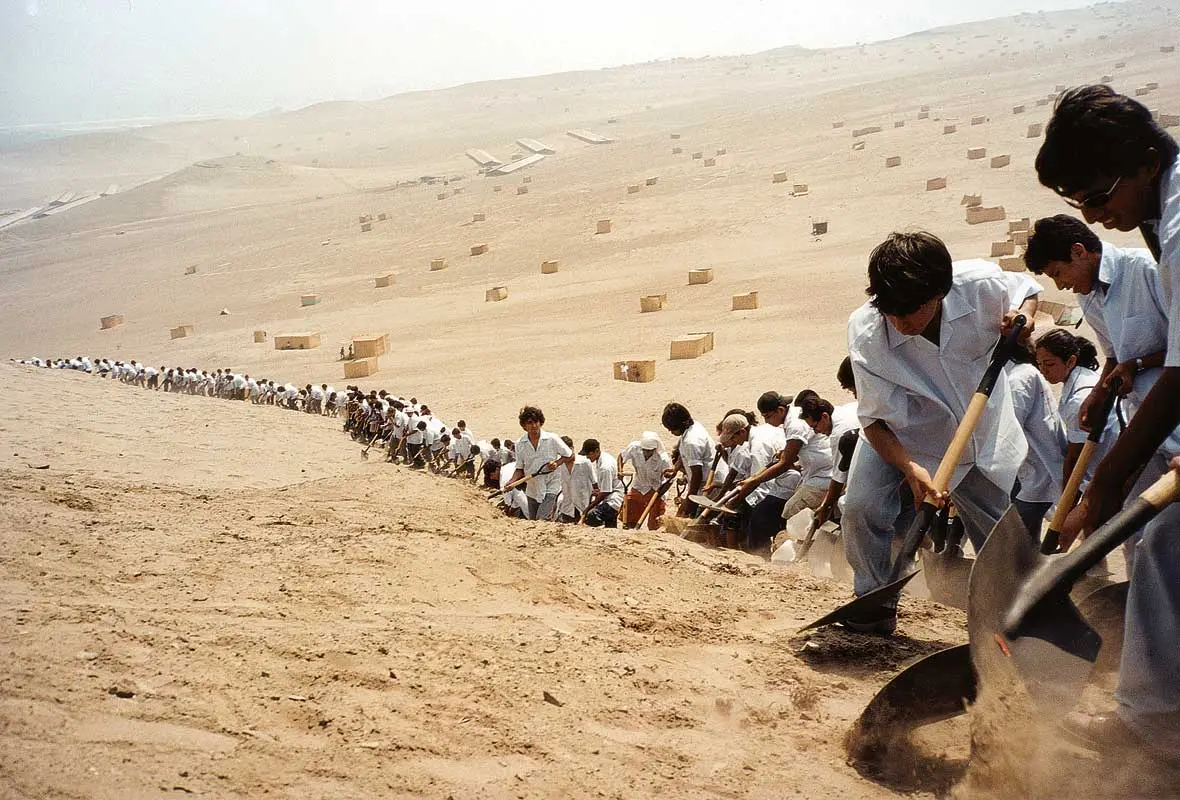
Cuando la Fe Mueve Montañas (When Faith Moves Mountains, 2002) is one of Alÿs’ better-known projects in which the artist presents a straightforward critique of Latin American societies. It is an action created to comment on the unrest in Lima following the end of Alberto Fujimori’s government, as Peruvians anticipated change after the dictatorship. In an area in the outskirts of Lima, about 500 volunteers were asked to gather before a giant sand dune and, using shovels, to move the dune approximately four inches from its original location. This proposal is similar to another project organized in Mexico City with street sweepers, who have formed a single line and is equipped with brooms, attempted to move a mountain of garbage piled up in a city street.
Also part of this exhibition was the piece titled Paradox of Praxis 1 (Sometimes Making Something Leads to Nothing), in which Alÿs can be observed pushing an ice block across city sidewalks, as the melting ice leaves behind a trail of water that eventually evaporates. Here, the artist notes the paradox of carrying out an action that possessed no meaning or that accomplished nothing. Although these projects may appear meaningless, they convey what Alÿs proposes as his politics of rehearsal. The process of the repetition of these events is much more important than the results that they yield. Each repetition represents a story, an effort that merits being taken into account, in that what matters is the process itself and not the results.
Alÿs’s projects are based on a seemingly basic and minimalist idea – such as that of pushing a block of ice, walking through the city streets with a weapon, or being on drugs. These acts are complemented by the time and space and by what surrounded them as they are performed. Not controlled by the artist and only perceived after the act has been recorded, these are reactions that such an act generates in relation to the context, which varies according to the existing idiosyncrasy of the place where each project is rehearsed, attempted, and developed.
Throughout the exhibition, we find tables and notes, drawings, annotations, e-mails, and many documents that form part of Alÿs’s personal archive. Here, one can observe the manner in which the projects – such as Cuando la Fe Mueve Montañas – were developed: the call process; the planning of the projects, etc. In addition, this archive addresses the idea of the rehearsal, because it makes one think that the entirety of the exhibit’s elements represent one more proof that something does not necessarily have been an end-product, but can instead be reused and rethought in a new light.
These projects by Francis Alÿs can be interpreted in several ways without the need for their leading to a conclusion, to an end. The most important aspect of a process is the process itself and the stories, records, and readings it generates through the repetition of a given action.
MAYA GUERRERO