Francisco Hung. Mirada Íntima. Selección de dibujos del legado familiar is the first-ever exhibition devoted entirely to the draftsmanship of this important Venezuelan artist. Born in China in 1937 to a Venezuelan mother, Hung, who died in Maracaibo in 2001, arrived in Venezuela at the age of 10, settling in the city of his maternal family. His most recognized work is in painting and follows the abstract expressionist school, characterized by gestural impetus and expressive force. But in parallel to that internationally recognized pictorial oeuvre, Hung kept up the practice of drawing throughout his career, almost always circumscribed to his most intimate and personal spaces. Thus the title of the show and its importance in the context of Venezuelan art. Mirada Íntima presents an almost unknown face of one of the highest representatives of the national Avant-Garde.
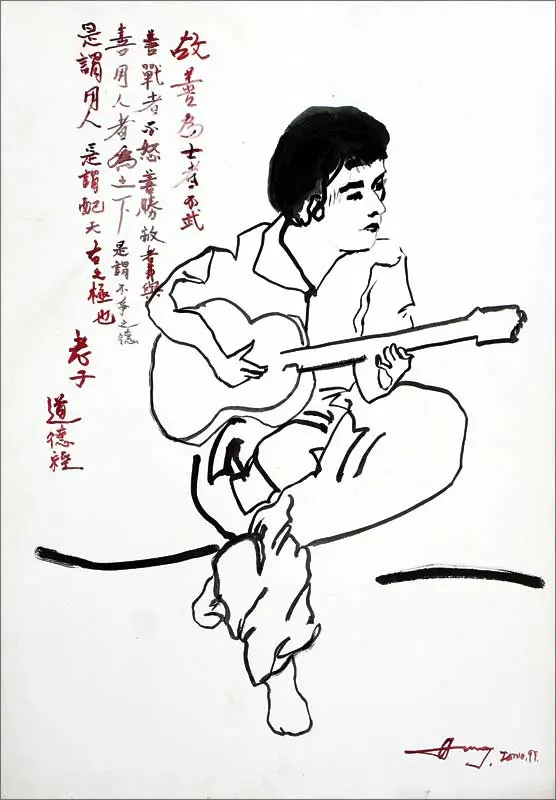
The show brings together some 180 drawings in the most diverse formats, supports, and techniques (ink, watercolor, pencil, crayon), and occupies the middle and upper levels of the Sala 1 at the Museo de Arte Contemporáneo del Zulia, in Maracaibo. The gallery’s ample space, which at some points has triple-height ceilings, is filled with natural light through a large vertical window and is used as a neutral stage for the contemplation of Hung’s drawings without the deployment of any theatrical museographic resource. The show’s design is tilted towards pulchritude. Meanwhile, the curatorial concept follows the path announced in the show’s title and seeks to reveal the thematic connection between Hung’s works and his private world. The subgroups into which the exhibition is divided connect with the artist’s recurrent themes in his daily drawing practice: his own image, his family, his pets, the news, and everything that captured his gaze.
Entering the first space, visitors are greeted by a series of self-portraits showing the artist’s constant drive to recognize and capture his own physiognomy. We can explore Hung’s visage as it passes through time and notes how he invested himself into a variety of characters: as an old man with a star on the forehead; as a classical warrior, standing with a sword to his side; as a draftsman. Each image contains a self-identified possibility for the artist’s personality, which allows us to see him through the mediations of his own perception
The next group is comprised of portraits of members of his family. These are direct images of faces of friends and relatives; the set is colorful and includes watercolors in small and medium format alongside quick ink drawings.
Ascending to the second level, we encounter two peculiar works, completely unknown until now: large drawings—almost nine meters long—created on rolls of rice paper. Each of them is in itself a compendium of Hung’s work. They contain family images as well as gestural and calligraphic work, all of it unfolding in a compositional scheme that is free yet adjusted to the paper’s vertical orientation. They are simply impressive, with images presented in a sequence that do not suggest a narrative intention of any kind but function as a visual expression of Hung’s multi-cultural background, nourished by the Chinese tradition and the Western Avant-Garde.
Moving forward in the space, two large paintings are on display, one from the 1960s, entirely gestural, and figurative work from 1998. The inclusion of these works seeks to reveal the common elements that run through Hung’s work as a whole. Later we are faced with drawings of animals: his dogs, and bull-fighting. These works retain the same quick treatment of the line and the vibrant colors that we notice in the rest of the exhibition.
Finally, the last two spaces contain works touching on four rather diverse themes: pictograms; everyday family life; erotic drawings; and caricatures. The pictograms are quick gestural exercises that make forcefully evident the link between Hung’s draftsmanship and the practice of calligraphy. In the family-themed and erotic drawings what we find is a kind of love chronicle: the wife and companion, the growing children, the close friends that share the space of daily life, they are all there as the subjects of the portrait and the recipients of affection. Lastly, the caricatures show Hung as a devoted TV watcher and are filled with images taken from the news and from comics.
Mirada Íntima allows visitors to approach an almost unknown facet of Francisco Hung’s work, and it is also a window into the world as seen through his eyes. Few art exhibitions offer such a clear opportunity to connect with an artist’s private life without any resource other than his own work.
SUSANA QUINTERO BOROWIAK