Although Gustavo Acosta’s exhibition does not clarify the questions mentioned in its title, it undoubtedly transports us to the other side of the mirror, to an alternate world, or a new interpretation of the one in which we cohabit. The exhibition, curated by Mirie de la Guardia, includes acrylic paintings that represent broad panoramas of large cities that belong to the tradition of landscape art and yet also break its customary paradigm. They propose alternative ways to understand the world because Acosta places us, as observers, in imaginary, elevated places; so elevated that we feel like airplane passengers looking out the window, or as if we were flying, considering the world from a bird’s-eye view.
In Acosta’s large urban landscapes, the horizon is placed in the highest part of the composition, or somewhere in the space beyond the canvas’s edge. In general, urban order—or disorder—takes up all the available space, creating a complex visual code of streets, avenues, houses, and buildings that repeat themselves infinitely, starting from the foreground at the bottom, until they are lost from our sight or run into the abrupt cutoff created by the horizontal line of the upper stretcher. With dexterous handling of the brush and of atmospheric perspective, Gustavo Acosta defines nearby buildings more carefully and renders those further away with fewer strokes, decreasing detail, and diminishing color, upon large-scale canvases. Thus, he creates compositions that seem to envelop us, granting us a position of grandeur, a celestial place that allows us to see “everything,” but which simultaneously resemble visions born of some dream or a deep nostalgia for places once known.
These landscapes represent spaces that are both physical and mental, an effect which is enhanced when there is semi-darkness, when the cities are suspended between day and night, as in Shadow or Signals of Light. One recognizes specific elements such as a stadium, a dome, or a river that flows into an uneven coastline, proof that Acosta is not painting unreal places but rather specific cities he has visited, lived in, or left behind. This feeling of nostalgia is not surprising in an artist who left his native Cuba to live in Mexico, then Spain and the United States. Moreover, it is not difficult to imagine a possible relationship between his life as a young man in Cuba and the sensation of constant surveillance, that someone is watching us all the time, which these all-encompassing aerial views produce.
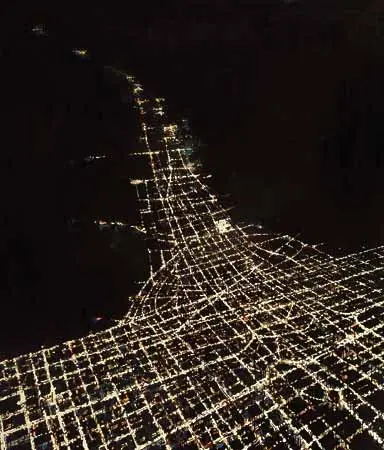
The nightscapes in Acosta’s exhibition are the culmination of this series of paintings. In these views, the details of buildings become lost in a pattern of luminous sparkles, accentuated and organized by the rivers of light that represent the lines of traffic. We stand before broad nocturnal aerial views with a stunning sense of depth that allow the observer to perceive multiple angles of vision. Now it is light, rather than perspective, that plays the main role, in compositions where the cities seem to float in an illusory, implausible space. This feeling increases dramatically when the artist raises us even further, placing the observer at a greater distance in space, and turning the cities into illuminated grids that emerge from huge, somber depths. The urban grid is transformed into a delicate latticework of lights placed against intense blackness. He invites us to become enveloped by that vast space and the thoughts triggered by works with titles such as A Dangerous Thing and Don’t Think Twice. Finally, in Mirror I, we see the nighttime city distilled by distance, reduced to just a few intensely luminous geometric shapes within the dark landscape, twinkling like stars in outer space.
In the smaller works titled Constellation I and II, Acosta seems to be commenting on how much he enjoys the process of painting, the exercise involved in creating visual patterns with the lights that burst into the dark surface as if the canvas were punctured and illuminated from behind. As part of the exhibition, one could watch a video that shows Acosta painting one of his works, from the first sketch through the final product, interesting because it demonstrates his creative process and the technical aspects of his work. The documentary demonstrates how the artist constructs and de-constructs with color, creates a surface and later paints over it, or applies a solvent so the pigment will drip, all part of the process to create the rich surfaces of his urban landscapes. It is an exhibition that brings pleasure because Acosta delivers an enriching visual experience linked to the theme of the modern city, but also to the emotions that are produced by certain physical and spiritual spaces, both past and present.
MÓNICA E. KUPFER