
A member of a generation of painters — young yet already mature — that sustain the high relevance of their discipline in Buenos Aires, Hernán Salamanco (Buenos Aires, 1972) presents his new works at the Braga Menéndez Gallery. Salamanco established himself in the Argentine circuit in recent years with mid- and large-format works generally resolved in a clearly identifiable technique: enamel on sheet metal. Found or sought sheets of metal became the support for the mysterious landscapes exhibited by Salamanco in these recent years, which now seem to turn inward.
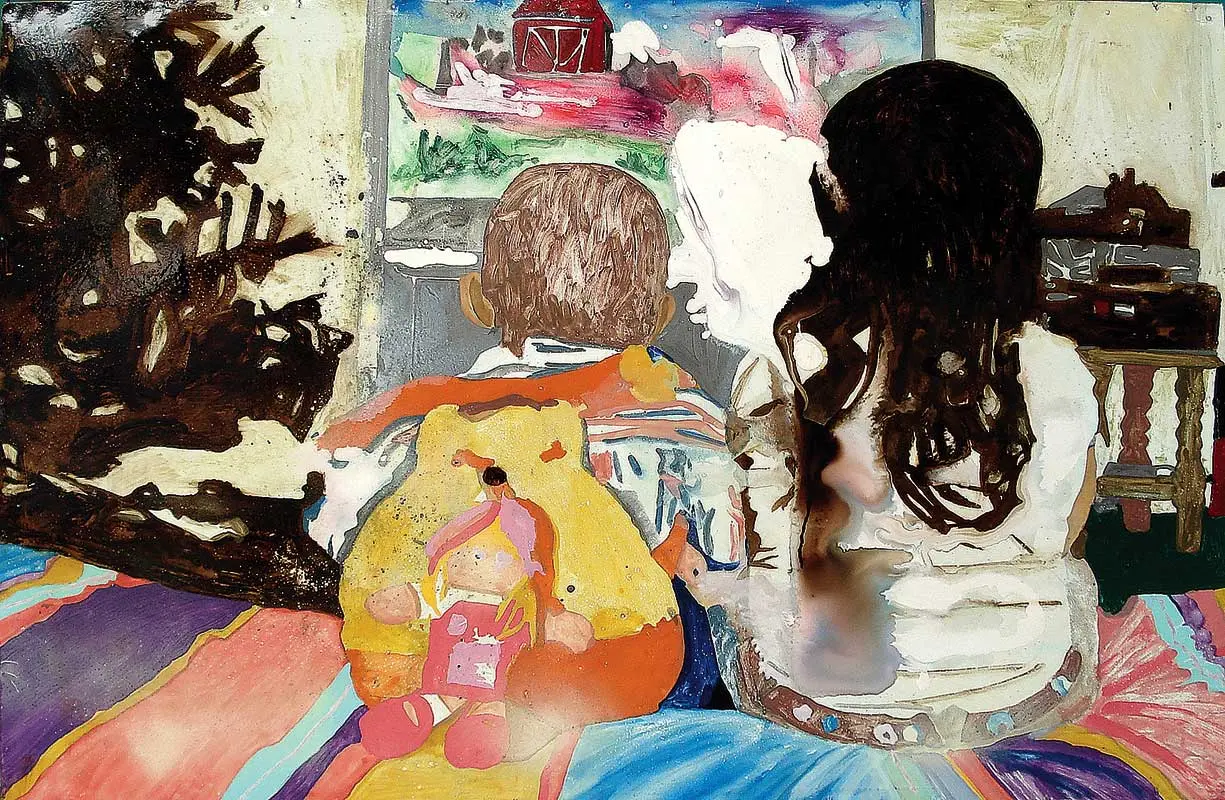
Salamanco’s recent works are traversed by a slight narrative tendency that peers into the universe of childhood. Whole and fragmented toys, a child’s body, the furniture of a child’s room, all combine and elude explicit storytelling. The characteristics of Salamanco’s technique contribute to this veiling of the theme (or is it the other way around, and the theme dissolves because of the technique triumphs?) and finally, the issue of childhood reaches an almost ethereal status that we don’t need to decode in order to enter into what the art proposes. The artist handles enamel in unexpected and surprising ways, finding in it abilities that are closer to watercolor or ink, discovering its capacity for dilution to generate delicate transparencies. The friction between theme, support, and material produces marvelously unsettling results: Salamanco’s children promise a certain bucolic quality; the sheet metal imposes its industrial-like harshness; the enamel should give a full coloring yet here it turns soft. Part of the enchantment of Salamanco’s work is produced in the fissuring of our expectations.
“My paintings go faster than me,” Salamanco said once. And that lack of mental speculation becomes palpable when the work is constructed as an amalgam of blotches, de-painted surfaces, and lines and shadows that adjust the image in the direction of some kind of referent. The composition appears as a small struggle between colors and values, and between a tendency towards balance and a desire to pull everything apart. Salamanco’s scenes unfold under this tension; we intuit them as happening inside the children’s room, festooned with teddy bears, and colored in the same pastel tones that acquire protagonist relevance in Cuco and Twins, the series two most figurative works. When not in a figurative mode, Salamanco uninhibitedly reaches for an expressionistic, gestural kind of abstraction, where the pleasures of mixed and textured color overtake the neatness of forms.
In Cuco, Salamanco joins three vertical metal sheets to form a 260 x 450 cm. mural that for various reasons stands out from the rest of the series. Because of its large size, because of its use of several sheets rather than a single surface, because of the anecdote (a joyous pile of blankets, blocks, dolls, and a child’s leg on a bed or crib), and because of a pictorial treatment that concedes greater space to the contour line (providing the image with a certain graphic quality not found in the other works), this work forces the rest to center around it. Yet it is precisely in those other, less ambitious works where Salamanco comes to us with greater freedom and intuition, reaching peaks like Twins where we clearly perceive two seated children, their backs towards us, in every day yet disturbing situation. It is probably this image that leads the density of the series, displaying and hiding at once, suggesting a climate that is as festive as it is dark, as close as it is distant, and definitively anchored in a painterly universe.
EVA GRINSTEIN