
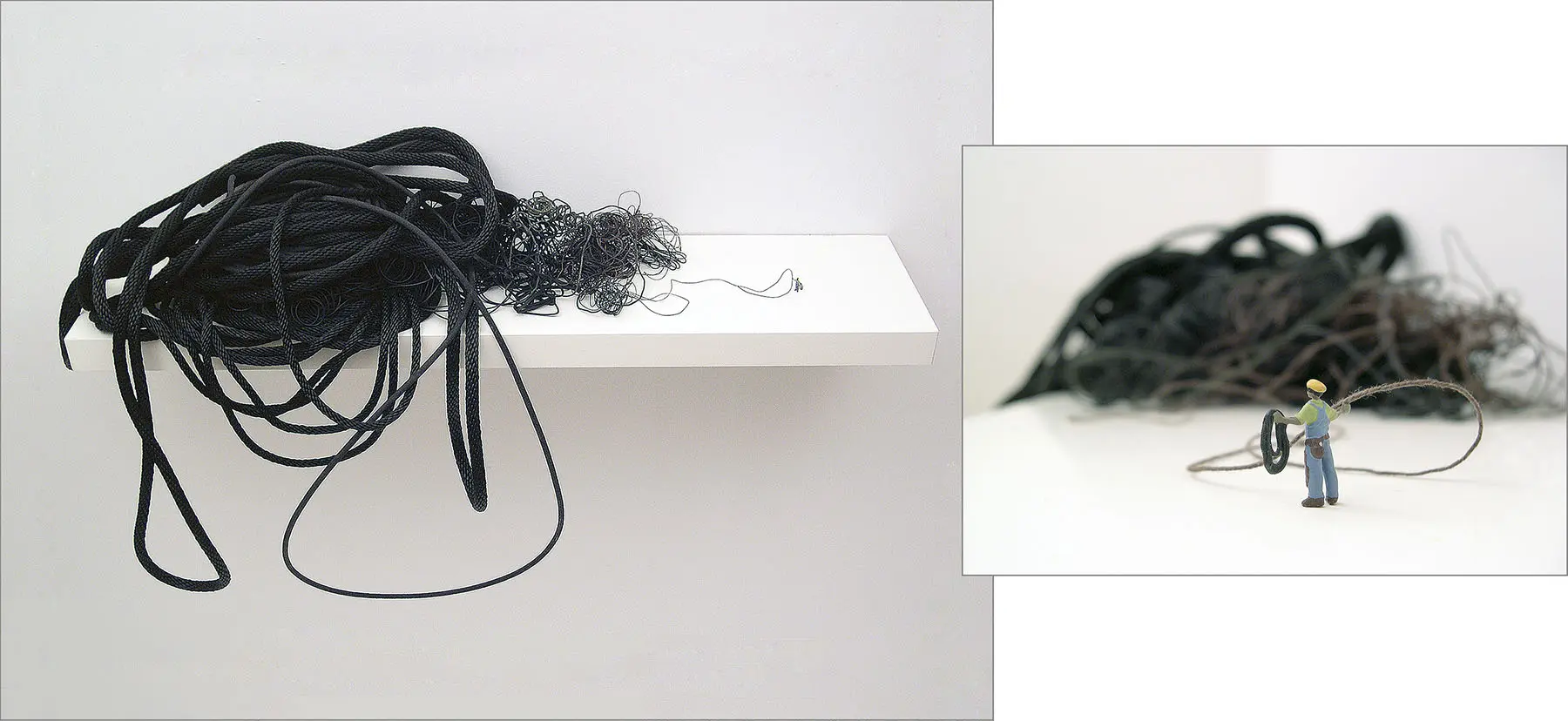
Línea de Tiempo (Timeline) is the title of the retrospective exhibit by Liliana Porter at the Museo Rufino Tamayo. It reflects 40 years of the artistic trajectory by the Buenos Aires-born artist (1941) who has lived and worked in New York City since 1964. These many years away from her native Argentina has not stopped her from using the narrative and the strong literary component so central to Argentine culture; her references to works by Jorge Luis Borges are a constant.
Fifty years have passed since Liliana Porter exhibited her work in Mexico, a country where she lived for 3 years and where she was a student of Mathias Goeritz, one of her “favorite” professors, and one whom she regarded as “an example of free-thinking; a transgressive artist full of new ideas.” Mexico was also the country where, at age 17, she presented her first exhibit at the Proteo Gallery in Mexico City.
This exhibit organized under the curatorship of Tobias Ostrander gathers together 38 artworks including paintings, engravings, drawings, photographs, installations, and videos, pieces some of which date back to 1968. According to Ostrander, Liliana Porter possesses the particular quality of presenting important questions about time and its affinities – space, memory, and mortality – through modest means; inquiries that reverberate throughout her work and in the complementary research that is articulated within them: research about representation, the structuring of reality, and the yearning for meaning, because a good part of her work relies on the traditional role of photography as a document and temporary record.
The fact that Porter migrated with her family from Buenos Aires to Mexico City and subsequently to New York for good – she calls these relocations – made her realize the way in which these three time-zones were able to co-exist on the same mental plane. On the other hand, moving to New York made her fully aware of what it meant to be Latin-American in an Anglo-Saxon context. Abruptly understanding this aided Porter in clarifying her public and the type of interests would drive her work.
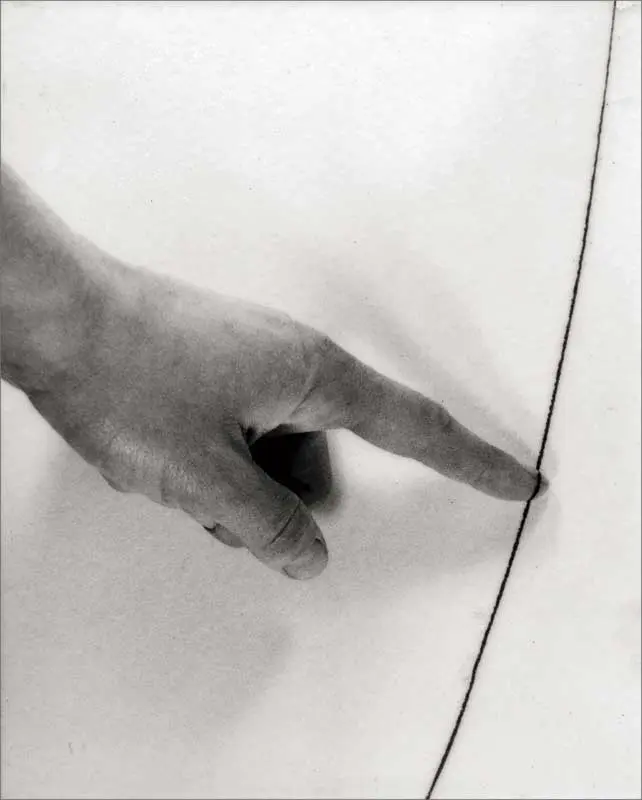
The theme of time and the manner in which it is approached in Porter’s works become the discursive axle of the exhibit, while the line in turn is the visual connecting thread throughout the exhibit rooms. Línea de Tiempo is a graphic assistant that aids us in organizing sequential time in a visual fashion. Across the entire exhibit, temporary events are placed one after the other following a linear structure. The concept of the line began with a piece created by Porter in 1973 titled The Line, in which she traced a line on her finger that then continued onto the surface of a white piece of paper. Later, the artist photographed the result to produce a photoengraving that was then to be printed on another piece of paper. On this new surface, Porter drew yet another line that gave continuity to the one drawn originally on her hand.
Although as spectators we observe one continuous line, the reality is that this line exists in several times and spaces. In the Renaissance tradition, the line was used to create the illusion of a real space. The final objective is that this line, a unifying and homogeneous form, toys with the idea of several temporalities gathered in one image and at a unique perceptive moment that stands above all lines across time.
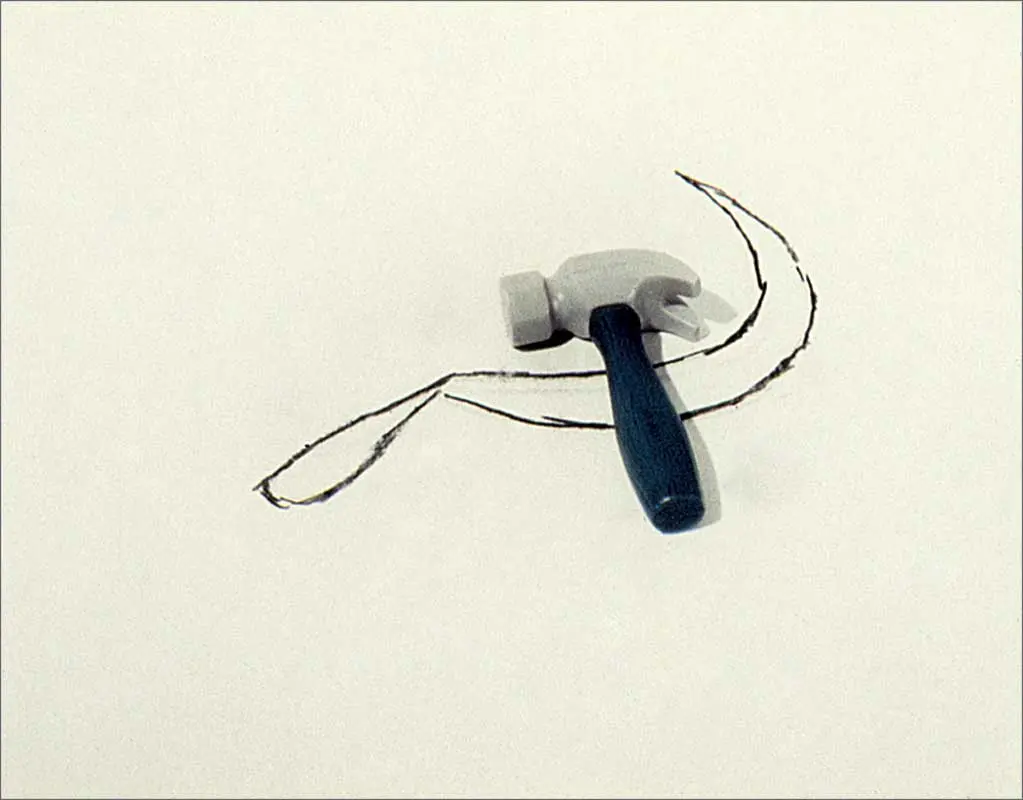
The probable references to the great masters of art are a form comprising the laying of a line across time that is maintained continuous by the history of art, as this idea of continuity is precisely that which is underscored here, along with, to a certain extent, reiteration and tradition. But in this particular piece, Porter alludes to lightness, to the greatest possible weightlessness, in order to evoke a suggestive and powerful mental image.
One of the most important characteristics in Liliana Porter’s work is that of associating lightness with the fragility of temporary structures. These contain the bonds that in the end mark a personal story and a very particular way of influencing events across time. Be it a line or an installation fashioned with threads or with those delicate and small ceramic replicas…her ability to evoke is immense. The wonderful spaces that the Museo Tamayo provides maximize the solemnity of the simple and the light and these expand the mental perceptive space.
The insistence on certain themes that recur throughout works created at different moments is a fundamental tool in Liliana Porter’s questioning of linear temporal evolution. This exhibit is about the futile and elusive theme that is time.
RUBÉN BONET
President of the Adopt a Writer Foundation.