
A creator of series that includes images of Marilyn Monroe, Batman, Spiderman, Power Rangers, and Superman, Peruvian Pop artist Magaly Sánchez presented the series Marcas de Agua(Watermarks) at the Galería Vértice in Oviedo, Spain. Sánchez chose this title because all these works have water as their central element, but also because, “basically, each work is meaningful to me, so each has left its mark or imprint in me."1 There is the water from the sea that brings us pleasure, that helps us relax, and to be playful. Then there is the calming and cleansing water that fills the bathtub, or the boiling water to make a cup of coffee or a soothing and enjoyable cup of tea. There are also decorative and enjoyable bodies of water in any given city. Because Sánchez happens to live and work across from the sea, water represents to her a form of passion that she artistically renders in various ways.
The painting titled Hierve el Agua (The Water Boils) depicts a kettle with a red lid that stands out from the remainder of the nearly monochromatic palette and gives life to the work. Although the water is boiling, we do not see this element of even the stove. Magaly Sánchez zeroes in on the kettle to emphasize the vapor that it expels. As Van Gogh said, “I am now attempting to exaggerate the essential, and I purposely leave the obvious things vague."2 For Sánchez, the boiling water “is an element that has a strong presence in my everyday life and it symbolizes the start of my day."3 But for the artist, this painting represents more than just the simple beginning of her day. It also embodies a process of purification, reached after the water boils at more than 100 degrees Celsius. This process exemplifies these important events in life that also represent changes or purifications. Therefore, the everyday boiling of water is a symbolic element for Sánchez and one she renders in a beautiful, metaphorical, and simple manner.
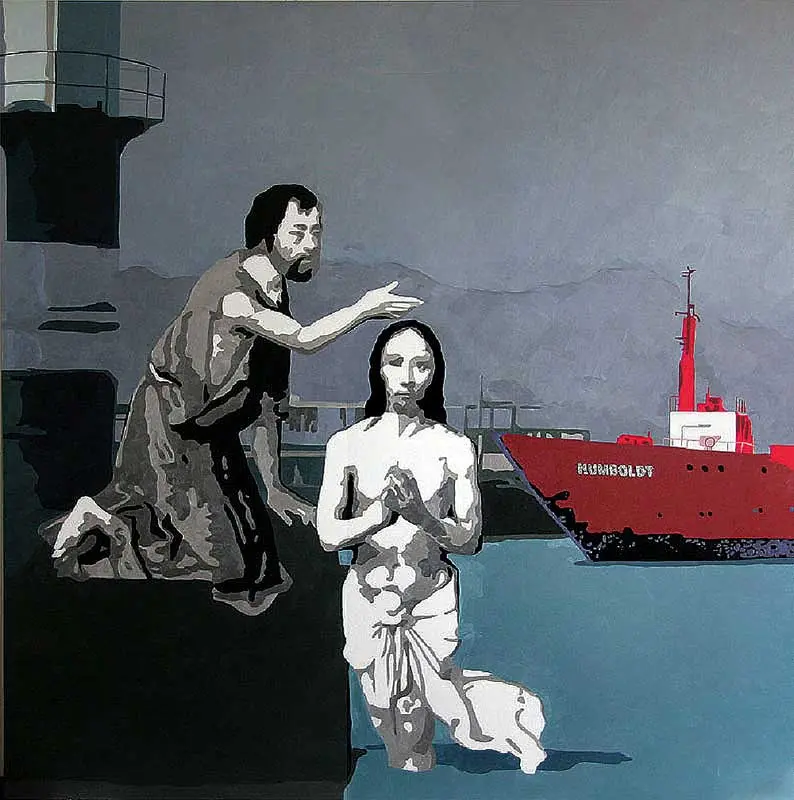
In this exhibit, Sánchez also presents works based on iconic figures from the history of art. She takes, for instance, the beautiful young man from pre-Raphaelite painter John Williams’s painting titled The Awakening of Adonis and surrounds him with water – not by a garden, as in Williams’ painting – in her version, Adonis. In this work, Adonis holds in one of his hands a pack of “lifesavers” candy, a detail that subscribes to the image by Sánchez within Pop Art. Another work in the exhibit, titled Bautismo en el Callao (Baptism in Callao), is based on the image by Renaissance painter Joachim Patinar titled Paisaje con el Bautismo de Cristo (Landscape with the Baptism of Christ). It is a work that utilizes water to symbolize salvation, in that it represents the moment Christ received the Holy Spirit. “The truth I say unto you, no one can enter the kingdom of God unless he is born of water and the Spirit” (John 3:5). Another work by Sánchez, Neptuno (Neptune), borrows the image of this god of the sea from the Fontana di Trevi in Rome. Nevertheless, this new Poseidon has an inflatable red horse – that represents a flotation device and therefore also salvation – that transforms the image into a work of Pop Art.
Similar alterations occur in the other two paintings, titled Escenas de Mar I (Ocean Scenes I) and Escenas de Mar II (Ocean Scenes II). Just as Andy Warhol would often do, Sánchez renders these two works as camouflages. She paints the children’s faces with little details; they lose their identities and become icons of her art. Magaly Sánchez tells us more than what her images reveal at first glance. In Baño de Tina (Bathtub), a woman takes a bath as she holds a rubber duck; her expression is serious and meditative, and she gazes towards the horizon while clouds gather in the background. The woman is painted in shades of gray. Nor are the clouds rendered in realistic colors: some are painted in brown and violet tones. Sánchez never employs a realistic palette when painting human beings; she only does so when she renders products of mass consumption. Because water cleans the impurities we accumulate every day, this cleansing ritual represents a necessity. The artist represents with this image the cleansing of the body and the soul. “A bath lasts longer and is more pleasurable than a shower. The lady taking this bath embodies the moment of enjoyment that is set in front of a late afternoon sky. This backdrop serves to extrapolate the bath from its normal context – inside a bathroom – and places it into a natural environment of soft colors to achieve an even more relaxing atmosphere."4 Why, then, the need for the rubber duck? “Because it saves her, and not precisely from drowning, but rather from a state of inertia. It distracts her from the tranquility, from introspection, and her thoughts. It allows her to be playful, to return to her childhood; therein lies salvation in this particular case."5 We can easily see the reasons behind Magaly Sánchez’s use of these kinds of symbols in her work. She is sentimental and emotional, and these personality traits make her work more interesting, given that in Pop Art the products portrayed are solely references to consumerism. Each subject and object depicted in the artist’s work has a profound, metaphorical, and even philosophical significance. While Pop Art is not known for its narrative attributes, Sánchez’s reinterpretation of this artistic current possesses many different facets: it is symbolic, story-oriented, and even mythological. And these are the qualities of her work that precisely make it more challenging for her. For she must combine banal consumerist images with characters from the history of art – relocated in our contemporary context – within the framework of Pop Art.
Magaly Sánchez considers water to be an important element in our lives. She underscores the functions it serves, such as keeping us clean, hydrated, joyous, safe as well as esthetically pleased. She insists on including the flotation device as a symbol of spiritual and personal salvation that is essential in lives such as ours, filled as they are with tribulations.
Magaly Sánchez’s artworks are impressive because of their large-scale formats, the balanced use of color, and the aesthetic elements they contain. Although her art is visual, it is also intellectual; therefore, the more the viewer learns about her work, the more he/she can appreciate the artist’s talent. It is a fact that Magaly Sánchez relies on the use of many metaphors. Thus, the observer must follow her work closely in order to enjoy fully and understand her images, in a much more interesting way than, let us say, a casual observer would ever be able to.
NOTES
1. Interview with the artist, June 2009.
2. Sam Hunter & John Jacobus. Modern Art: Painting-Sculpture-Architecture. (Prentice Hall, Inc., Englewood Cliffs, New Jersey, 1992), p. 45.
3. Interview with the artist, June 2009.
4. Interview with the artist, June 2009.
5. Interview with the artist, June 2009.
AUGUSTO CHIMPEN