
“The land does not belong to mankind, but rather mankind belongs to the land. Everything is interconnected, like the blood that binds us together. Human beings did not weave the weft of life, as we are solely one of its strands. What we do to the weft, we do it to ourselves.” With these few words, Margarita Checa (Lima, 1950) conveys the spirit that energizes La Trama de la Vida (The Weft of Life), the latest exhibition of her recent sculpture works at the Galería Lucía de la Puente. The group of ten sculptures fashioned from several types of wood, in addition to two other bronze sculptures, represents a host of characters claiming their humanity to affirm their individuality against the dimension of otherness. In the introspective, serene expressions of these adults (over 6.5 feet tall, with the exception of the small-format bronzes) and children (life-size), it is possible to perceive a respectful union with “the other” and with “that other” (nature).
The style of these pieces is a result of the language that Checa absorbed during her school years at the Pontificia Universidad Católica in Perú, and at the Cristina Gálvez workshop, which was consolidated during the 1980s. They are naturalist representations of the human figure, accentuated by the stylization of certain parts: dolichocephalous with large feet (perhaps an allusion to the connection with the land), and the elements of a ritualistic gathering in the gallery space where the sculptures, with their bodily gestures and facial expressions, seek answers from the spectators. The variety of emotions contained in these characters range from a contemplative hieratism to the amazement before the life that is so particular in children. The wood (mainly olive, but also from other Amazonian trees) has a natural colorfulness and a bright and smooth finish that is inviting to the touch. One distinctive characteristic of Margarita Checa’s work is the use of incrustations from diverse materials: bull horns; wood; huamanga (Andean alabaster); silver, and bronze. Thus, Checa continues the ancient Peruvian tradition of (marquetry) that originated in pre-Columbian times and that was applied to metalwork and used in furniture-making and for other applications during the colonial period.
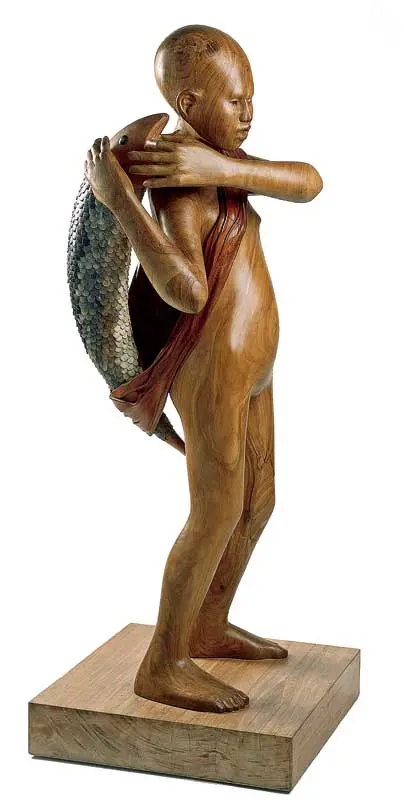
Lo Inevitable (The Inevitable) exemplifies the general characteristic mentioned previously This mysteriously titled piece was created in 2008 and combines olive and mahogany wood. The child it represents is life-size, and his head, hands, and feet reveal a stylization that is characteristic of this artist: he wears a bandoleer that holds some sort of fish that could easily come from the Amazon. Its scales are fashioned from bull horn fragments that have been integrated with the wood, achieving a harmonious contrast. The contact of the child’s hands with the body of the animal suggests successful cohabitation with the natural surroundings (Checa’s assertion that “everything is interconnected” comes to mind). The nude figure is exempt from any specific cultural circumscription: we stand before representations that belong to a universal plane. It is this omission of coordinates, these temporary spaces that confer a mythical dimension to the characters of Margarita Checa, because the problematic that she addresses is transcultural and timeless. Even when attired (with cloaks, headdresses, or bracelets), the bodies are never completely covered. In this utopian world that Checa has created, men, women, and the earth (to which human beings belong and not otherwise, as this artist has stated) to be indivisible parts of the vital weft of life.
This group of works is completed by two small-scale bronze sculptures that measure 19 and 13 inches tall, respectively. The stylization of their shapes is more accentuated than those in the wooden pieces, and their slender bodies and the metallic texture they display evoke the sculptural language of Alberto Giacometti. Like the other sculptures in pairs included in the exhibit, these two are also dressed in sober clothing – one wears a sort of short skirt, and the other, a long skirt – that in this instance are silver in color and contrast with the dark patina of their skins. Despite their small scale, these sculptures convey a monumentality that can be attributed to the deliberate disproportion of the extremities. One of these bronze sculptures bears the same title as the exhibit. Her posture suggests an attempt to reach out and touch that embodies Checa’s call to preserve the ability to be amazed at life, to favor discovery as an inalienable vocation.
The opening words convey a declaration of humility. We appear to be oblivious to our nature as “symbolic animals” (to quote Ernst Cassirer) to the degree that, guided by our supposed rationality, we attempt to go against the principles of equity toward others and respect toward the environment. Indeed, the etymological meaning of the word “symbol” refers to the idea of gathering, of unity (in contrast, “diabolo” is that which divides). Without attempting to generate literary allusions (for there is no overt “agenda” to speak of here), the work by Margarita Checa reveals the essential need of human beings to gather in reconciliation with their own selves, with others, and with nature. From the mature perspective of her proposal, Checa invites us to (re)incorporate ourselves into the weft of life.
LUIS AGUSTI