In the early 1980s, Miguel Von Dangel began to utilize maps for the creation of his works. These first collages would reveal a new facet in his artistic trajectory. Since the beginning of his career, Von Dangel had presented proposals that reflected his interest in exploring new techniques. The integration of materials from different sources would notably enrich creations based on the assembling of diverse objects. Another aspect of Von Dangel’s visual activity is represented by his encapsulated works that exhibit vegetal, animal, and mineral segments that have been fossilized with artifice under the transparency of polyester. On the other hand, the cadavers of stuffed animals and their byproducts – skins, feathers, skeletons, etc. – reveal problematics that the artist develops daringly. Such is the case of his work titled Retrato espiritual de un Tiempo, 1960-1970 (Spiritual Portrait of a Time, 1960-1970), in which he presents a crucified dog, and Monumento, 1975-1985 (Monument, 1975-1985), which consists of a stuffed horse erected in an equestrian position. His is a transgressive and residual aesthetic that harmonizes with the practice of taxidermy practice and that enables the artist to create sculptures with unanimated bodies, allowing him to confer a necrophilous, and in many instances, mystical accent upon these productions, which blur the lines between art and nature; this blurring is transformed into a clear call for the need to care for and rescue the planet’s fauna.
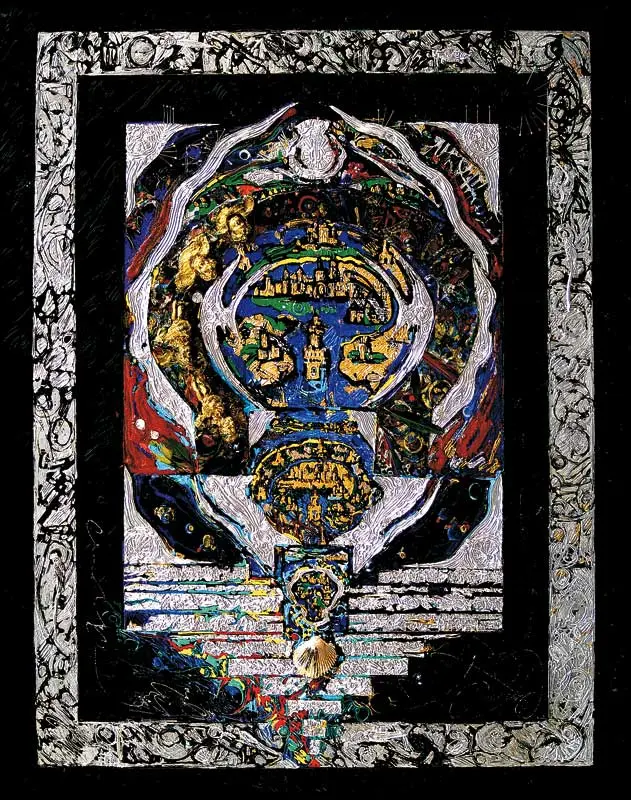
Von Dangel has deepened these searches throughout his artistic trajectory. In 1991, he received the National Visual Arts Prize in Venezuela and was also awarded the 1992 Eco-Art prize in Rio de Janeiro. Afterward, Von Dangel represented Venezuela at the 1993 Venice Biennale, where he participated with a work titled La Batalla de San Romano (The Battle of San Romano, 1990), a monumental execution not only for the length of its dimension (105 feet), but also for its eloquence and expressiveness. Twenty-two pieces designed in different formats and created between 2008 and 2009 were presented from March 8 to May 31 during this recent exhibit by the artist titled Utopía at the Galería Medicci. Here, Von Dangel inquires intensely about the themes that he favors; he delves into ancient, religious, cultural, and cosmic subjects to build images that evoke a mythical time and space. Fragments and objects are randomly agglutinated to find their place in the space, as a totalizing vision is configured in which the smallest of seashells is combined with the vastness of a world map. This is the way in which Von Dangel is able to create a multicolored reality that heightens our sense of sight: chromatic stridencies; bubbling reliefs, and dissimilar textures permit each element to acquire polysemous significations.
Nevertheless, one or more rectangles can be observed in the middle of the group of works whose borders have been purposefully emphasized and that, to a certain extent, serve to stabilize the compositional overflow that appears to expand beyond the frameworks. This is evident in the work titled Tenochtitlán Insvla Venezuola (2008), onto which feathers and pins have been attached and intertwined into a profuse expressiveness; other works, such as La Gran Tau, Tawantinsuyo, Así en la Tierra como en el Cielo, and Memoria de Lampedusa exemplify this type of pictorial treatment. Symbolically, the rectangle is one of the variations of the mandala that refers to both universal orders and to an individual equilibrium. Utopía Según Tomás Moro (2008) is a composition that is closely related to these types of designs, as concentric forms alternate to underscore the contrasts between the ordered and the chaotic, the organic and the geometric, the light and the dark.
Reliant on excess, Von Dangel’s poetic is associated with what some authors have called Latin-American characteristics; in these latest proposals, the artist resorts to a narrative of the fantastic, of imaginary cartographies, and of implausible events. Von Dangel seeks to overcome the limitations of materiality through artistic endeavor. Therefore, he scrutinizes the world through the heterogeneity of its components. Since the dawn of the Twenty-first Century, Von Dangel’s proposal offers to us an innovative landscape that was perhaps never before seen due to its connotations associated with the globalized culture that identifies the society of our times, immersed as it is in telematic networks and permanent transculturization.
As is often the case with the majority of artworks, those of this artist pose questions related to the destiny of humanity and the world in which we live. – Susana Benko writes in the exhibit’s catalog –“Utopía exhibit emulate the elements of the cosmos, the movements, and the transformation that occur in the world, and even the historical future approached from this global vision of human processes and behaviors. It is the entirety of the creative becoming an act of faith. The artist, like God, is a creator of universes that embody his work.” Miguel Von Dangel transmits a vigorous force that never fails to amaze us, due to the impact of his images and the rawness of their themes.
GLADYS YUNES YUNES