The colorful but absent faces and the monochromatic bodies of the women in Miky Fabrega’s recent paintings are balanced most precariously between the greatest superficiality and the insinuation of a valuable message about popular culture in our time. In this series of acrylics, the Panamanian artist presents thin girls with huge handbags and fashionable clothing, who appear either alone or in gatherings of anonymous people, in works with images and titles that make reference to rock music, alcohol, drugs, and psychological problems. It is a pictorial world that describes a potpourri of current styles and contemporary ills.
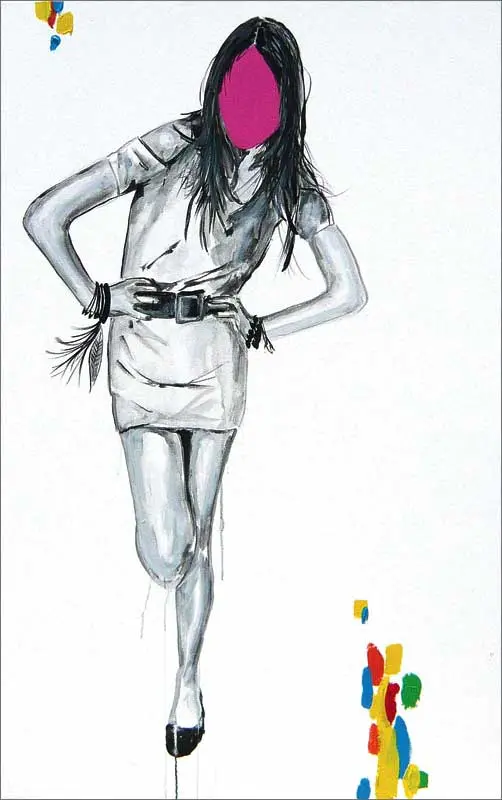
These girls, whose bodies and clothes are painted only with black, sometimes dripping, brushstrokes, are all placed against white backgrounds. Where one might expect to see the details of their faces (the windows to their souls?), we see only empty oval surfaces painted in an intense, flat, hot pink. Clearly, these are not traditional portraits, as these women cannot be identified by their individual physiognomies but rather only by their clothing, their poses, and the lifestyle implied by the symbols of material culture that surround them. Even within the career of an artist who has always emphasized the values promoted by consumerism and advertising art, this interpretation of modern woman seems tormented.
The apparently empty white backgrounds have at times been prepared over previously painted surfaces that appear like hidden palimpsests or traces of other times. This feature grants the backdrops a measure of sensorial complexity that complements the series of superficial dabs of color that adorn most of the paintings in this series. These colored strokes, which bear resemblances with the semi-abstract style of several current Latin American artists, create visual patterns that are valuable because they emphasize the flatness and the surface qualities of the canvas, as well as the superficial nature of the human beings represented in the paintings. Nevertheless, the wish to read greater depth into these colors and their interaction with the subject is dramatically denied by the carnival of colors the artist employed to decorate the gallery walls for this show. In a flashy denial of the idea of the “white cube,” Fabrega painted the gallery walls with broad vertical bands of saturated color, alternating between yellow, blue, red, green and fuchsia.
In the center of the exhibition, the same bright colors are present in a group of pieces of furniture manufactured according to the artist’s designs. They are small tables lacquered with intense colors, which had legs turned to produce a variety of shapes, like friendly three-dimensional beings with their own personalities that, nevertheless, hold no real connection to the paintings. They are proof of Fabrega’s interest in crossing the line between art and commerce, between creation as an aesthetic activity and the possibilities it offers for the production of objects—like clothes, furniture or environments—or public self-expressions—such as the enigmatic stencils he sprayed on city walls a few years ago or the set designs he has created for contemporary ballet performances.
In a smaller exhibition space towards the back of the gallery, Fabrega hung an unusual series of small square paintings in a horizontal line quite close to the floor, which depict only the lower part of women’s legs. Like small fetish objects, they constitute another group of faceless women. If the empty faces seemed perturbing in the larger works, here we find an entertaining view of women who can be represented—maybe even identified—by their shoes. There are ankle boots, sandals, heels, shoes with fringes, platforms, or straps that tie around ankles, laces that tighten…lots of raw material for the imagination.
Beyond the playful triggers and the sensorial impression this exhibition produces, there is an effect on the mind. The initial reaction of surprise to the intensely color-saturated room might be followed by a sense of rejection of the superficial interpretation of the female gender or, maybe for those who are more fashionable, a feeling of pleasure at seeing themselves represented in an art exhibition. However, the most powerful effect is generated by what seems to lie behind all this apparent banality. The key is in the exhibition’s title: Queen of Denial. Are these women “queens” of contemporary popular culture? Or do we stand before a visual interpretation of the problem of denial, of not being able to acknowledge weakness or an addiction?
The painting titled Egypt, in which the phrase “Denial is not a river” appears written in dripping, hot pink letters, refers directly to addiction and the process of recovery. Denial is not a river in Egypt is the title of a book for people who are struggling to overcome addiction, a publication focused on the benefits of humor during the process of recovery, with a series of funny quotes covering subjects such as fear, denial (as in the title), madness, ego, resentment, acceptance, healing, and laughter. It is an important component in this apparently lightweight exhibition which, nevertheless, provides much food for thought.
MÓNICA E. KUPFER