
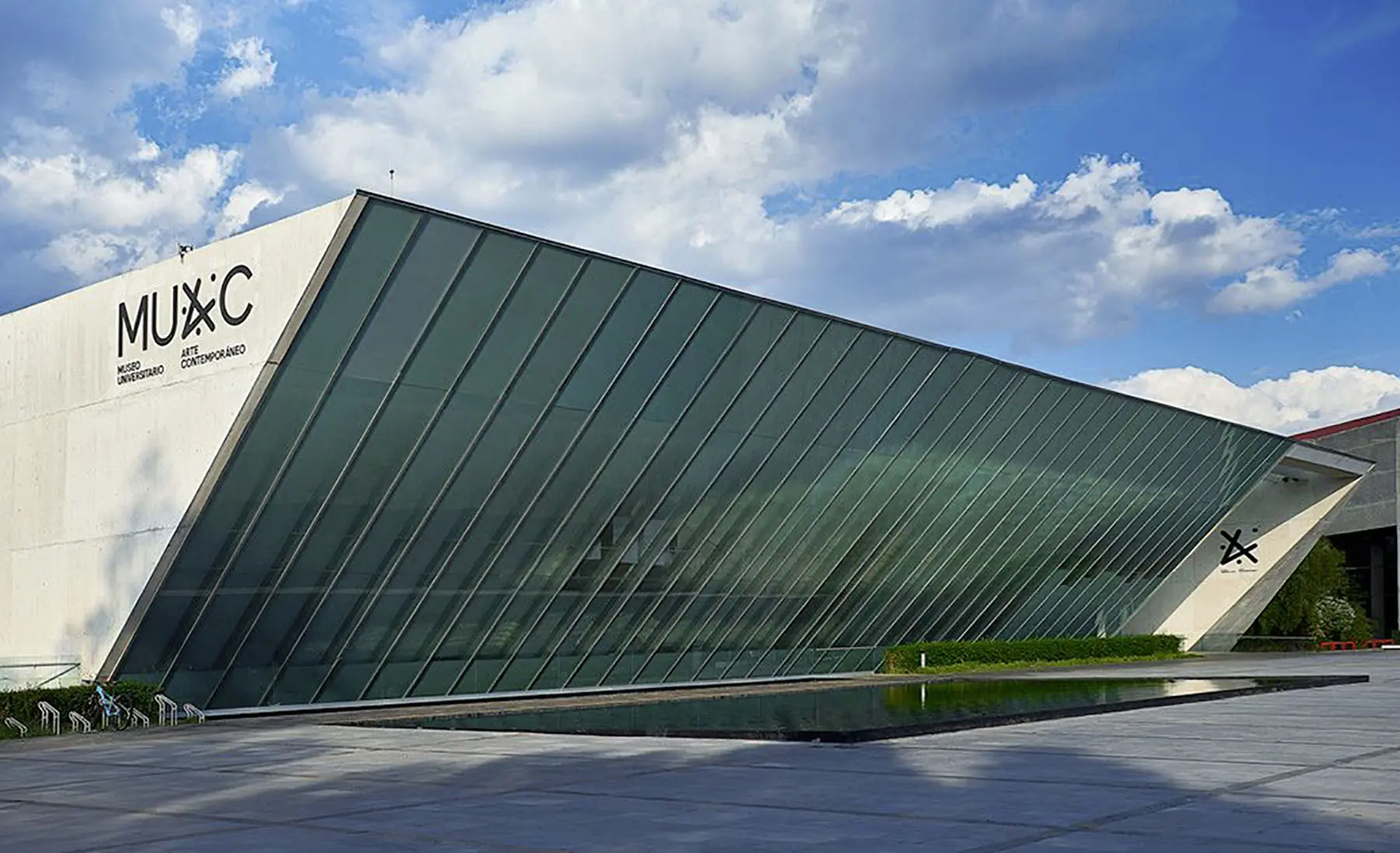
The Museo Universitario de Arte Contemporáneo in Mexico City was inaugurated on November 27th, 2008. Part of a project launched years ago and promoted especially by Juan de la Fuente, former President of UNAM (Universidad Nacional Autónoma de México), the MUAC building was erected on the space of the Centro Cultural Universitario. The renowned Mexican architect Teodoro González de León was charged with the design. The opening show comprises four different interdisciplinary exhibitions: Recursos incontrolables y otros desplazamientos naturales (collection); El reino del coloso. El lugar del asedio en la imagen (thematic); Cantos cívicos (university connection); and Las líneas de la mano (resonance.)
Seldom does the opening of a contemporary art museum generate so much debate in Mexico. The pertinence of its construction and use, in particular regarding its architectural design and the site on which it was built, has been discussed in the media, among artists, and in the country’s culture and art circuits. The first criticism relates to the similarities between González de León’s MUAC and the 21st Century Museum of Contemporary Art, designed by Japanese architect Kasuyo Sejima. Also, the fact that the majority of artists featured in the exhibitions (approximately 244; 200 of them Mexican) come from Mexico’s best-established galleries or are clear representatives of the art world mainstream. Given that visual art exhibitions are governed by principles of exclusion, the debate should focus not on who is included, but on the pertinence of a university museum of contemporary art’s very existence. To that point—and since public funds were used for the construction—it wouldn’t be all that misguided to start with a basic premise: it is better for there to be a museum than not. The acceptable, well-founded critique is to abandon useless and unjustified aesthetic value judgments.
Recursos incontrolables y otros desplazamientos naturales opens the museographic proposal. This show, curated by Oliver Debroise, presents 37 large-format works that “seek to unveil tensions and contradictions between artistic practice seen as a mechanical and ‘unnatural’ act that perverts the order of things to reveal their foundations, and its constant reference to nature.” The show includes paintings, drawings, graphic arts, collages, sculptures, and multimedia installations, by, among others, Vicente Rojo, Jan Hendrix, SEMEFO, and Melanie Smith.
In El reino del coloso. El lugar del asedio en la época de la imagen, curator José Luis Barrios suggests an exhibition “conceived as a traveling shot” that, starting with the image (photography, film, and various digital techniques), aspires to show how “terror overtakes images in an exercise in disassemblage that seeks to make the unrepresentable evident.” The Montaje section includes 55 photographs from different international agencies, most of them rather well known and award-winning over the years (such as Leo Miller’s photographs of a beaten-up SS guard, Robert Cappa’s image of a captured soldier, and Nick Út’s photograph of Kim Phuc, Vietnam, under a napalm attack.) The Desmontaje section seeks to explore how terror is constructed through images. Fragments of five films are presented: Alexander Sokurov’s Spiritual Voices; Jean-Luc Godard’s Notre Musique; Werner Herzog’s Lessons of Darkness; and Claude Lanzmann’s Sobibor, October 14, 1943. The module is complemented by Santiago Álvarez’s short feature 79 Primaveras. Finally, in the section titled Remontaje we find the installations Aliento, by Óscar Muñoz, and Apóstasis, by Rafael Lozano-Hemmer, both created on site.
The next two exhibitions are less relevant in contrast with the first two curatorial efforts: Cantos cívicos. Un proyecto de NILC en colaboración con Miguel Ventura, curated by Juan de Nieves, is “conceived as a project that brings forth the ironic parallels between human and animal groupings, while unmasking the conflicts of identity, belonging, and territoriality inherent to human development in the contemporary age,” while Las líneas de la mano, curated by Jimena Acosta, is inspired by Julio Cortázar’s story and proposes “the course of a line through a city in order to find shelter in the hand of an individual getting ready to shoot himself in the head.” Among the artists are Fiona Banner, Mircea Cantor, Diego Pérez, and Santiago Sierra.
These four exhibitions are temporary and will be renewed every six months (Spring-Summer and Fall-Winter.) At least four shows will open each season, and a special emphasis will be placed on the curatorship’s interdisciplinary discourses. Gradually, the Museum’s own collections and individual works will be brought out on display. The MUAC also has a documentation center, Arkheia; an educational connection site, El Ágora; and a space for sound experimentation located on the building’s ground floor.
Independently of the unconnected character of the four exhibitions, the fact that there doesn’t seem to be a connecting thread between them, and that the project seems to have been opened in haste in response to circumstantial political demands at UNAM, the MUAC is an art space that must be judged on its own terms. While the shows do not reflect a totality and are not a measure of contemporary Mexican art (a much better proposal, museograpically, curatorially, and discursively, is found in La era de la discrepancia, presented at the Museo Universitario de Ciencias y Artes, MUCA, in 2008), it would be fruitful to articulate a critique after the fact that considers possible shifts, based on errors and achievements, in the museum’s global concept. And I repeat: It is better for it to exist, than not.
CARLOS ANTONIO DE LA SIERRA