Venezuelan Muu Blanco and German Robert Lippock are two artists from different cultures united by music and their urban sense. They jointly presented a sound exhibition at the Sala Mendoza that remained open from February to March of this year. The exhibit was complemented with video showing images taken in Caracas and Berlin.
Although the project became a reality during an hour and a half inaugural musical performance, the origin of the project goes back to an earlier time. Muu Blanco visited Berlin in 2007 and 2008 to capture the sounds and images of that city, and Robert Lippock did the same during his visit to Caracas in November 2008. The project was sponsored by the Goethe-Institut Venezuela. The project will also be presented at the Wohnmaschine Gallery in Berlin during the summer of 2010. The music created by both artists for the Sala Mendoza will be released on a CD that will include two 15-minute pieces by each artist. The CD will also include several unedited sounds takes – that have not been intervened – presenting sounds from Caracas and Berlin. The experience will become an interesting sound document.
Lippock is a musician who belongs to the German band To Rococo Rot, founded in the mid-1990s. Born in Berlin in 1966, Lippock studied theater and has worked in the music field as well as in the visual arts field. With his band, he has created music for the installation and for performance works by other artists as well as for his own projects. His visual work centers on the interaction among architectonical spaces. On the other hand, Muu Blanco was also born in 1966, but in Caracas. He studies (through a fellowship) at the Escuela Federico Brandt and at the Instituto Universitario de Estudios Superiores Armando Reverón. Like Lippock, Blanco is a creator of abstract urban landscapes who, as a photographer and video-artist, uses his images to shake the logic of the spectators at the core. He creates impossible urban spaces by composing images into sequences – as is sometimes done with a kaleidoscope, and at other times by changing the direction of the images. It is no accident that in 1983 Blanco defined himself as a producer of ideas, more than a visual artist or a musician. Indeed, he has concentrated on establishing connections between music and contemporary visual art in its multiple forms of expression: photography; video; digital art; performance, and installation, among others. His other activities – as a DJ, producer, and animator of a live radio program on electronic music – are justified by his role as an artist whose work is closely related to life, city life in particular. This, and the digital resources at his disposal (a computer and a digital camera), are the tools of his music and/or his photography and digital video. What is important is the exploration of the diverse forms of the production of an image, whether visual or auditory. At any rate, it is always sensorial.
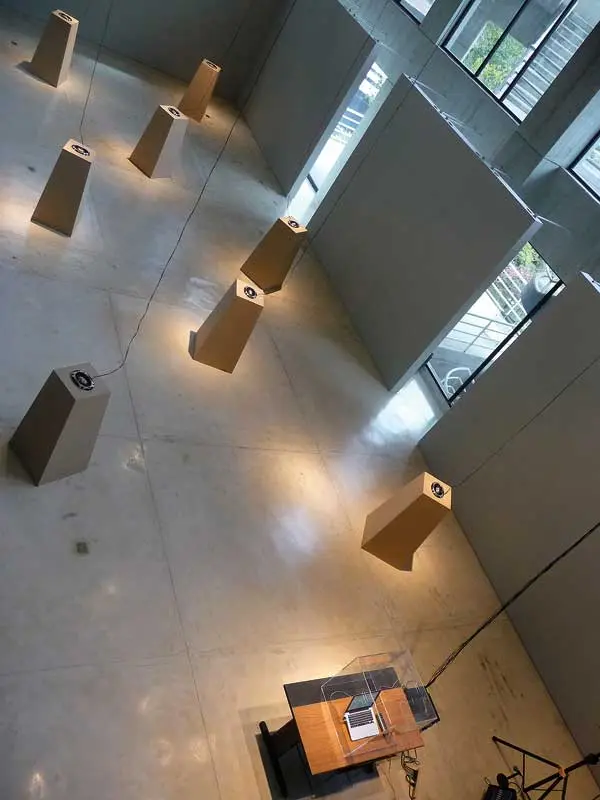
Paisaje Sonoro is the logical consequence of these two life experiences that once joined, resulted in an exploration that sought to build a highly abstract landscape. The exhibit consisted of eight modules with eight-speaker systems arranged at the Sala Mendoza main exhibition room, each playing musical compositions that were the result of a fusion of recorded sounds from both cities. During the inaugural event, each artist individually utilized the eight available channels to project the sounds of the city visited by each of them. Then, Muu Blanco combined 16 channels that continued to play sounds for the remainder of the exhibition. At the same time, the sound areas were active videos that were projected in the adjacent exhibition room. The contrast between the foreign city visited by each artist and the city to which they had become accustomed became a defining factor for both artists. “While Berlin is a city of singing birds and of log sound pauses -Blanco recalls– Caracas near Parque Central (a series of towers erected in a highly congested area of the city) left Lippock nearly deaf. These two cities obviously are radically different from each other thus, upon experiencing their differences, the artists’ perceptions of urban music are subjected to a transformation.”
As Blanco has noted, “instead of recycling objects, the experience consisted of recycling fragments and remnants of sounds.” To Muu Blanco, the melody of singing birds in Berlin was much more intense than the noise created by trains and buses. On the other hand, for Lippock, Caracas represented random anarchy of sounds, something he discovered on visiting busy areas of the city such as La Yaguara, Parróquia Sucre, Avenida Victoria, and the cellars of Parque Central. In an interview, Lippock pointed out the following: “I attempt to present sounds just as I perceive them. Sound in Caracas appears to have more layers and to be more intense than in other places. It is musical. Whether salsa, classical, or reggaetón, the music here is an ellipsis of life.”
With this exhibit, the Goethe-Institut ended the Cultura Urbana project that was carried out in Venezuela throughout 2008. This exhibit opened other borders regarding the manner in which contemporary art is perceived because foundational sounds form part of a new concept and a new sensorial objectuality.
SUSANA BENKO