
The long, high-ceilinged hall at the entrance of El Eco Experimental Museum in Mexico City sets the tone of the unreal and abstract atmosphere that will envelop the spectators in the exhibition by Néstor Quiñones (México, 1967).
Just as we have left behind the alienating weight of urban daily life, Quiñones invites us to reflect on the evolution of life on Earth. It is inescapable that to enter his world, we must initiate neuronal connections while we confront the repeated forms by which we make associations in our mind, in order to fracture our inertia and be able to think deconstructively about ourselves.
Texts are essential to understand Quiñones’s visual proposal, as it expresses an old, unyielding preoccupation with human intelligence and the perception of what we call reality. The clarity and selection of the scientific writings – the raw material for this installation – intentionally reveal the marginal and residual aspects of the theories expressed in them, which surprisingly provokes in the spectator a nearly mystical experience.
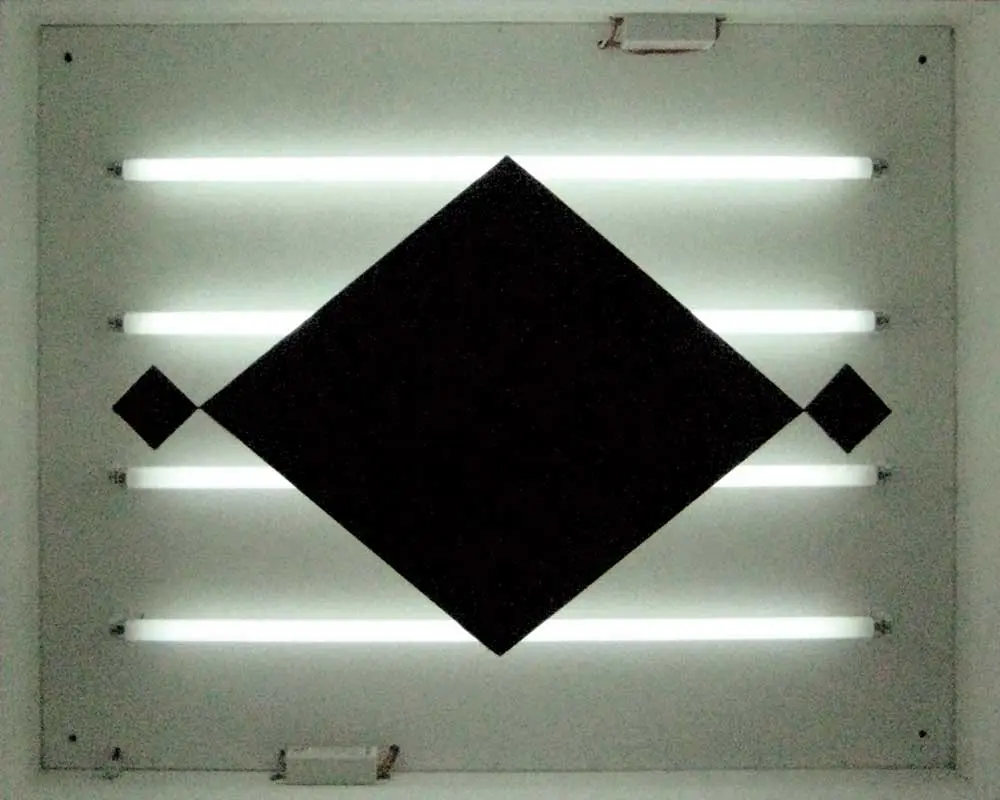
As if we were part of a ritual, Quiñones prepares us for the first installations, but he does nothing to arm us for the complexities of what we are about to experience. The pieces are there to surprise us, as the artist toys with us. Apparently simple pieces that contain several types of lights dazzle us as we attempt to look at them and go so far as to hurt us, while amorphous dark holes that lack any light appear to pull us toward a universal black hole. We are besieged by a sensation of horror and vertigo, but also of uncontrollable curiosity. What lies behind?
The exhibit is divided into two interconnected parts that, in my opinion, need and complement each other to incite the spectator’s reflection. Ending with the text titled Memoria Emocional (Emotional Memory), the first part includes three luminous pieces. These consist of boxes with acrylic tops that contain regular, spiral, or cylindrical lights. At the center of each of these pieces, there is a superimposed amorphous shape, which is draped convexly with black cloth that presents us with total darkness.
Is there a mistake? Why do I think something is not quite right? Is light real, or is it darkness? What leads me to think this way?
Wondering about our perception is precisely what the artist seeks with this installation. The accompanying texts deal with Carl Jung’s collective unconscious theory, as well as with thoughts by Henri Bergson in which he delves into “the existential continuity of human beings, whose present is merely the past that is prolonged into the future.” In the pieces that follow, shadows expand and melt like a miasma, or these become rigid and symmetrical, like our insistent attempts to repress our deepest desires.
The second part of the exhibit, titled Sobre las Cajas Vivas (Over Live Boxes), can be approached as a continuation of the earlier reflection, given that it confronts us with the way we contemplate reality and the concept of reality itself.
Four large-format photographs, approximately one by one and a half meters each, float around the spectator, who must become the pivot around which these images appear to be rotating in order to see them. But the spectators and their minds are those that are actually rotating, as they wander from one scene to the next, asking themselves once again: What lies behind?
The photographs depict low-income neighborhoods located in all directions throughout Mexico City. The neighborhood and the moments were chosen to be photographed exclude nearly all life. They tend to be grey, desolate scenes in their majority, in which asphalt fills our gaze. These are the marginal spaces that surround the urban belt.
Perhaps the images appear unreal because of the raw manner in which the places are presented. Complemented by concrete, the lighting in the photographs generates a weird sensation that makes the observer feel suffocated. All of the photographs are purposefully perforated either symmetrically or chaotically, which corroborates the suffocating sensation, in that the perforations generate the desire to escape. Once again, What lies behind? The darkness that more or less can be observed through the photograph's perforations appears to be more real than the image displayed. It is as if we desire it to be this way, to fulfill our desire to disappear, to return to nothingness, or simply to think that there is actually “something more to it than meets the eye.”
The hill is overcrowded with dwellings, where the grey landscape is sprinkled once or twice by a wall that had the good fortune to be painted. The empty street of a marginal neighborhood shows an abandoned garbage pushcart. It is no man’s land. There is also the image of an empty fair, where not even the wind seems to be active, and another of an empty basketball court in which a black hole opens up “like the Eye of God.” These advance from and then retreat into the void, as they succumb under the weight of their possible reality. What lies behind?
TANIA TURNER