
Priscila de Carvalho’s installation, Passageways showing March-August 2009 at the Jersey City Museum, comprises a 10 by 35-foot labyrinthine city, built with paper boxes and cutouts on foam, wires and poles, painted canvases, photographs, drawings, and collage. The city is modeled after Rio de Janeiro’s slums, although one side of the installation displays identifiable parts of New York City. Rio’s hilltop slum architecture is here minimized to tiny white or yellow dots representing the lights of the shantytowns, an exotic view from the skyscrapers that stand on the “official” geography of the city of Rio. Here, the city is not defined by fixed dwellings—since not a single home is represented—but by spaces of transit, passageways, steps leading nowhere, subway stations without trains, or defense towers used by drug gangs. According to the artist, this narrative of Rio slums in the heart of Carnival connotes hope and happiness in spite of poverty and danger, a duality featured in the work of numerous Brazilian artists since early modernism. Nevertheless, otherness has continued to trigger critical claims of exoticism, opportunism, and exploitation.
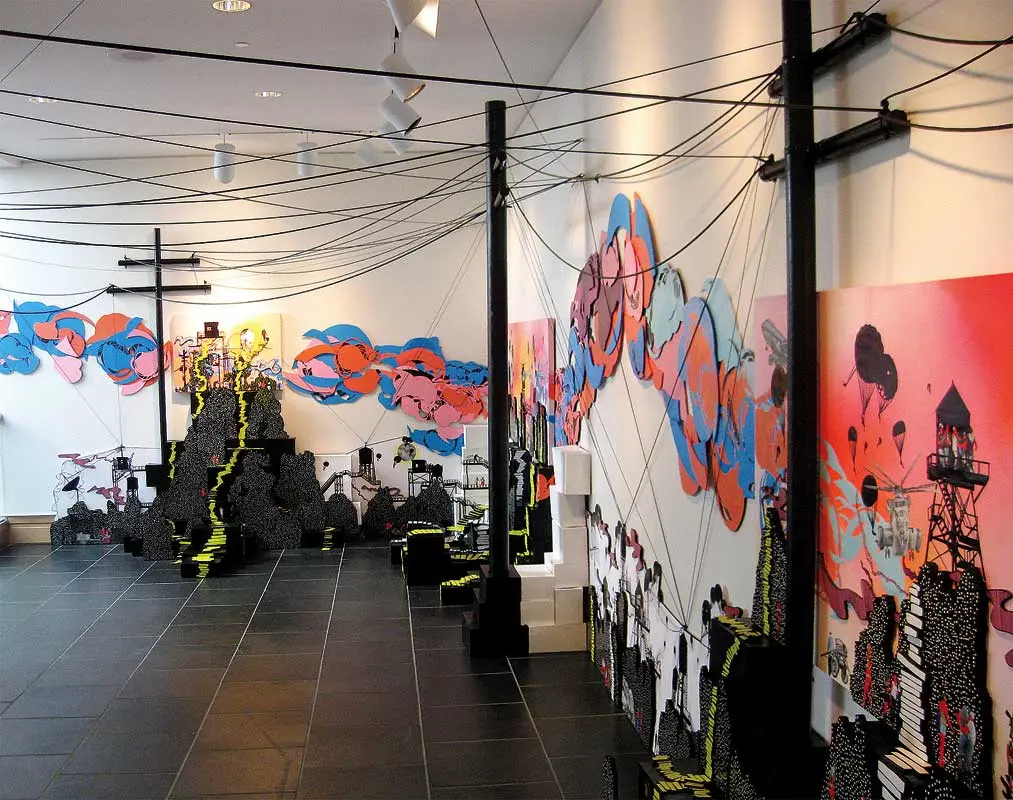
In Priscila de Carvalho’s Passageways, the link between Rio’s peripheries and New York City’s non-elite areas hints at the city not as an aggregate of communities, but as a place of class divisions determined by city demarcations and control. The shift from fixed dwellings to spaces of transit points to a nomadic lifestyle, a less-networked version of the rhizome, with urbanites constantly on the move, displaced but trapped within a city that lacks infrastructure. Otherness, in de Carvalho’s work, is depicted through faceless people wearing carnival regalia, gang masks, or costumes. Sometimes the costumes suggest a hybrid state between displaced tribal community members and people dressed in indigenous costumes, alluding to the fine line between stigma and generalization. Although Passageways references Rio de Janeiro’s slum architecture, one can locate prototypical New York places and people, such as break dancers, the homeless sleeping inside grocery carts, commuters awaiting trains or traversing Brooklyn’s Bedford and North 7th Street subway platforms. Two possibilities emerge the artist’s critical commentary on new cultural imperialist tendencies after globalization, and/or it's the total opposite, a kind of dismissal of imperialist tendencies through a more cynical acceptance of stigmas and generalities.
De Carvalho’s approach is clearly appropriational: she reuses imagery from various media sources, such as documentary films, the Internet, or her own photographs, intentionally avoiding any direct connection with traditional medium. Some of the characters in the narrative are photographic cutouts of friends, to which she adds a collage of new clothing and uniform red skin. These characters—carnival participants, gang members, soldiers, hoodlums—are only recognizable through their stigmatized positions, while the leading Brazilian telephone company, Telemar, is clearly depicted on the telephone booth. Even though Telemar is a company known for its unreliable service, naming companies, not people, highlights the semiotics of capitalism over a disappearing humanism. Other identifiable details are a sign of foreign exchange, Forex, with the title Bank of Baroda and Reserve of Indian Bank, and the intersection of street signs in the district of Barra da Tijuca, a growing district in Rio since the 1980s, blurring the borders between the elitist South Zone and the peripheries of the North Zone of Rio. Water towers are depicted amongst defense towers, signifying the lack of access to clean water, another necessity veering towards privatization. In this off-limits city, the military, not the state police, invades with weaponry and grenades, an allegory of the actual conflict between drug gangs and military police in the slums of Rio.
Although de Carvalho’s work is an inevitable reference to Brazilian naïf painting, the only paintings featured in the installation are three canvases with abstract yellows and pinks, used as scenery, suggesting the dawn before sunrise. These canvases allude to a glimpse of hope in the midst of havoc, an allegory of the tragic yet beautiful scene from Black Orpheus, in which the protagonist falls down the hilltop of the slum holding his dead lover’s body in his arms, all under a gorgeous sunrise of Ash Wednesday, the morning after Carnival. As in Cinema Verité, the connection between everyday situations and mythical tales, such as love, life, and death, are familiar to all, and therefore extend beyond nationality or cultural difference. Elliptical cutouts, clouds reflecting the pinks, purples, and yellows of the passage between night and day, or perhaps kites, reference Black Orpheus: a yellow kite representing the sun, a metaphor to the dawning of a new day, reminding that life goes on.
DENISE CARVALHO