
On January 3, 1954, The New York Times published an article about the second Bienal do São Paulo suggesting that through the presentation of art “US artists might win friends and influence allies.” These were the early days of the Cold War and indeed many were preoccupied with the spread of communism and searching for tools to combat it. The title of that magazine article, “Cultural Diplomacy: An Art We Neglect?” is also the title of Alessandro Balteo Yazbeck’s current and compelling exhibition at Christopher Grimes Gallery, which questions whether cultural diplomacy itself isn’t an art form that should be studied, interpreted and held up for historical analysis, precisely the project the artist undertakes in the show. However, Balteo Yazbeck is only tangentially concerned with the spread of communism and instead zeroes in on a different twentieth-century phenomenon: the development and expansion of a global oil market.
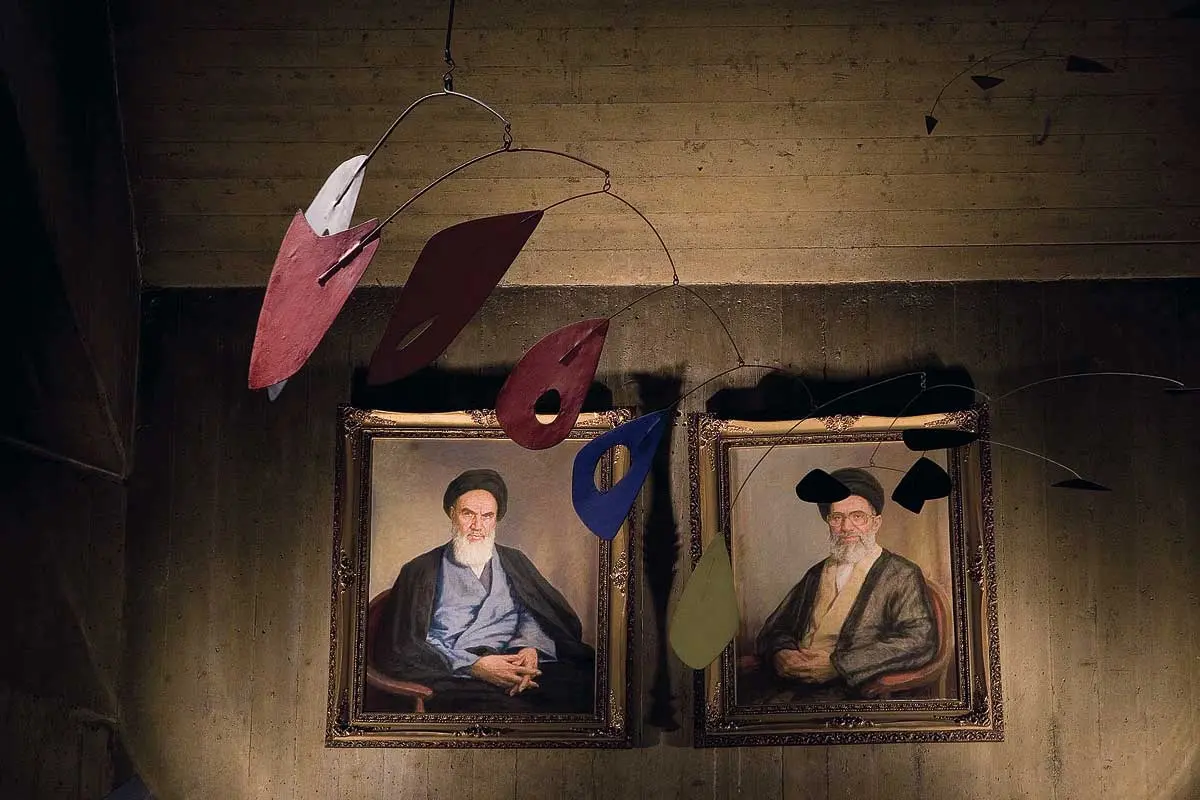
The exhibition is installed in two galleries, and although there is an ideological consistency in Balteo Yazbeck’s entire project, each room functions independently from one another. The larger front gallery displays ten works, which combine text, documents, and sculpture. All of these materials are appropriated from other sources and then reconfigured to create Balteo Yazbeck’s own subjective narrative about the role of the US in the oil-producing nations of Latin America and the Middle East from the 1930s through the 1970s. The texts, which dominate the exhibition, appear in such various forms as quotations from the period, didactic panels, historical data, and documents such as maps, photographs, magazine articles, and postcards. In several instances, these texts are then paired with a reproduction of a Calder mobile or sculpture. For example, Calder’s immense 1933 jet-black mobile Cône d’ébène, which looks as if it has been dipped in crude oil, hangs next to a didactic panel that includes quotes by and about Saddam Hussein. Mounted on the back wall, a small 1943 sculpture, Tower with Mobile, resembles the scaffolding of an oil derrick, an observation made by a critic in the 1950s, which is included on the adjacent wall panel. In addition to Calder, other names such as Roosevelt, Rockefeller, Hussein, and Khomeini drive the narrative that Balteo Yazbeck strategically constructs through a calculated presentation of historical facts. Juxtaposing such quotes by Rockefeller as “I learned about politics at the Museum of Modern Art,” (attributed to a biography by Cary Reich) with photographs of the luxury hotel he built in Venezuela to accommodate US diplomats and industrialists are provocative reminders that art and politics are always intertwined. A compelling example of this is the work Detail of Alexander Calder’s performing mobile Orange Fish (1946) at the Tehran Museum of Contemporary Art. Essentially an installation photograph, it shows Calder’s mobile Orange Fish hanging in Tehran’s museum in front of two oil portraits. One is of the Ayatollah Ruhollah Khomeini, who led the Iranian Revolution in 1979, and the other is of the present Ayatollah Ali Khamenei, who is currently at the center of recent Iranian election scandals. The juxtaposition of Calder’s work, which was exported by the US at mid-century for its presumed associations with freedom and democracy, in front of Iran’s post-revolutionary leaders demonstrates exactly how subjective the act of interpretation is and how easily artwork can be marshaled for divergent political ends.
The smaller second gallery displays four large-scale photographs of architectural projects executed by Venezuelan Carlos Raúl Villanueva in Caracas in the 1950s. Each image is a digital reproduction of a defective photograph taken by Paolo Gasparini of the then newly inaugurated buildings. Balteo Yazbeck selected these images precisely for such imperfections as fingerprints, bubbles, or poor coloring, which serve as visual metaphors for the now debilitated conditions of these same buildings, as well as the failed modernist and democratic projects that were then underway in Venezuela. Calder’s work appears in this gallery as well in a beautiful rose-tinted image from 1954 of the Aula Magna auditorium at the Ciudad Universitaria de Caracas, which shows Calder’s large curvilinear disks floating from the ceiling. In many ways, these photographic works are visually more successful than the overtly political works in the larger gallery since the digital images seamlessly integrate the political and the visual in a more cohesive way.
Balteo Yazbeck creates his own narrative of the social history of art. Fundamentally a visual presentation of a research project, the work is reminiscent of Hans Haacke’s projects from the seventies at MoMA and the Guggenheim, which questioned the role of museum financiers such as Harry Shapolsky and then-Governor Rockefeller in social policy. Although Rockefeller, Roosevelt, Hussein, and Khomeini are all implicated in the disreputable oil market, one wonders whether Balteo Yazbeck finds Calder complicit or subversive to these operations. These ambiguities make the exhibition all the more compelling and thought-provoking.
ALECA LE BLANC