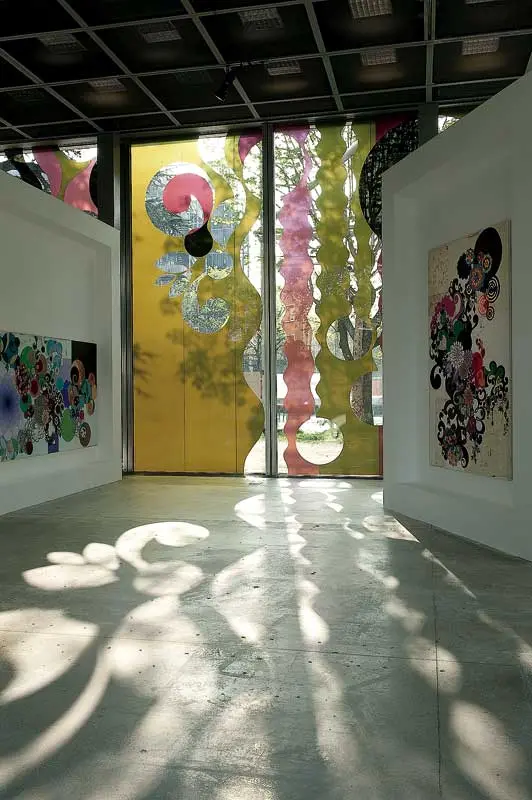
Beatriz Milhazes strikes up a vibrant dialogue with Jean Nouvel. At the Fondation Cartier, designed by Nouvel, the artist created two monumental installations specifically created for the glass walls of the building. Nouvel-designed construction with glass walls and steel to render the architecture of the space invisible. Milhazes accentuates the immaterial effect with two collages comprising vinyl cut-out forms attached to the glass. Her exhibit also includes 10 acrylic-on-canvas paintings and one collage on paper.
Outside, visitors are welcomed by the collage on the façade, Casa de Baile (Dance House, 2009). The piece titled Samambaia (2009) is on the building’s rear glass walls. On working over the glass, Milhazes continues with the exploration she began last year on the windows of the Pinacoteca do Estado de São Paulo. Her vinyl murals have become more monumental, cascades of red, yellow, and violet tones. While the connection of her work to the city was impressive at the Pinacoteca, in this exhibition at the Fondation Cartier, what is impacting is the relationship of her works with the garden. The collages direct the energy of the sun and the vegetation toward the building’s interior.
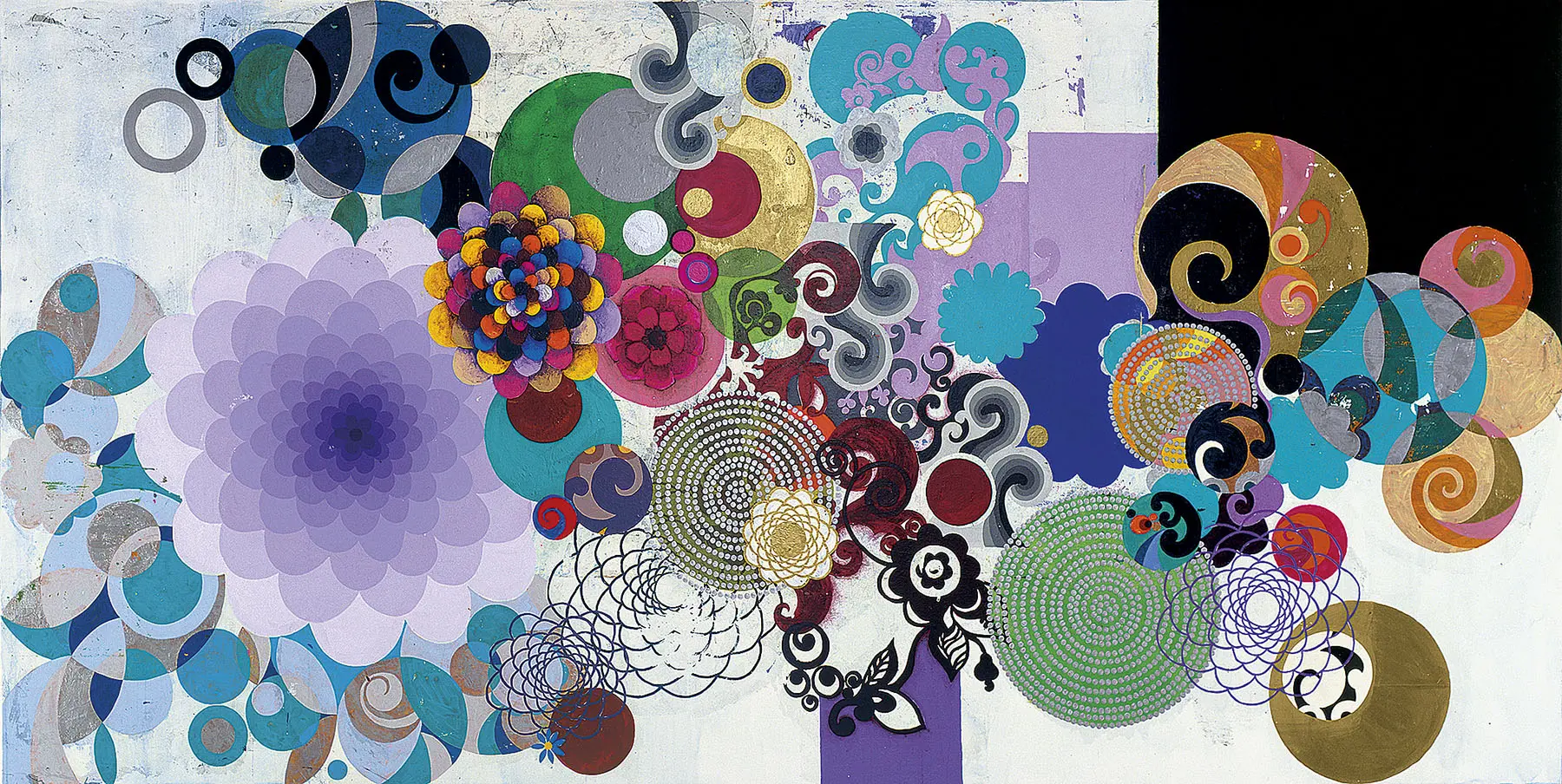
Inside, a rigorous selection of paintings represents Milhazes’s artistic trajectory from 1995 to date. The walk through the exhibit space becomes a walk through the motifs of her artistic vocabulary: the sun; pearls; a rose; rays; spheres; embroidery and geometry elements, among many others. This group of works also allows us to observe the way by which, in time, the nostalgic effect of the pale colors gave way to a more strident and exuberant palette. It is also possible to detect that the inclusion of straight lines – that began in 2001 – has not impeded the movement of the circular forms so characteristic of her work. Milhazes’s paintings do not offer a moment to pause, a center for support; contrariwise, her compositions seem to continuously transform. Reaching beyond the purely optical, Milhazes appeals to every organism. When the themes on her canvases begin to rotate, one’s body sways insecurely. The only certainty is the structural precision. Milhazes punctuates the dynamism with exactitude; she finds a counterpart to every form.
With regard to the works, her pictorial strategy can be clearly observed. She stamps one motif on another. She repeatedly overlays thick layers of paint on the plane with a singular technique of her own invention. She allows scratches and erasures to show. At times, the forms have a perfect outline. At others, they are eroded. One is not exactly certain that what one sense was something else there previously under the current surface. The canvas borders occasionally reveal layers, as each exhibits little relation to the previous one, which appears to be of a totally different nature.
In the monumental collage titled Milk Mel (2008–2009), the superimposed layers of paint acquire even more literality through the fragments of paper glued on top of one another. Milhazes combines several types of chocolate wrappers – the classic vibrant yellow wrapping of Brazilian Garotos, and the metallic wrappings of the Argentinean alfajor Havana candies, among others – with colored paper clippings to create a composition defined by rhythm and equilibrium. On observing this Parisian exhibit of collages, the influence of Matisse’s cut-out paper silhouettes could not be greater. Among many other referents, we could include Tarsila do Amaral and Bridget Riley, artists whom Beatriz Milhazes herself recognizes as highly influential in her work. We are also reminded of Sainte Chapelle because of the way that Milhazes is able to transform the space by manipulating the light as well as the glass. But the image of Mondrian’s apartment at 26 Rue du Départ is perceived throughout the exhibit, for it was he who experimented with form and color in the three-dimensional architectonic spaces that were part of his studio and not solely on the pictorial plane.
Milhazes stated, “the colors and forms in the work at the façade maintain an immediate relationship with the building and with the garden; thus, there is a ‘dialogue through transparencies’ with the environment is fashioned that attains a magical and immaterial effect. On the other hand, paper collage is opaque and concrete; it has a more material presence.” Indeed, Milhazes achieves a space of juxtapositions in which her works interact and superimpose developing relationships to which we would otherwise not be privy. The display of these works, intimately close to each other, formulates questions while it also elicits new connections and thoughts. What is support? How is it possible that everything is concentrated on the plane, without losing the ability to expand and to go beyond the frame? Is it feasible that such a multiplicity of layers can coincide with the thin and unique supporting surface?
Milhazes knows as no one does how to calibrate the visual forces and counterpose the centrifugal impulse with the centripetal retraction. While the spirals on her paintings always expand toward the outside of the canvas, they inexorably always return to these. In the mural at the façade, the transparent image irradiates colorful light toward the inside of the building, as such irradiation depends on the vinyl shapes attached to the glass. Everything is constant change and movement. It is difficult to believe: the flat and static surface can allow for fluxes, successive integrations, and progression. Milhazes’s works can be placed at the antipodes of contemporary super flat. I dare to think that, on contemplating her works, that support could be interpreted as that which holds the exploration of new directions that are traced over the plane of current art. Far from exhausting the field of action, painting permits the conditions to open up these new paths.
FLORENCIA MALBARÁN
Independent curator - University of Rosario, Argentina.