
Bert Rodriguez’s entire—eventually—artistic production is marked by a self-referential drive. An egocentric vocation that turns invariably on two axis: art as an obligatory quotation, and the self as an absolute center.
It is as though the spirit of Baudelaire, with all its Romantic arrogance, had come and settled in this artist’s precise creative moment. Yet, there is something that remains ambiguous, ungraspable, uncomfortable for Rodriguez. He refuses to acknowledge himself as an artist and rather sees himself as trapped within a kind of automata-like program that forces him into the aberrant and uninterrupted production of objects: things, devices that—for lack a better term, at least for now—we insist on calling art.
It should be noted that we are not all that demented in our insistence. A shard of reality fuels such as capricious mania. The fact is that Rodriguez—perhaps lacking a better context, or maybe because of concurring serendipities, or out of simple self-centeredness, or to avoid being called crazy, or who knows—has decided to place this bunch of objects and intentions inside the art circuit, choosing galleries, museums, fairs, biennials as the medium for his elaborations, along with so many regrettably rarefied spaces of the everyday.
In Your Own Image: The Best of Bert Rodriguez – Greatest Hits Vol.I, presented at the Bass Museum, is not an exception. The show emphasizes what seems to be an obsession in the case of Rodriguez: his desire to make a repertoire of his work on the basis of retrospectives for a career that, while prolific, is still young. Already in 2000, the artist had presented A Pre-Career Retrospective, offering a meticulous inventory of relevant objects that evinced his early incursion in the realm of art. Among them, childhood drawings and his sole unconditional companion at the time: his toothbrush. What the show did make clear, while paying tribute, were the two inescapable references one needs to make when confronted with this artist’s work: Duchamp and Beuys, of course.
In Your Own Image: The Best of Bert Rodriguez – Greatest Hits Vol.I, presents us with a vast selection of Bert Rodríguez’s work. From the conceptual standpoint, three large groups, representative of the artist’s entire oeuvre, are identifiable. The self; co-creation, and the work of art as process.
The incorporation of the self in Bert Rodríguez’s work is associated with a sense of self-centeredness, playfulness, and sarcasm. Firstly, the self represents a Manichaean conception of the artist, implying notions such as high culture and genius with which Rodríguez plays brilliant games.
In that sense, a highlight is My Favorite Outfit, 1998, where the artist carefully arranges on the wall his most favored suit; or My Most Memorable Feature, 2009, where Rodríguez puts at our disposal one of those Mold-O-Rama machines that offer the public, for the sum of $50 in exchange for the gold coin that does the trick, a mold of the artist’s nose, seemingly his most noted physical attribute—most noted, at least, by a female audience addicted to cosmetic surgery.
The self also functions as a link with the co-creative act, where it crosses its own boundaries in order to exist in the other. There is a lot here of the playfulness that characterizes Rodríguez’s work. Where My Eyes Meet You, 2005, is significant in that connection. This poetic and minimalistic work comprises a slim white neon that, placed at the level of the artist’s visual horizon, suggests a frontal encounter, a direct—even if mediated—exchange of gazes. This work is referenced in Where My Eyes Meet You (V.II) 2006, where the artist uses classical works from the museum’s collection to invite us to revisit the history of Art.
The unfinished work, the work as a process, is equally important. Time becomes an essential element that speaks of a progression, a flow, and inevitably an end. This notion of transitoriness, where the only stable thing is change, marks the limited existence –as brotoi– of human beings and of artists. On the one hand, the creator implied already in the continuation of that unfinished work he is offering us now; on the other, the viewer who is compelled to participate in a process of reception whose sole meaning and completion are to continue over time.
Here the landmarks are lambert.net and The End.lambert.net, 2008, is an internet project where the artist presents us with a photograph of himself naked on a kind of topography and requires the viewer to move from a quadrant to the next in order to traverse Rodríguez’s physical territory. The work is intended to be updated on a yearly basis with a new photograph, with the prior versions archived in Iwasbert.net.
The End, 2001, appropriates the museum’s elevator to take us by the hand on a somewhat ghastly trip. The installation is comprised of a large number of musical themes associated with climactic moments of films that Rodríguez has seen over the years. Taking the elevator on the first floor, the viewer experiences a sensation of ascent, enhanced by the installation’s highly suggestive soundtrack. By the end, however, descent wins over and the box in which we are trapped joined to the idea of transitoriness implied in the work triggers clashing sensations.
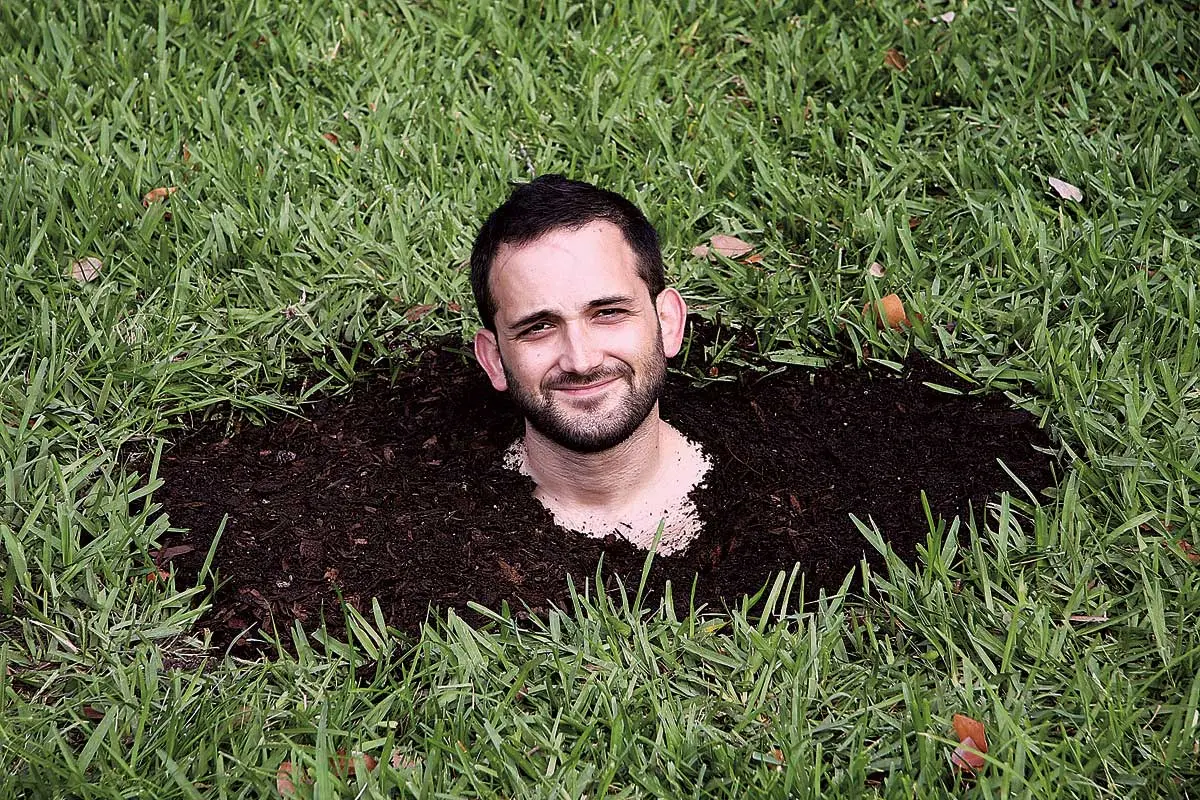
Once out of the elevator and in search of the museum’s exit, we traverse the show from a different perspective and in the opposite direction. The feeling of déjà vu, added to the music that still rings in our ears, remains as disquieting as before. And we hurry outside. Rodríguez is still there, unfazed, playing at being a tree, buried up to his neck as if it was all a game.
JANET BATET